 By ByteBot
Playwright hit 83 million weekly npm downloads in Q3 2026, up from 1 million in 2021. The framework won that race definitively. But winning created a new problem: teams that went all-in on AI test generation now manage thousands of tests they cannot fully trust, cannot audit, and cannot maintain at pace. On September 30, Leapwork released Play — an enterprise platform that sits above Playwright and handles what the framework was never designed to do.
The Bottleneck Moved
Donovan Brady, Leapwork’s VP of Developer Relations, put it plainly in the GA announcement: “Generating a test with AI became table stakes this year. All that did was move the bottleneck. What slows an enterprise team down now is proving where a test came from and managing thousands of them.”
This is accurate. The proliferation of AI test generation tools — everything now integrates Claude, Copilot, or Gemini for test scaffolding — means spinning up hundreds of tests takes an afternoon. The problem is what you have after that afternoon: a large suite of probabilistic outputs in an environment that requires deterministic verification. AI is not inherently wrong about test generation, but it is inconsistent. A green test is not necessarily a safe test. Some AI-authored tests execute successfully without validating any business-critical behavior.
What Leapwork Play Does That Playwright Cannot
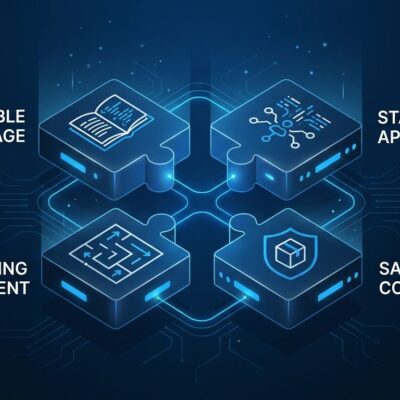
Playwright is a browser automation framework. It runs tests. It does not govern them. Play is the governance layer, and it addresses three gaps that every team running Playwright at scale eventually hits.
The first is maintenance. Play watches your Git repository for commits that materially affect functionality or the interface, then recommends the specific test updates those changes call for. Self-healing locator repair handles the routine drift underneath. The alternative — engineers manually reviewing test failures after every deploy — does not scale.
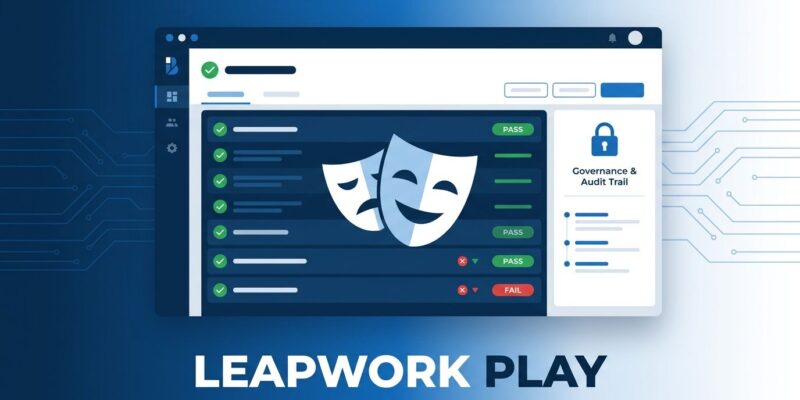
The second is audit. In banking, insurance, life sciences, and manufacturing, a test suite is an audit artifact. Auditors do not want to see a passing CI pipeline; they want to know which requirement a test covers, who approved it, and what the system did during the last ten runs. Play retains authoring history, approvals, and full run logs as exportable evidence, with role-based permissions governing who can create and modify what.
The third is visibility. Play surfaces flaky test rates, coverage distribution by team and application, pass/fail breakdown across the entire suite, and requirement traceability. That information exists in every Playwright installation — it is just scattered across CI logs, Jira tickets, and individual developer knowledge. Play aggregates it.
The AI Integration Layer
Play does not replace AI for test generation — it coordinates it. The platform connects to Jira, Git repositories, and product documentation to build a knowledge base, then generates Playwright tests grounded in actual product context rather than generic UI patterns. It integrates with Claude, ChatGPT, Gemini, and Copilot, so teams keep the models they already use. Browser journey recording is also available for teams that prefer that workflow.
The distinction from running an AI model directly on your test files is the grounding. A test generated from a requirement ticket in the context of your existing suite is more useful than a test generated from a page screenshot alone. Play’s knowledge base is the mechanism for that grounding.
Pricing and Availability
Play is available now at leapwork.ai. New accounts receive 1,000 complimentary credits with self-serve credit card billing for additional usage. Enterprise packages with full governance and security features are available through Leapwork account teams. Play joins Flow (visual regression) and Go (performance testing) in Leapwork’s Continuous Validation platform.
The Bigger Picture
Playwright being free does not mean Playwright-based testing is free. Everything that makes it enterprise-ready — governance, audit, compliance, at-scale management — is work your team builds on top of the framework. Most teams build fragments of this: a spreadsheet here, a Jira integration there, a custom flakiness dashboard someone wrote and only one engineer understands. Play replaces that patchwork with a single system.
The organizations that adopted Playwright fastest — banks, insurers, manufacturers — are also the ones with the strictest requirements for proving what their software does. The governance layer was always going to exist. The question was whether it would be a product or something your engineers built themselves. Play is the product answer. Leapwork reports 3x faster releases, 70% productivity increases, and 90% fewer defects from customers on its broader platform. If your test suite has grown past what a shared spreadsheet can track, the SD Times coverage and the free tier at leapwork.ai are both worth starting with.