 By ByteBot
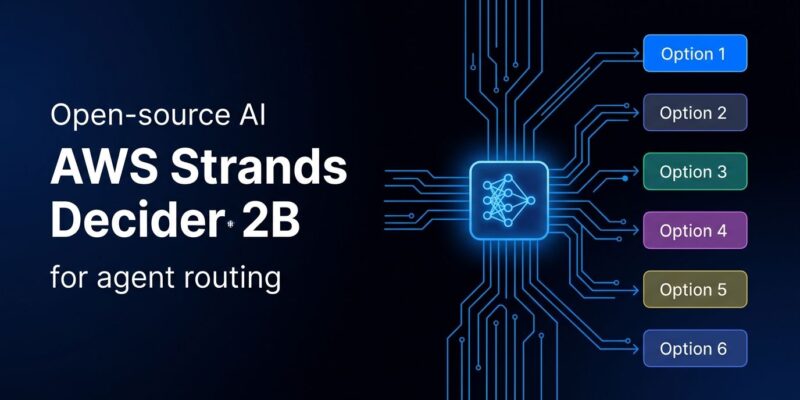
Every agent you build has a hidden tax. Routing decisions — “which tool do I call?”, “does this request go to billing or sales?” — currently cost a full LLM inference. You’re paying frontier-model prices for a multiple-choice question. On October 1, AWS Strands Labs released Strands Decider 2B, a 2-billion-parameter open-source model purpose-built to eliminate that tax. It cannot write prose, but it can route your agent in 115 milliseconds — and it’s free.
The Category That Emerged Last Month
TypeSafe launched Jev in September 2026 and, in doing so, accidentally named a new category: “System One models.” The term borrows Daniel Kahneman’s framework — System 1 being fast, intuitive thinking versus System 2’s slow deliberation. Applied to AI agents, the argument is blunt: most routing calls don’t need reasoning. They need speed and confidence scores.
Unlike a language model that generates text token-by-token, decision models take a question with a predefined set of choices and return a calibrated probability distribution in a single forward pass. No autoregressive loop. No parsing LLM output for a JSON key that may or may not be there. The model answers “billing, sales, or retail?” in tens of milliseconds and tells you how sure it is.
TypeSafe’s Jev charges $0.042 per million input tokens and runs as a hosted API. Amazon answered with something structurally different: a downloadable, self-hostable, Apache 2.0 model with its full training recipe published.
What Amazon Actually Changed
AWS Distinguished Engineer Marc Brooker started this as a personal project, then Strands Labs formalized it. The architecture is surgical: take Qwen3.5-2B, remove the language modeling head entirely — the component responsible for generating tokens — and replace it with a pointer head of just over one million parameters. Add rank-16 LoRA adapters and train with Reinforcement Learning for Calibrated Decisions (RLCD). The result is a model that makes one forward pass and returns a scored distribution over your answer options.
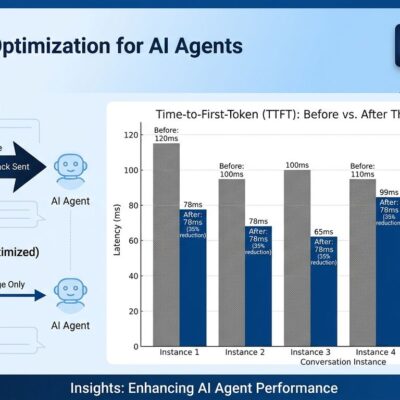
That design change is why the latency numbers are what they are: 115ms median on an RTX 3090, 153ms on an M3 MacBook. No token generation loop means no waiting for tokens to accumulate. Brooker summarized the implication directly: “a decision this cheap can sit in a path where an LLM call never could.”
On JevBench v1 — the benchmark for this model class — Strands Decider v19 achieved 72.3% accuracy with a Brier score of 0.342. That puts it third among 33 models in the 2B class, and first among models that have published their training recipes. It hits 100% on easy tasks, 87.5% on standard, and 50.5% on hard ones.
Open vs. Proprietary: The Real Differentiator
Benchmark position alone does not explain why this release got attention. The real story is the open-source stance in a category that TypeSafe has so far owned as a black box.
| Strands Decider 2B | TypeSafe Jev | |
|---|---|---|
| Cost | Free | $0.042/M input tokens |
| Access | Download weights | API only |
| License | Apache 2.0 | Proprietary |
| Deployment | Self-hosted | Hosted |
| Training recipe | Published | Secret |
TypeSafe’s CEO Diogo Almeida was direct about Amazon’s entry: rivals “might be underestimating the difficulty of making the models actually smart.” His broader point — that accuracy and calibration are harder to get right than the architecture — is fair. Strands Decider’s hard-task performance at 50.5% is a real limitation. But that criticism misses what Amazon is actually selling: reproducibility and data sovereignty. At enterprise scale, “we can audit everything and run it in our VPC” beats “we have a slightly better Brier score” for most procurement conversations.
What to Actually Do With It
The primary use cases are agent patterns you are probably already implementing with expensive LLM calls:
- Tool selection — validate which tool to call before committing to execution
- Model routing — route simple requests to cheap models, complex ones to frontier
- Guardrails — screen inputs and outputs for policy violations at volume
- Memory management — decide what context to keep or evict from a window
- Evaluation — score LLM outputs without paying for another LLM call
The integration point in the Strands framework is a before_tool_call hook. One 115ms Strands Decider check validates that your agent’s arguments are grounded in user input before a 3-second LLM execution proceeds. At any meaningful request volume, that math is not close.
pip install strands-decider

strands-decider ask StrandsAgents/strands-decider-2b-hobson-v19 \
  --state "Help! My payouts have been failing for 3 days!" \
  --choice "Which team should handle this?=billing,sales,retail"
Weights are on Hugging Face under Apache 2.0. The repo includes training data and scripts — meaning you can reproduce the model, fine-tune it on your own decision patterns, or build on top of it without a licensing conversation.
The Broader Trend
This is not an isolated release. VentureBeat noted the market is moving fast: Mapika’s decider family (2B, 4B, 35B MoE) sits second on JevBench. The category is compressing from a TypeSafe monopoly to a crowded open-source ecosystem in under six weeks.
The pattern mirrors what happened with embedding models: OpenAI owned the space, open-source caught up on benchmarks, and now enterprise developers run their own. Decision models are on the same trajectory, compressed into months instead of years. If your agent stack is routing everything through a frontier LLM, you have roughly one quarter before this becomes an optimization everyone has already made.