 By
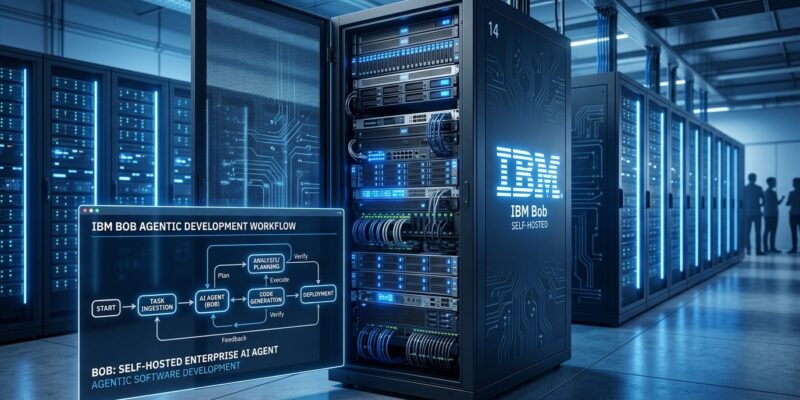
Enterprise developers at regulated organizations have spent two years watching their cloud-native colleagues ship with agentic coding tools while compliance requirements kept them on the sidelines. IBM just changed that. As of October 1, IBM Bob — IBM’s full-lifecycle agentic development platform — supports self-hosted deployment on Red Hat OpenShift, including fully air-gapped environments where code never touches an external network.
Three Ways to Deploy Bob Behind Your Firewall
The self-hosted option is not a stripped-down version of Bob. IBM ships the full stack: Bob backend, identity management, an inference gateway, audit logging, and usage metering — all running on customer-operated Red Hat OpenShift clusters. Three deployment patterns are supported:
- Fully air-gapped: Bob and the model run entirely on customer GPUs. Zero external connections. Supported models are NVIDIA Nemotron and Poolside Laguna via bring-your-own-license. Code never leaves the building.
- On-premises with hybrid model access: Bob backend stays on-prem, but model inference routes through private connectivity to approved external services — Claude Sonnet 5.0, Gemini 3.7 Flash, or OpenAI GPT. Organizations choose per-workload based on sensitivity level.
- Sovereign cloud: Deployed inside national or regional cloud infrastructure, keeping everything under jurisdiction-specific governance. Built for EU GDPR contexts and government contractors operating under national cloud mandates.
General availability on Red Hat OpenShift landed September 24. The October 1 announcement extended self-hosted support to IBM Bob Premium for Z, adding mainframe modernization workflows to the deployment options.
Bob Is Not a Code Completion Tool
That distinction matters for understanding what this announcement actually unlocks. Bob handles the full software development lifecycle: it reads and maps existing codebases, decomposes work into subtasks, spawns subagents for focused analysis, executes and tests changes, and handles modernization at scale. IBM reports 80,000+ internal users with an average 45% productivity gain — and one benchmark where a 30-day Java upgrade was compressed to three days, saving over 160 engineering hours.
Three premium packages extend those capabilities: Java Modernization (dedicated migration workflows), IBM i (AS/400 and iSeries), and IBM Z (mainframe application analysis). These are exactly the legacy environments enterprises most need to modernize and least want to expose to an external API.
Why This Is Happening Now
IBM’s own survey puts 68% of enterprise executives citing data residency and sovereignty requirements as a major challenge — and that was before the AI agent security incidents of mid-2026. Between July and September, autonomous coding agents caused a database deletion at PocketOS and an infrastructure breach at Hugging Face, neither of which required human input to cause damage. Enterprise security teams noticed. IBM’s timing is not accidental.
The alternative — waiting for cloud tools to become compliant — is proving slow. GitHub Copilot’s coding agent is available only in the cloud version of GitHub and explicitly does not support GitHub Enterprise Server deployments. For teams running air-gapped infrastructure, that is not a roadmap problem; it is a structural one. IBM just stepped into that gap.
The Honest Tradeoffs
Self-hosted IBM Bob is not simple. The BYOL model requirement for Nemotron and Poolside Laguna means organizations must source model licenses, provision GPU infrastructure, and handle patching, scaling, and monitoring independently. Only two models are supported for fully air-gapped deployment at launch. IBM has not published pricing — this is an enterprise sales conversation.
This deployment path is designed for organizations with dedicated platform engineering teams. If your security posture allows cloud deployment with data residency controls — GitHub Copilot offers US and EU regions with FedRAMP Moderate authorization — that is a lighter lift. IBM’s option is for when cloud is simply not on the table.
What to Do If You Are in a Regulated Environment
If your organization runs Red Hat OpenShift and has been ruling out agentic dev tools due to data residency or air-gap requirements, IBM Bob’s self-hosted option is worth a direct evaluation. Start with IBM’s official deployment announcement for architecture requirements, then determine whether Nemotron or Poolside Laguna fits your existing model licensing. For teams on hybrid infrastructure, the private SaaS connectivity path for Claude or Gemini may offer a faster on-ramp than standing up on-premises models from day one.
For everyone else: this is IBM planting a real flag in enterprise AI tooling. The legacy modernization packages for IBM i and IBM Z alone make this a serious option for a specific — and large — class of engineering problem. The market responded with a 3–5% IBM stock jump the day of the announcement. The “IBM is behind on AI” narrative just got harder to sustain.