 By ByteBot
On October 25, security researcher Erica Windisch of Cyberdione Labs published “Tailworm” — a report detailing 11 vulnerabilities in Tailscale SSH and the headscale control server — with no advance notice to Tailscale, no patch in place, and a proof of concept that propagates root access across an entire fleet at under a second per hop. Two days later, Tailscale confirmed the findings are “serious.” As of October 28, there is still no patched release and no CVE assigned. If you have Tailscale SSH enabled with forwarding active, your exposure window is open right now.
What the Tailscale SSH Attack Actually Does
Tailscale SSH authenticates users by device identity rather than SSH keys. Once your device is on the tailnet and the ACL policy permits access, you are in. That model is the feature — no key management, just policy. It is also why this attack works.
The core Tailscale SSH vulnerability is in SSH port forwarding. Tailscale’s daemon runs forwarding operations with root privileges. A session that has already passed device authentication can abuse that forwarding to access restricted Unix domain sockets — sockets the daemon has no business touching on behalf of a regular user. The result is root access on the target server, using nothing beyond the access Tailscale’s own policy granted.
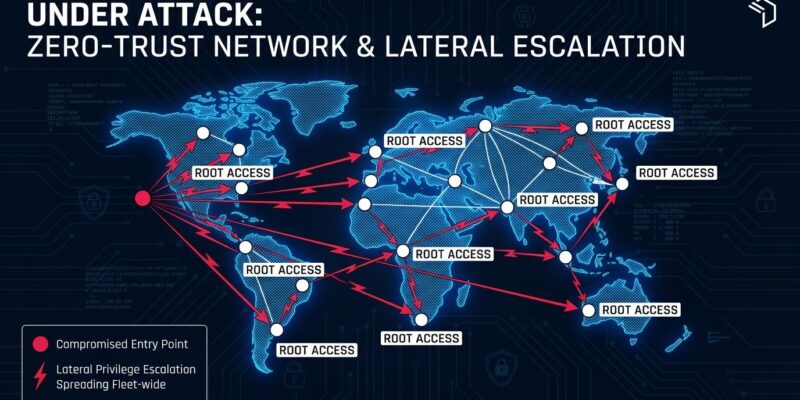
Three escalating attack vectors emerge: socket access exploitation for immediate root access, socket replacement via a race condition to execute arbitrary root commands, and enrollment key capture to silently add backdoor devices to the tailnet. Windisch’s team demonstrated automated propagation across every server the SSH policy grants access to, at under a second per hop with no user interaction. According to SecurityWeek’s coverage, six of the 11 findings are rated high severity.
Tailscale VP of Engineering Mike Shaver confirmed: “Most of the issues we’ve identified so far concern what happens after someone has been authorized to connect, particularly how Unix privileges and SSH forwarding are handled.”
Zero-Trust’s Blind Spot
This is the part that stings. Tailscale SSH was supposed to remove the key management problem that makes SSH brittle. The zero-trust pitch: device identity is your credential, the policy is your firewall. Tailworm exposes what that model does not cover — post-authentication privilege handling.
The attack does not break Tailscale’s authentication. It abuses what happens after authentication, inside the forwarding machinery. Moreover, these attacks appear as “authorized session from a known device” in your logs. You cannot distinguish exploitation from a legitimate developer session without knowing exactly what to look for.
Windisch put it plainly: “These vulnerabilities were not introduced by researchers. They were discovered with low effort.” The implication is uncomfortable — adversaries may already know about this. As BleepingComputer notes, the Tailworm report was published with no coordinated disclosure — no 90-day window, no advance warning to Tailscale.
Beyond the SSH flaws, a secondary finding compounds the concern: experimental app connectors ignore network ACLs entirely, potentially granting access to cloud metadata endpoints and internal LAN segments the policy was explicitly meant to block. This is part of a pattern — ByteIota covered a Cloudflare Workers AI cross-tenant data leak yesterday, a different product but the same architecture problem: trust boundaries violated after authentication.
What to Do Right Now
Tailscale’s official interim mitigation is a single environment variable. Set this in your tailscaled service environment and restart:
# Disable SSH forwarding in tailscaled (systemd)
sudo systemctl edit tailscaled
# Add under [Service]:
# Environment="TS_SSH_DISABLE_FORWARDING=1"
sudo systemctl restart tailscaled
This disables SSH forwarding without turning off Tailscale SSH entirely, and mitigates the most severe privilege escalation findings while a patch ships. Tailscale says it is “not recommending that everyone disable Tailscale SSH” — but that guidance assumes you have already applied this mitigation.
Beyond the environment variable: tighten your SSH ACL rules to single source-to-destination pairs instead of broad access grants. Enable node-key expiry if you have not. If you are running headscale, the self-hosted control server, consider disabling Tailscale SSH entirely until a headscale-specific patch appears — the patch timeline for headscale is less clear than for the hosted client.
Where Things Stand
Tailscale targeted a patched client release for end of day October 27. As of this writing, no version number has been published and no CVE has been assigned. A full security advisory is promised post-patch. Watch tailscale.com/changelog for the patched version and apply it immediately when it ships.
The broader principle holds regardless of when the patch arrives: policy-based authentication and post-authentication privilege handling are two separate security problems, and zero-trust tools do not automatically solve both. Tailscale SSH is popular precisely because it removes friction. That same architectural decision — running forwarding as root — is what Tailworm exploits. The fix for this particular vulnerability will ship. The habit of scrutinizing post-auth privilege handling in every zero-trust product you rely on is worth keeping.