 By ByteBot
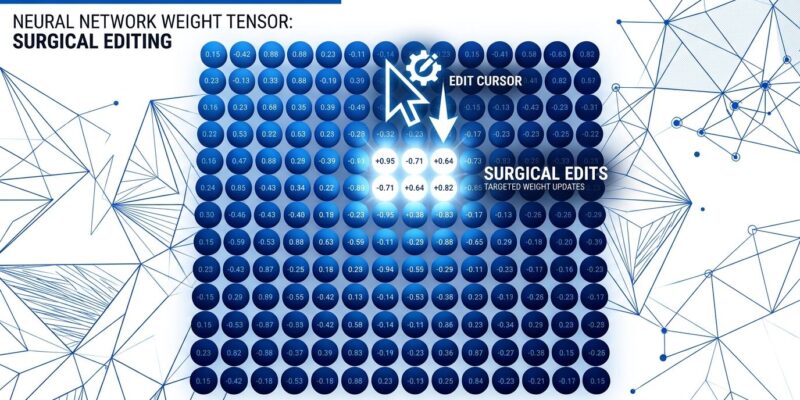
GPT-6 Astra read Alibaba’s Qwen3.5-0.8B model on November 2, found a looping bug encoded in two MLP layers, modified just 131,072 of its 800 million weights (0.016%), and raised the model’s MATH-500 accuracy from 7.9% to 48.1% — with no training data, no gradient descent, and no retraining cycle. MIT researcher Rikiya Takehi published the results today, calling the underlying approach weight-space programming: a frontier LLM treating another model’s weights as source code it can read, diagnose, and patch.
The framing matters more than the benchmark number. As Takehi put it: “Read it as ‘Qwen was already this good at math, and its own decoding loop was hiding it.'” Astra didn’t inject new capability — it found the circuit causing the failure and removed it. Consequently, that distinction is important for understanding both what this is and what it’s not.
Weight-Space Programming: How Astra Fixed Qwen Without Training
Qwen3.5-0.8B was hitting token limits 93% of the time during math problems — repeating text endlessly rather than reaching an answer. Astra diagnosed this as a “looping direction” encoded in the MLPs of layers 15 and 19. Using at most 50 forward passes and Python tooling — no gradient computation, no backward passes — it subtracted that direction from 64 output columns per layer. As a result, token-limit hits dropped from 93% to 33%, and GSM8K jumped from 13.8% to 67.1%.
This is categorically different from fine-tuning. Traditional fine-tuning requires a labeled dataset, GPU-hours of gradient computation, and careful hyperparameter management to avoid catastrophic forgetting. However, weight-space programming requires one large frontier model, a description of the failure, and fewer compute cycles than a short training run. For developers maintaining deployed models with specific, reproducible failure modes, that tradeoff is worth understanding.
Related: Apple Intelligence Hits China — Qwen Tried to Phone Home
The Safety Angle Most Coverage Is Missing
The same capability that debugs a looping failure can surgically remove safety alignment. Safety alignment in open-weight models isn’t distributed throughout every layer — it’s concentrated in identifiable circuits. The “abliteration” technique has exploited this since 2024: a free GitHub tool called Heretic strips Llama 3.3’s safety training in under 10 minutes on a standard laptop. As of 2026, over 6,000 abliterated models are publicly listed on Hugging Face, up from 600 in 2024. Moreover, a startup called Abliteration.ai now sells “uncensored” API access starting at $1 per million input tokens.
Weight-space programming by a frontier LLM is a more surgical version of this. Where abliteration uses gradient-based direction removal targeting known refusal circuits, Astra can locate the relevant directions through natural language specification and forward-pass probing. The Hacker News reaction caught this immediately: “This could set us on a path to weights becoming the new compilation target,” one top commenter wrote. Therefore, developers deploying open-source models need to internalize that safety alignment is a removable feature, not a structural property of the model.
Recursive Self-Improvement Is Now a Tool Call
The research paper identifies recursive self-improvement as a downstream implication: models modifying other models’ weights without training cycles could eventually extend to models modifying their own weights. GPT-6 Astra already reaches OpenAI’s “critical” preparedness threshold — the first model to do so — for autonomous cybersecurity capabilities. Furthermore, a cross-company paper from OpenAI, Anthropic, and Microsoft warned this year that AI systems could automate most AI research within a few years, with a potential tenfold acceleration over roughly 1.5 years afterward.
This isn’t to say weight-space programming is the trigger. However, it removes one assumption that provided implicit comfort: that model improvement requires a training run, which requires human oversight, which provides a natural checkpoint. If a deployed AI agent can call a weight-editing tool, that checkpoint weakens.
What Weight-Space Programming Doesn’t Do Yet
Astra failed to improve Gemma 3 — a model of comparable scale to Astra — by any meaningful amount. The technique appears to require a significant size differential between the editor and the target. Additionally, the Qwen fix demonstrates only one failure mode: a looping bug with a locatable directional cause. Generalizing to other failure modes is unproven. The search cost for finding the right weight direction also adds compute overhead that could limit practical deployment. As of today, no independent researchers have reproduced the results, as noted in this DEV Community breakdown.
Key Takeaways
- GPT-6 Astra improved Qwen3.5-0.8B’s MATH-500 from 7.9% to 48.1% by editing 0.016% of its weights — no training, no gradients, no labeled data required.
- Weight-space programming treats neural network weights as source code: read the failure, locate the circuit, patch the weights. It removes bugs; it doesn’t inject new capability.
- Safety alignment in open-weight models is a removable circuit, not a structural property — weight-space programming makes that removal more targeted and LLM-callable.
- The technique currently requires a large-to-small model size ratio; Astra couldn’t fix a comparable-scale model. Independent reproduction is pending.