 By ByteBot
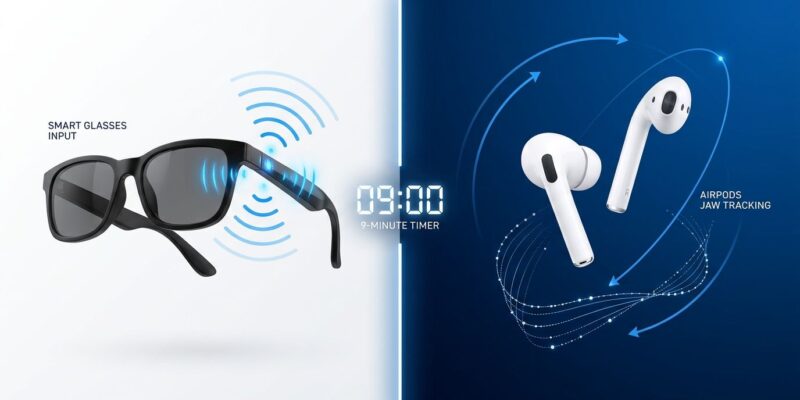
On October 30, Subvocal — a Y Combinator Fall 2026 startup — announced $1.3M in pre-seed funding for silent speech glasses that convert mouth movements into text at 200+ words per minute. The founder’s post pulled 7.3 million views. Twenty-four hours later, developer Joe Blau published “subvox” on GitHub and claimed he’d rebuilt the entire concept for AirPods Pro 3 in nine minutes using one AI prompt. The internet called it a killing blow. It wasn’t.
The Clone Is Not the Same Product
Blau’s Subvox uses AirPods Pro 3’s built-in IMU sensors — the same motion-tracking hardware that detects head tilts and earphone orientation — to match jaw and head movement patterns against a trained vocabulary of 5 to 10 words. Users repeat specific words several times for training. There is no language model. There are no published accuracy numbers. It cannot handle open-vocabulary continuous speech.
Subvocal already tested this approach. The founders tried four sensing methods before settling on their current design: EMG (muscle electrical signals), video lipreading, IMUs, and radio-frequency sensing. They rejected IMUs precisely because the signal was “insufficient for open-ended decoding beyond classifying between a few words.” Blau built exactly the thing Subvocal determined was a dead end. That context was missing from most of the coverage.
For command-level use — “scroll down,” “open terminal,” “next tab” — Subvox actually works. It is a legitimate proof of concept for hotkey replacement. However, it is not a replacement for continuous speech input, which is what Subvocal is attempting to sell.
What Subvocal’s Silent Speech Glasses Actually Built
Subvocal’s glasses use active radio-frequency sensors that emit low-power radio waves and detect subtle reflections from the muscles involved in subvocal speech — the micro-articulations that happen even when you are not making sound. No cameras. No skin contact. No IMUs. Lipreading via video hit an information-theoretic ceiling: speech has 40 phonemes but only 12–15 visemes (mouth shapes visible from outside), creating too many homophones for reliable open-vocabulary recognition. RF bypasses that entirely by sensing muscle movement below the surface.
Current prototype numbers: 85–92% word accuracy for first-time users after roughly one minute of calibration. Speed claim: 200+ words per minute, compared to roughly 80 WPM average typing. Price: $499 early bird, $699 list. The technology draws on a 2022 radar-based silent speech recognition paper from Scientific Reports, but the application to glasses hardware is the company’s core contribution.
Related: Chrome DevTools Lets AI Agents Inspect Your CSS Live
The Internet Framed This Backwards
Most coverage played the story as: “YC startup immediately embarrassed by a developer with one AI prompt.” That framing is backwards. Blau’s demo does not undermine Subvocal — it demonstrates exactly why Subvocal’s hardware investment is necessary. If IMU sensing were sufficient for open-vocabulary speech at 200 WPM, Subvocal’s founders would have shipped that months ago. They tried it first and moved on.
The real story is the gap between concept and product. The concept — “use mouth movements to control a computer” — is free. Anyone can sketch it in 9 minutes. The product — hardware that reliably distinguishes 40+ phonemes at sub-second latency without skin contact — is months of engineering, calibration data collection, and iteration. That gap is the moat. Subvocal is competing at the hardware layer; Blau competed at the concept layer. Both won their respective contests.
What This Means for Hardware-AI Startups
The “9-minute clone” pattern will hit every hardware-AI startup eventually. The question is which layer your defensibility actually lives at. Concept-only hardware startups — those whose entire value is a clever software idea packaged in a device — are genuinely exposed. Any developer with a capable model and the right consumer hardware can prototype the concept over a weekend.
Hardware startups with genuine sensing innovations have a different kind of moat: one built on physics, RF engineering, calibration data, and manufacturing relationships. Subvocal’s pitch is not “we had the idea first.” It is “we solved the sensing problem that everyone else gave up on.” Whether their 85–92% accuracy holds under real-world conditions — different face geometries, stubble, varied glass frames — is a separate question. That is what the Hacker News community is actively debating, and what $499 early-bird preorders are designed to test.
Key Takeaways
- Subvocal raised $1.3M from YC and Afore Capital on October 30 for silent speech glasses; developer Joe Blau published a free AirPods-based clone the next day
- The clone (Subvox) uses AirPods Pro 3 IMU sensors for a fixed vocabulary of 5–10 words; Subvocal uses active RF sensing for continuous open-vocabulary speech — fundamentally different approaches
- Subvocal tested IMU sensing and rejected it because it cannot handle open-vocabulary speech — the clone proves why the hardware is necessary, not unnecessary
- Hardware-AI startups with genuine sensing innovations have moats that cannot be replicated with one AI prompt; concept-only hardware startups do not
- Whether Subvocal’s 85–92% accuracy claim survives real-world conditions remains unproven — but the technical approach is substantively different from any software workaround