 By ByteBot
Cloudflare just open-sourced the four-agent pipeline that slashed Astro’s GitHub issue backlog from over 200 down to roughly 30 — an 85% reduction — and any maintainer can drop it into their repo today with a single GitHub Action. The tool is called triagebot-action. It does not just label your issues. It reproduces them in a sandbox, diagnoses the root cause, proposes a fix, and ships a preview release for the reporter to validate. Then it opens a PR. The Astro team expects to hit zero open issues — a first in the project’s five-year history.
The Problem Is Worse Than You Think
Open source issue debt is not a workflow inconvenience. It is a structural maintainer burnout driver. A 2026 survey found 60% of OSS maintainers work unpaid and 44% report burnout. Issue counts have grown faster than the maintainer pool for a decade, and AI-generated code is now accelerating the submission side of the workload without adding any review capacity. Astro spent five years unable to get its open issue count below 200.
The typical responses — auto-close bots, stale issue sweeps, “issue bankruptcy” — all require closing issues without resolving them. Contributors hate it. Cloudflare found a different answer: fix the bugs automatically.
Four Isolated Agents, One Report File
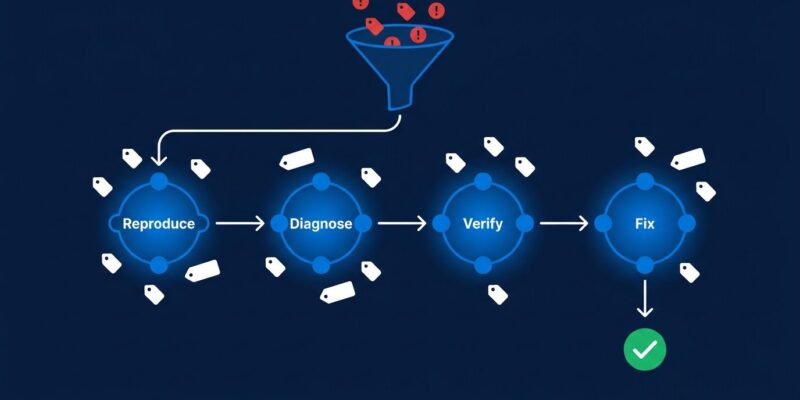
The architecture is deliberately simple and worth copying. When a new issue is opened, triagebot-action kicks off a four-stage pipeline:
- Reproduce — Clone the reporter’s reproduction repo and verify the issue actually exists.
- Diagnose — Instrument the codebase, add logging, and pinpoint the root cause.
- Verify — Check test suites, comments, and documentation to confirm this is a real bug and not expected behavior.
- Fix — Convert the reproduction case into a failing unit test, consult the project’s architecture guide, and ship a fix.
Each subagent is isolated. They do not share execution context. They communicate only through a report.md file passed sequentially between stages. This prevents the LLM from developing bias toward forcing a solution when no bug actually exists. The Verify step exists precisely to kill false positives before wasting time on a fix.
The whole pipeline is driven by GitHub issue labels acting as a state machine. No external database, no separate infrastructure. Labels progress from triage needed through to fix verified. When a fix is ready, the tool publishes a preview release via pkg.pr.new, asks the reporter to test it, and only opens a PR after confirmation.
Getting It Running Costs Nothing
The setup is a single workflow file and a folder of skill instructions. Cloudflare’s Workers AI provides the model inference on a free tier. No Cloudflare Worker deployment required — the action runs on standard GitHub Actions runners and calls Workers AI over an OpenAI-compatible REST endpoint.
- uses: withastro/triagebot-action@v1
  with:
    read-token: ${{ secrets.GITHUB_TOKEN }}
    write-token: ${{ secrets.BOT_GITHUB_TOKEN }}
    cloudflare-api-key: ${{ secrets.CLOUDFLARE_API_KEY }}
    cloudflare-account-id: ${{ secrets.CLOUDFLARE_ACCOUNT_ID }}
    triage-model: cloudflare-workers-ai/@cf/moonshotai/kimi-k2.7-code
    triage-skill: .agents/skills/triage
If you prefer not to use Cloudflare’s models, you can swap in Anthropic or OpenAI. The skill files in .agents/skills/triage/ are where you give agents project-specific context: your architecture, testing conventions, and what counts as a bug versus a feature request. That context is what makes the agents effective rather than generic.
When Agents Fail, Your Codebase Is Telling You Something
Here is the part that makes this tool more interesting than a simple triage shortcut. Cloudflare treats failed agent runs as a codebase health signal. When the pipeline repeatedly fails to find a fix, it typically reveals one of three problems: opaque abstractions with unclear boundaries, missing rationale comments, or gaps in test coverage. As the Cloudflare blog explains: “When an agent fails to identify a correct solution, we interpret that failure as an indicator of an underlying architectural or documentation issue.”
This reframes the whole tool. You are not just outsourcing triage — you are getting an automated audit of where your codebase is hard to reason about. Every persistent agent failure is a documentation debt ticket you did not know you had.
The Framework Behind It: Flue
triagebot-action is built on Flue, an open-source, platform-agnostic framework for durable agent workflows. Flue generalizes the pattern: define your agent’s context declaratively — model, skills, sandbox, instructions — and react to any event source. The orchestration model works on Node.js, GitHub Actions, or Cloudflare Durable Objects. If you want to build a custom workflow variant for your team, Flue is where to start.
The Verdict
The maintainer burnout problem is not new. What is new is that a free, proven solution now exists and is deployable in an afternoon. The architectural pattern — isolated subagents communicating through a shared state file, driven by a label-based state machine — is worth understanding even if you never adopt triagebot-action directly. It is a more reliable pattern than monolithic LLM loops for any multi-step agentic workflow, and the InfoQ analysis of this release makes that case well.
Cloudflare’s workers-sdk team is already prototyping it internally. If your repository has an issue backlog that has been growing for years, this is the most actionable thing you can do about it this week.