 By ByteBot
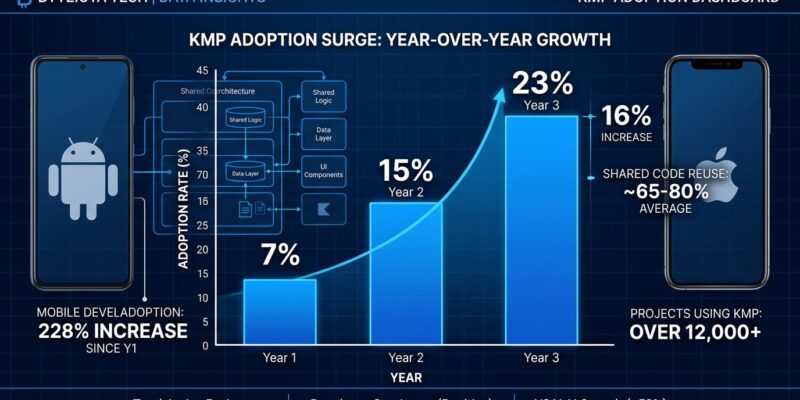
Kotlin Multiplatform adoption tripled in one year—jumping from 7% in 2024 to 23% in 2025—as Netflix, Airbnb, and VMware deployed production apps using a pragmatic “shared core + native UI” architecture. In 2026, KMP officially transitioned from experimental to production-ready status with stable APIs, Swift interoperability, and proven ROI. Moreover, Airbnb achieved 95% code sharing for booking logic within six months. VMware cut time-to-market by 40%. The inflection point is here.
From Experimental to Production: The Numbers Behind KMP’s Breakthrough
The growth metrics tell the story. Kotlin Multiplatform usage jumped from 7% adoption in 2024 to 23% in 2025—a threefold increase that signals fundamental market validation. Furthermore, KMP’s presence among the top 10,000 mobile apps doubled year-over-year. This isn’t gradual adoption. It’s acceleration.
Enterprise validation provides the proof points. Netflix became the first FAANG company to publicly adopt KMP in October 2020, building Prodicle—a mobile app for TV and movie production teams. Airbnb returned to cross-platform development in 2025 after abandoning React Native in 2018, achieving 95% code sharing for booking logic within six months. Consequently, the release cycle improved from monthly to weekly. VMware centralized networking and authentication in a shared Kotlin codebase, cutting time-to-market for enterprise apps by 40%. Forbes shares 80%+ of its logic across iOS and Android.
Production-ready status in 2026 removes the biggest adoption barrier. JetBrains and Google officially back KMP with stable APIs across all platforms—Android, iOS, web, desktop, and server. Companies now have enterprise validation instead of vendor promises. The experimental phase is over.
Shared Core + Native UI: Why Enterprises Choose Kotlin Multiplatform Over React Native
The industry is converging on “shared core + native UI” as the default Kotlin Multiplatform architecture in 2026. Share business logic, data layers, and networking—typically 60-90% of code—in Kotlin. Keep UI fully native with Swift for iOS and Jetpack Compose for Android. This pragmatic approach balances code reuse with platform-specific UX, differentiating KMP from React Native and Flutter’s “share everything” philosophy.
The typical code sharing breakdown reveals the strategy. Business logic: 100% shared. Data models: 100% shared. Networking with Ktor: 100% shared. Database with SQLDelight: 100% shared. However, authentication: 90% shared with platform-specific biometric APIs. Analytics: 80% shared with platform-specific SDKs. UI: 0% shared for native experiences, or 100% shared with Compose Multiplatform for internal tools.
Architectural clarity makes staffing easier. ViewModels, use cases, and repositories live in the shared Kotlin layer. UI components stay platform-specific. Enterprises can structure teams around shared logic developers and platform UI specialists—a staffing model that scales better than requiring developers who master both cross-platform and platform-specific concerns.
Enterprises don’t want to sacrifice native UX for code sharing. KMP lets them have both. React Native and Flutter demand compromises on platform-specific feel. KMP prioritizes quality over quantity of sharing.
De-Risking Migration: Start Small, Prove ROI, Expand Gradually
KMP’s killer feature isn’t technical—it’s strategic. Gradual adoption without rewrites de-risks migration and allows teams to upskill over time. Start by sharing isolated modules like authentication, validation, or networking. Measure ROI. Expand based on proven results. In contrast, React Native and Flutter require upfront commitment and complete rewrites.
Migration patterns reveal the success formula. Successful migrations started small with low-risk modules, measured results objectively, and expanded gradually. Failed migrations attempted “big bang” rewrites, underestimated platform-specific complexity, or chose frameworks misaligned with team expertise. Airbnb’s journey illustrates the difference—after abandoning a React Native rewrite in 2018, gradual KMP adoption succeeded in 2025.
The three sharing levels provide flexibility. Share specific modules for a gradual approach starting with authentication or networking. Share logic with native UI for the typical enterprise pattern with 60-90% code reuse. Share logic plus UI with Compose Multiplatform for maximum cross-platform coverage. Choose based on risk tolerance and team skills.
Enterprise risk management favors this approach. A CTO can approve a three-month pilot sharing authentication logic without betting the entire mobile roadmap. Proven ROI justifies expansion. React Native and Flutter demand betting the entire roadmap upfront.
KMP vs React Native vs Flutter: When to Choose Each in 2026
The framework choice isn’t binary anymore. Market positioning in 2026 reveals specialization. KMP leads for enterprise and AI applications where gradual adoption and native performance matter. Flutter dominates consumer apps with rich animations requiring pixel-perfect custom UX. React Native serves teams with strong JavaScript expertise needing fastest time-to-market. Modern architectures increasingly deploy multiple frameworks simultaneously.
Market share and costs tell the hiring story. Flutter holds 46% market share, React Native claims 35-42%, and KMP reached 23% with 3x annual growth. React Native developers command $145K average salaries and are easiest to hire from the massive React ecosystem. KMP developers average $135K but are harder to find, requiring specialized Kotlin expertise.
Performance characteristics differ meaningfully. KMP compiles to native code with no JavaScript bridge overhead. Flutter uses the Skia renderer for consistent cross-platform rendering. React Native improved with the New Architecture and Hermes, narrowing the performance gap, but KMP maintains the edge for compute-intensive operations.
The strategic trend challenges conventional thinking. Deploy KMP for performance-critical business logic, React Native for rapid prototyping, or Flutter for consumer-facing apps with heavy animation requirements. The either/or framework decision is outdated. Specialization beats one-size-fits-all.
Five Breakthroughs That Made 2026 KMP’s Year
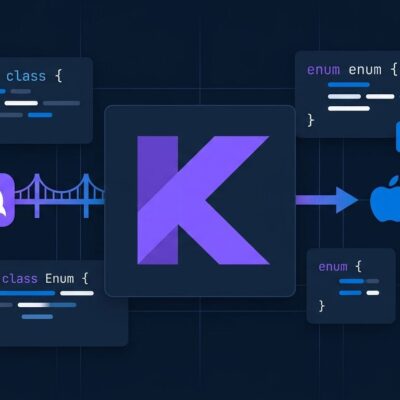
Five developments pushed KMP from experimental to production-ready in 2026. First, Swift Export enabled by default translates Kotlin code directly to pure Swift instead of Objective-C, dramatically improving the iOS developer experience. Second, stable APIs across all platforms remove the risk of building on experimental foundations. Third, Core Android Jetpack libraries gained KMP-compatible versions, enabling reuse of familiar patterns. Fourth, JetBrains published an official 2026-2027 roadmap, providing the transparency enterprises demand. Fifth, third-party SDK support matured with KMP versions of Firebase, Sentry, Auth0, and Stripe.
Swift Export solves the iOS adoption barrier. iOS teams won’t adopt a framework requiring Objective-C interop in 2026. Direct Swift translation makes KMP feel native to iOS developers. Moreover, Kotlin 2.3 delivered faster builds, smaller binaries, and smoother interoperability across platforms—removing the friction points that slowed earlier adoption.
Ecosystem support addresses the missing-library problem. Enterprises can’t migrate if critical SDKs lack KMP versions. Analytics, crash reporting, authentication, and payment processing now have KMP-compatible SDKs. The ecosystem gaps that blocked migration in 2024 closed in 2025-2026.
Key Takeaways
- KMP reached production-ready status in 2026 with 3x adoption growth and enterprise validation from Netflix, Airbnb, VMware, and Forbes
- “Shared core + native UI” emerged as the winning pattern—share 60-90% of business logic while keeping UI fully native for platform-specific UX
- Gradual adoption de-risks migration by allowing module-by-module sharing without forced rewrites, unlike React Native and Flutter
- Choose based on requirements: KMP for enterprise apps with existing native codebases, Flutter for consumer apps with custom animations, React Native for teams with JavaScript expertise
- 2026 maturity signals include Swift Export for direct Swift interop, stable APIs across platforms, Jetpack library support, roadmap transparency, and third-party SDK ecosystem