 By ByteBot
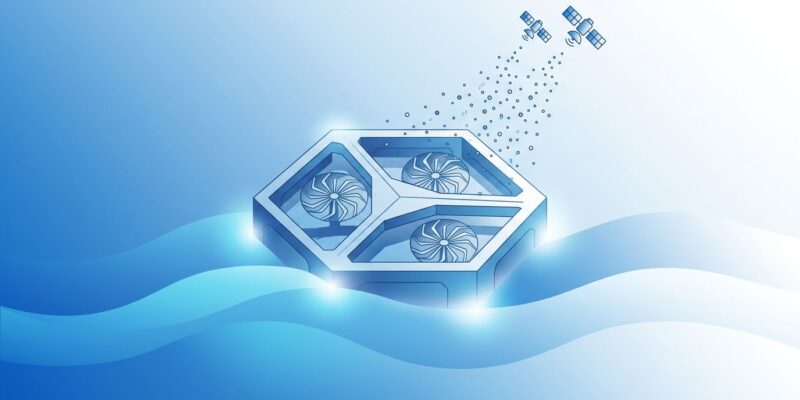
Panthalassa, an Oregon-based startup, raised $140 million in Series B funding led by Peter Thiel on May 5 to deploy floating AI data centers in the open ocean. The company’s 85-meter steel platforms sit mostly beneath the ocean surface, generate electricity from wave motion, cool servers with seawater, and transmit data via satellite. This isn’t a moonshot project – it’s a response to an impossible problem: AI data centers are projected to consume 945 TWh globally by 2030, triple of 2024 levels, while grid operators warn they’ll be 6 gigawatts short of reliability requirements by 2027.
When electricity prices are up 42% since 2019 and residential bills are rising $16-18 per month due to data center demand, building compute infrastructure in the middle of the ocean – fighting waves, corrosion, and storms – is now the pragmatic choice.
AI’s Power Crisis Has No Land-Based Solution
The numbers are stark. Global data center electricity consumption hit 415 TWh in 2024 and is growing at 12% annually. By 2030, data centers will consume 3% of all global electricity. A single AI training cluster draws 100 MW – enough to power a small city. PJM Interconnection, the largest US grid operator serving 65 million people across 13 states, has confirmed it will be 6 GW short of reliability requirements in 2027.
Meanwhile, electricity prices have risen 42% since 2019, partly driven by data center demand. In the PJM market alone, data centers added $9.3 billion to capacity costs in 2025-26. The result: residential electricity bills increased $16-18 per month in Maryland and Ohio. Grid operators aren’t just warning about future strain – they’re saying they can’t keep up right now.
Panthalassa’s offshore solution bypasses terrestrial grids entirely. There’s no interconnection queue, no transmission losses (which waste 5-8% of grid power), and no competition with residential demand. The ocean offers unlimited wave energy and free cooling. It’s radical, but when grids are failing to meet demand, radical starts looking necessary.
How Wave Turbines Power AI Chips
Panthalassa’s platforms are 85-meter solid steel structures – roughly the height of Big Ben – with a 50-meter spherical top and a neck extending 60-70 meters below the surface. As waves cause the platform to rise and fall, water is forced into a pressurized reservoir inside the spherical top. The pressurized water flows through an internal turbine, generating electricity for AI chips housed in hermetically sealed containers.
The design eliminates hinges, flaps, and gearboxes – mechanical components that plague wave energy systems. Only the turbine moves. Cooling comes from direct seawater heat exchange through sealed containers, cutting cooling energy by 40-60% compared to conventional data centers (which spend 40% of total energy on active cooling). Data transmits via low-Earth-orbit satellites, eliminating the need for undersea fiber optic cables.
This isn’t theoretical engineering. It’s a decade of hard-won ocean lessons distilled into a brutally simple design: fewer moving parts mean fewer failure points in an environment that punishes complexity.
A Decade of Ocean Prototypes Proves It Works
Panthalassa was founded in 2016 and has spent nearly ten years developing wave energy conversion, autonomous operations, and offshore computing. The company deployed three prototypes between 2021 and 2024: Ocean-1 (proof of concept), Ocean-2 (full-scale deployment off the Washington coast), and Wavehopper (additional testing platform). All three delivered results matching or exceeding simulation forecasts.
The company plans to deploy its Ocean-3 pilot series in the northern Pacific Ocean by August 2026, with commercial systems targeting 2027. Microsoft’s Project Natick (2015-2022) already proved underwater servers work better than land-based ones – 8x lower failure rates due to hermetically sealed, nitrogen-filled environments. Microsoft abandoned the project, but the technical validation stands. Panthalassa is asking: why not go further and add energy independence?
This is the crucial point: ocean data centers aren’t vaporware. The core technologies – hermetic sealing, passive cooling, wave energy – have been tested at sea and validated. Ocean-3 will determine if they can scale commercially.
Peter Thiel’s $140M Bet Isn’t Random
The $140 million Series B was led by Peter Thiel (Palantir co-founder) and included Marc Benioff’s TIME Ventures, Max Levchin’s SciFi Ventures, and John Doerr of Kleiner Perkins. Total funding now stands at $210 million. These investors have track records: Thiel backed Palantir and SpaceX early, Benioff runs Salesforce cloud infrastructure, Levchin co-founded PayPal, and Doerr backed Google and Amazon before they dominated.
This caliber of investor doesn’t throw $210 million at unproven concepts. They’ve seen the ocean prototypes, reviewed the engineering, and understand the economics. More importantly, they recognize the same reality driving Panthalassa: AI’s power demands are unsolvable with terrestrial infrastructure alone.
The Ocean Is Unforgiving
Offshore data centers face saltwater corrosion, biofouling from algae and barnacles, storm damage, and extreme wave heights. Many wave energy ventures have failed precisely because ocean conditions are brutal. Maintaining floating platforms hundreds of miles from port requires logistics no company has managed at scale – boat access, weather windows, specialized crews, and storm-resistant operations.
Panthalassa addresses some risks through hermetic sealing, dry nitrogen atmospheres (preventing internal corrosion and condensation), and minimal mechanical parts. However, one major storm-related failure – a platform lost at sea, catastrophic hardware damage, or prolonged outage – could kill investor confidence and the entire offshore data center concept. The ocean punishes mistakes, and there’s no room for iterative fixes when your infrastructure is 100 miles offshore in open water.
This is the reality that $210 million in funding is betting against. The engineering looks sound, the prototypes work, and the need is desperate. But the ocean has sunk bigger ambitions before.
Key Takeaways
- AI’s power crisis is forcing radical solutions – offshore data centers aren’t crazy, they’re a pragmatic response to grid operators warning they’ll be 6 GW short by 2027
- Panthalassa’s wave turbine design learns from past failures by eliminating hinges, flaps, and gearboxes – only the turbine moves, reducing failure points in harsh offshore environments
- $210 million from Thiel, Benioff, Levchin, and Doerr signals serious investor confidence backed by a decade of successful ocean prototypes (Ocean-1, Ocean-2, Wavehopper)
- Ocean-3 pilot deployment in August 2026 will prove or kill the concept – one major storm failure could destroy the entire offshore data center market
- If it works, expect hyperscalers (AWS, Google Cloud, Azure) to follow – unlimited renewable wave energy with zero transmission losses is too attractive to ignore when grids are failing
Panthalassa’s bet is simple: AI’s energy demands have outgrown land-based infrastructure, and the ocean is the only place with unlimited renewable power at scale. By 2027, we’ll know if they’re right.