 By ByteBot
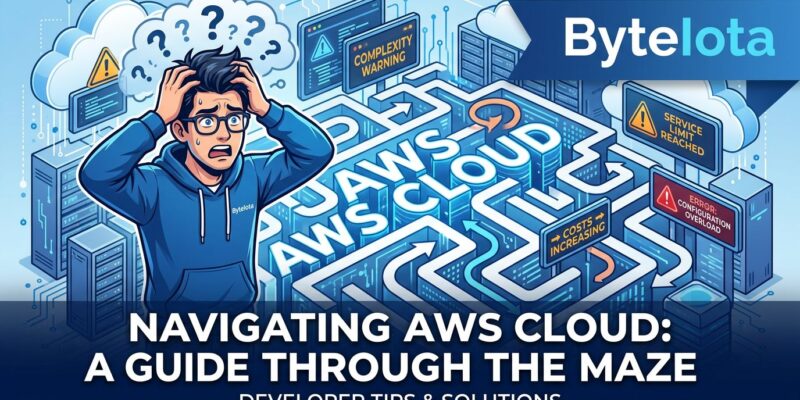
On May 10, 2026, a developer’s blog post titled “I returned to AWS – and was reminded HARD why I left” hit Hacker News front page with 368 points and 298 comments. Within hours of returning to AWS, the author encountered a $75 DynamoDB bill from testing, fought Byzantine IAM policies that suspended his legitimate account, and faced $0.09/GB data egress costs he described as “fucking insanely expensive.” The kicker? These are the exact traps developers complained about a decade ago. AWS’s complexity isn’t accidental—it’s the business model.
AWS dominates cloud with 31% market share, but a generation of developers is quietly choosing simpler alternatives for new projects. Railway, Render, and Cloudflare Workers offer git-push deploys and predictable pricing. The “returned and regretted” pattern exposes AWS’s strategic choice: optimize for enterprise lock-in through complexity and switching costs, not developer experience.
The AWS Traps That Keep Catching Developers
The viral blog post details four specific traps. First, DynamoDB hit the author with a $75 bill from hours of testing. On-demand pricing costs 7.5x more than provisioned capacity and rounds writes up to 1KB chunks—a 1.2KB item gets billed as 2KB. The author’s assessment? “DynamoDB is the worst system I can imagine in every possible way.”
Second, IAM’s Byzantine complexity suspended his account during legitimate testing, leaving business email non-functional for days with unresponsive support. Third, data egress at $0.09/GB means serving a 10MB page to 1 million users costs $9,000. Fourth, Lambda delivers “massive development complexity” with 200-2,000ms cold starts without genuine benefits over traditional web servers. AWS raised Lambda INIT phase billing 22x in August 2025—from $0.80 to $17.80 per million invocations.
These aren’t edge cases. The Hacker News discussion (298 comments) reveals similar experiences: NAT gateways double-charge at $0.135/GB total ($0.045 processing + $0.09 egress), often exceeding $2,000/month without developers noticing. Cross-AZ data transfer adds 30-40% to total spend for distributed architectures—$200/month for a busy Kubernetes cluster moving just 10TB between availability zones.
Complexity Is the Moat, Not a Bug
AWS’s 260+ services, Byzantine IAM policies, and hidden billing charges aren’t accidental complexity. They’re a strategic moat that creates switching costs and locks in enterprises. The more expertise you invest in AWS-specific knowledge—IAM policy troubleshooting, service-specific optimizations, cost management tricks—the harder it becomes to leave. Migration costs far exceed ongoing frustration for large organizations.
“Access denied” errors in IAM are “the main point of frustration,” requiring “time-consuming investigation across multiple policy types,” according to analysis from DigitalOcean. S3 storage appears cheap at $0.023/GB, but 20TB monthly egress costs $1,800—78x the storage expense. Costs spread across dozens of line items rather than appearing transparently.
AWS defenders on Hacker News say “you just don’t understand it”—but that’s exactly the point. Understanding AWS requires expertise investment that becomes a sunk cost. Enterprises with compliance requirements (HIPAA, SOC 2, FedRAMP), multi-region infrastructure, and teams trained in AWS-specific services can’t easily migrate. AWS’s financial results prove the strategy works—31% market share despite constant developer complaints. Complexity is profitable.
The Developer Exodus to Simpler Clouds
A new generation of developers is choosing simpler cloud platforms over AWS for greenfield projects. Railway and Render, described as “Heroku-spiritual-successors,” offer git-push deploys, managed databases, and simple billing. Railway provides usage-based pricing that scales to zero with a tighter developer experience. Render offers per-service pricing for long-lived services with more mature infrastructure. Both target developers who “just want to ship my app without learning AWS.”
Cloudflare Workers provides edge compute in 35+ regions with transparent pricing and sub-millisecond response times. The trade-off is obvious: these platforms sacrifice AWS’s breadth (260+ services) for operational simplicity and predictable costs. Developers outgrow shared PaaS for three reasons: cost at scale (markup gets expensive), compliance requirements (healthcare/finance needs infrastructure control), and configuration limitations.
The shift is visible in community sentiment. Hacker News and Reddit discussions increasingly recommend Railway or Cloudflare for new projects, suggesting AWS only “when absolutely necessary.” Experienced developers remain trapped by AWS migration costs, but new developers are actively avoiding the platform. AWS is becoming “legacy cloud”—dominant but unloved by the next generation.
Why AWS Doesn’t Care (And Why That’s the Problem)
AWS remains the market leader for good reasons: 260+ services covering every use case, global infrastructure with robust SLAs, mature ecosystem, and unmatched breadth for complex multi-region workloads. The problem isn’t that AWS is bad—it’s that AWS optimizes for enterprise retention over developer experience.
AWS’s 2026 roadmap “strongly favors serverless abstractions over infrastructure management”—more managed services increase lock-in. The company’s response to complexity criticism is adding more services, not simplifying existing ones. Financial results prove the strategy: 31% market share, growing enterprise revenue, success despite developer complaints.
The strategic bet is clear: enterprises will tolerate frustration because migration is too expensive. This creates a generational divide—experienced teams are locked in by sunk costs, while new developers learn cloud elsewhere. The “returned and regretted” viral post proves AWS made a choice: optimize for Amazon’s bottom line through enterprise lock-in rather than developer love. Financially successful, but breeding an AWS-avoiding generation.
AWS chose enterprise lock-in over developer experience, and complexity proved profitable. The exodus is real but slow—enterprises stay for 5-10 years while new developers start on simpler platforms. The “returned and regretted” pattern proves nothing has changed in a decade.