 By ByteBot
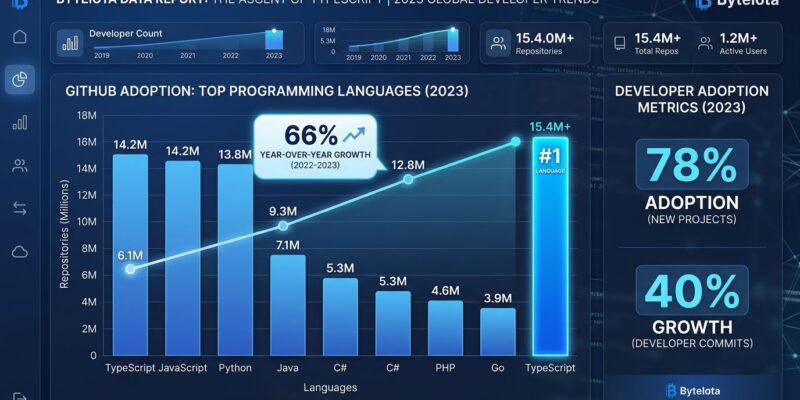
TypeScript overtook both Python and JavaScript in August 2025 to become the most-used programming language on GitHub—the first time any language has claimed the top spot in this measurement. The shift marks what GitHub calls “the most significant language shift in more than a decade,” driven by a 66% year-over-year surge that brought over a million new TypeScript contributors in 2025 alone. Today, 40% of developers write exclusively in TypeScript, up from 28% just three years ago.
For the 78% of professional developers already using TypeScript, this validates a choice they’ve made. However, for the 22% still writing plain JavaScript, the market is sending a clear signal: it’s decision time.
Why TypeScript Won: AI Tools and Framework Defaults Changed Everything
The explanation for TypeScript’s rise isn’t mysterious—it’s practical. Moreover, two forces have fundamentally reshaped how developers choose their tools: AI coding assistants and framework defaults.
AI tools like GitHub Copilot perform roughly 20% better when working with strongly-typed code. The reason is structural: type annotations give AI models explicit context about what methods exist, what data shapes are valid, and what the code expects. Furthermore, a 2025 academic study found that 94% of LLM-generated compilation errors are type-check failures. Consequently, when you write TypeScript, you give your AI assistant a map. When you write JavaScript, it’s guessing.
The correlation is direct: TypeScript’s growth accelerated precisely when GitHub Copilot crossed mainstream adoption, with 80% of new developers using it within their first week. In fact, developers aren’t choosing TypeScript purely on merit—they’re choosing it because the tools they use every day work better with it.
Frameworks sealed the deal. Every major frontend framework—React, Next.js, Vue, Nuxt, SvelteKit—now scaffolds projects with TypeScript by default. Additionally, React’s documentation shows TypeScript examples first. Daniel Roe from the Nuxt team put it plainly: “TypeScript has won. Not as a bundler, but as a language.”
When new developers learn React or Vue, they’re learning TypeScript whether they intended to or not. The decision is being made for them, and the network effects compound: more TypeScript means more tutorials, more Stack Overflow answers, more npm packages with first-class type support.
The Numbers Tell a One-Way Story
The adoption data shows a decisive, accelerating shift—not gradual growth but migration.
Professional developer adoption hit 78% in 2026, up from 69% in 2024. More revealing: 40% of developers now write exclusively in TypeScript, while only 6% stick with plain JavaScript. Nevertheless, that’s not a preference split—that’s a landslide. The gap between exclusive TypeScript users (40%) and exclusive JavaScript users (6%) has never been wider, and it’s still growing.
Satisfaction data backs this up. TypeScript users report an 84.1% satisfaction rate compared to 61% for JavaScript. When the State of JavaScript 2025 survey asked non-TypeScript developers about their biggest pain point, “lack of static typing” topped the list. Consequently, even developers not using TypeScript acknowledge its value.
The voting is even starker. When asked whether JavaScript should implement native types, developers voted 5,380 to 3,524 in favor of TypeScript-style compile-time annotations over runtime types. Therefore, the message: even JavaScript developers prefer the TypeScript approach.
Job Market Reality: 78% Mention It, 30% Require It
The TypeScript job market tells a more nuanced story than the adoption numbers suggest.
78% of JavaScript-related job postings now mention TypeScript. However, only 30% make it a hard requirement—most list it as “preferred” or “nice-to-have.” Companies value TypeScript experience, but they’ll hire strong JavaScript developers willing to learn. The barrier isn’t high, but it exists.
Salary data shows the value: ZipRecruiter reports a $129,000 average for TypeScript positions as of April 2026. Backend TypeScript engineers working with Node.js, NestJS, or Deno remain in especially high demand—smaller talent pool, harder to find, faster to hire when found.
What “TypeScript experience” actually means in practice is revealing. For most positions, interviewers aren’t testing advanced generic types or complex utility types. Instead, they want comfort with everyday TypeScript: annotating function parameters, defining interfaces, understanding basic type inference. Two weeks of focused learning is enough to clear that bar for most roles.
The shift in the market isn’t “TypeScript required everywhere immediately.” Rather, it’s “JavaScript-only is increasingly a red flag.” You don’t need mastery, but ignoring it completely limits your options.
What This Means If You’re Still Writing Plain JavaScript
JavaScript isn’t dying. TypeScript compiles to JavaScript—they’re symbiotic, not adversarial. Plain JavaScript still makes perfect sense for quick scripts, prototypes, and learning fundamentals. Nevertheless, the professional standard has shifted.
If you’re working on a team, building something you’ll maintain long-term, or working in a codebase larger than a few files, TypeScript is now the expected default. The 6% of developers still using only plain JavaScript are either working in specific niches where it makes sense, or they’re falling behind market expectations.
The learning curve is real. TypeScript adds complexity, especially for beginners trying to understand both JavaScript and a type system simultaneously. However, the 84.1% satisfaction rate suggests developers who make the switch don’t regret it. The advice from the community is consistent: learn JavaScript first, then add TypeScript on your second project.
Use TypeScript when you’re building with teams, planning for maintenance, or working on large systems. Stick with JavaScript for prototypes, quick automation, or when you’re still learning programming fundamentals. The choice isn’t binary, but the market pressure is real.
If you’re still on plain JavaScript in 2026, you’re not wrong—but you’re swimming against the current. The frameworks default to TypeScript. The AI tools work better with it. The job postings expect it. Two weeks of focused learning opens doors. The question isn’t whether TypeScript will keep growing—it’s whether you’ll wait to learn it or start now.