 By ByteBot
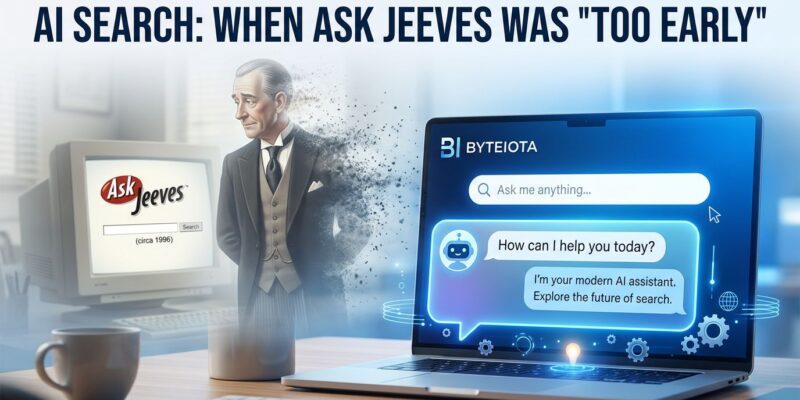
Ask.com, formerly Ask Jeeves, shut down on May 1, 2026, after 30 years online. The irony is brutal. Ask.com pioneered question-first, conversational search in 1996—exactly the model that ChatGPT, Perplexity, and Google AI now use. It failed to compete with keyword-based Google for two decades and died just as AI proved its vision was right all along. Ask.com didn’t fail because it was wrong. It failed because it was 25 years too early.
The Timeline: From Pioneer to Forgotten
Ask Jeeves launched in April 1997 with a radical idea: let users ask questions in natural language and get direct answers. While competitors like AltaVista and early Google demanded keyword searches, Ask Jeeves offered a conversational interface with a butler mascot representing helpful assistance. Type “What’s the weather in New York?” and get an answer, not a list of links. Revolutionary for 1996.
IAC acquired Ask Jeeves in 2005 for $1.85 billion, betting it could compete with Google. It couldn’t. By 2010, IAC chairman Barry Diller admitted defeat: “We’ve realized in the last few years you can’t compete head on with Google.” Ask.com shut down its independent crawler that year and became just a front-end for third-party results. Market share told the story: Ask.com held less than 2% of US search traffic while Google dominated with 65%.
On May 1, 2026, IAC pulled the plug entirely. The parent company exited the search business, and Ask.com posted a farewell message. After 30 years, the question-answering butler was gone.
The Irony: AI Search Returns to Ask.com’s Vision
Here’s what makes the shutdown brutal. Everything Ask.com promised in 1996 is winning today.
ChatGPT launched SearchGPT in late 2024 and fully integrated it by 2025. Users ask questions in natural language and get direct answers with web citations—exactly what Ask Jeeves promised. Perplexity, valued at $21.21 billion as of January 2026, does the same: question-first search with sourced answers. Even Google adopted the approach with AI Overviews, putting direct answers at the top of results instead of just blue links.
OpenAI’s revenue hit $2 billion per month in February 2026. Perplexity raised $200 million at a $20 billion valuation in September 2025. Conversational, question-first search is now a multi-billion-dollar market. The model Ask.com pioneered 30 years ago finally works—because the technology finally exists to execute it.
Ask.com was right. It just couldn’t survive long enough to see it.
The Lesson: Being Too Early Kills
Ask.com’s problem wasn’t vision. It was timing. Natural language processing in the 1990s couldn’t understand questions the way large language models do today. Keyword-based search was “good enough” and scaled better. Google won because it worked with the technology that existed, not the technology Ask.com needed.
Being too early is indistinguishable from being wrong. Ask.com isn’t alone in this trap.
Apple’s Newton launched in 1993 as a PDA with handwriting recognition. The tech wasn’t ready. Handwriting recognition failed, the device was too expensive ($699, equivalent to $1,165 today), and it died in 1998. Fifteen years later, the iPad succeeded where the Newton failed—same concept, mature technology.
WebTV launched in 1996 to bring web access to TVs via a $350 set-top box. The idea was sound. The infrastructure wasn’t. No broadband, limited app ecosystem, and no developer support killed it. Smart TVs and streaming devices proved the concept 15 years later.
Google Glass launched in 2013 with augmented reality and a built-in camera. Privacy concerns created the “Glasshole” stigma, and cultural resistance killed adoption. AR wearables are slowly gaining acceptance today, but Google Glass was a decade too early for the market to accept it.
All three had the right idea. All failed due to timing—technology, infrastructure, or culture wasn’t ready. Many succeeded later, but Ask.com didn’t. It shut down while its vision thrives.
What Developers Can Learn
Ask.com’s death raises an uncomfortable question: Which of today’s “innovative but struggling” technologies are Ask.com moments?
Meta is betting billions on VR and the metaverse. Too early or too wrong? Blockchain evangelists promise Web3 infrastructure will replace centralized systems. Future standard or permanent niche? Autonomous vehicle companies insist full self-driving is five years away—they’ve been saying that for a decade. Brain-computer interfaces like Neuralink sound futuristic. Are they 10 years out or 50?
The Ask.com test: Is the underlying technology mature enough? Is the infrastructure ready? Is the market culturally ready to adopt? Can you survive long enough for the market to catch up?
Ask.com pioneered conversational search but couldn’t survive 25 years until AI made it viable. The companies that execute question-first search today—ChatGPT, Perplexity, Google—aren’t Ask.com’s successors. They’re its vindicators. Ask.com died proving it was right, and that’s the lesson: Being right doesn’t guarantee success. Timing does.