 By ByteBot
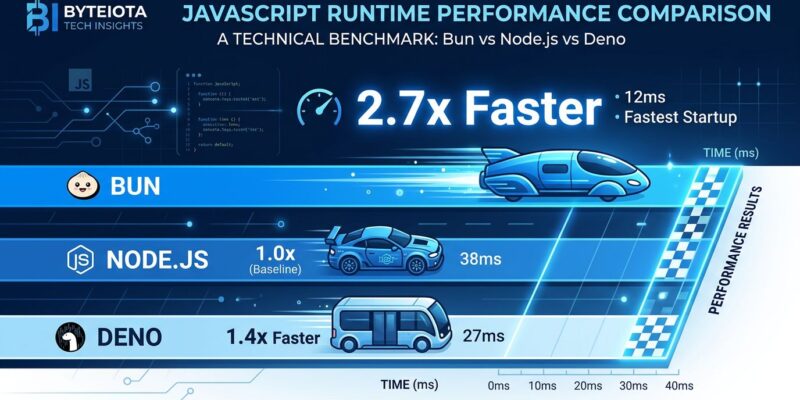
2026 JavaScript runtime benchmarks reveal a dramatic performance gap. Bun achieves 14,320 requests per second in HTTP tests—2.7x faster than Node.js (5,240 req/s) and 2.3x faster than Deno (6,180 req/s). Cold starts clock in at 31ms compared to Node.js’s 142ms, a 4.6x advantage critical for serverless deployments. However, the production story differs: Node.js maintains 90% market share with universal cloud support and 2 million npm packages, while Bun’s 4,700 open issues and memory leak reports temper its benchmark dominance.
The runtime choice in 2026 isn’t about what’s possible anymore—it’s about what’s optimal for your specific use case.
HTTP Performance: 2.7x Faster, But Why?
Bun processes 14,320 HTTP requests per second versus Deno’s 6,180 and Node.js’s 5,240 in standardized benchmarks (10,000 requests, 100 concurrent connections on AWS m5.xlarge instances). The performance gap stems from architectural choices: Bun’s JavaScriptCore (WebKit/Safari engine) combined with Zig runtime and io_uring for direct OS calls, versus Node.js’s V8 engine with C++ runtime and libuv abstraction layer.
The benchmark methodology measured requests per second, latency percentiles, and memory usage across REST APIs, WebSocket servers, and file processing. Bun averaged 7ms latency while Node.js hit 18ms. Yet in real production scenarios involving database queries, CDN latency, and third-party API calls, runtime overhead accounts for less than 5% of total request time.
For high-volume APIs handling hundreds of thousands of requests per hour, the 2.7x throughput advantage translates to meaningful infrastructure cost savings—fewer instances needed to handle the same load. But for typical CRUD applications where the database is the bottleneck, the real-world impact is minimal. Runtime choice matters most for edge and serverless with tight resource constraints.
Cold Start Performance: Serverless Game-Changer
Cold start times tell a different performance story. Bun wakes up in 31ms (process launch to request-ready), Deno in 87ms, and Node.js in 142ms. For serverless deployments where cold starts directly impact user experience, Bun’s 4.6x advantage over Node.js enables use cases previously impossible with traditional runtimes.
Production deployments at X (Twitter), Midjourney, Railway Functions, and Claude Code prove Bun’s serverless viability. Platforms like AWS Lambda and Cloudflare Workers prioritize sub-50ms cold starts for responsive edge deployments. Bun achieves 5-15ms in 2026 optimizations—well under the threshold.
However, Node.js’s V8 engine excels at sustained throughput for long-running processes. Servers running hours or days warm up code paths over time, and V8’s optimization strategy shines here. For traditional 24/7 servers, cold start performance is irrelevant. For edge functions spinning up on-demand, it’s everything.
Memory Usage: 40% Savings Equal Cloud Cost Reduction
WebSocket server benchmarks (5,000 concurrent connections) show Bun handling 67,800 messages per second using 620MB memory, versus Node.js’s 24,500 messages per second at 890MB. That’s 2.8x throughput with 30% less memory. File I/O benchmarks (processing 1,000 JSON files at 1MB each) reveal Bun completing the task in 11.2 seconds using 640MB peak memory, compared to Node.js’s 42.3 seconds at 1.2GB—3.8x faster with 47% less RAM.
JavaScriptCore’s aggressive garbage collection for short-lived objects typically saves 40% RAM versus V8-based runtimes for the same microservice workload. Bun’s Zig implementation with manual memory management provides fine-grained control Node.js’s C++ and V8 combination can’t match.
Cloud cost is directly tied to memory allocation. If Bun uses 40% less RAM for equivalent workload, you pay 40% less on Lambda or Cloud Run charged per GB-second. For cost-sensitive teams running hundreds of functions, this compounds to significant savings beyond raw performance gains.
Production Blockers: The Critical 5%
Bun achieves 95% npm package compatibility as of v1.3, but the missing 5% includes critical blockers: node-gyp compiled packages (native C++ addons), some database drivers (Prisma edge cases, certain Postgres drivers), and Worker Threads edge cases. Additionally, Bun has 4,700 open issues versus Node.js’s 1,700, with production teams reporting memory leaks in long-running processes and debugger crashes (the –inspect flag failing on every other breakpoint).
Anthropic shipped Bun 1.1.13 in April 2026 with 5% memory usage reduction and an upgraded allocator (Libpas scavenger) to fix memory leaks, but reports persist. JavaScriptCore versus V8 binary incompatibility means native addons don’t work at all—a fundamental architecture limitation, not a bug to patch.
Related: Bun Runtime Production Reality: 3 Critical Blockers in 2026
The production reality: 95% compatibility sounds great until you realize the 5% includes packages you probably depend on. Migration blockers aren’t obscure edge cases—they’re ORMs, database drivers, and debugging tools enterprises require. This explains why Node.js maintains 90% market share despite performance disadvantages.
Developer Experience: 18x Faster Package Installs
Package installation speed matters more than runtime performance for many development teams. Bun installs a medium-sized project in 1 second, pnpm in roughly 7 seconds, Deno in 17 seconds, and npm in 20 seconds. Bun’s 18-20x advantage over npm eliminates daily friction—faster install and reload cycles that compound over hundreds of development iterations.
pnpm achieves 2-3x faster installs than npm with 50-70% disk savings via a content-addressable store with hard links. Yarn 4 (Plug’n’Play) eliminates node_modules entirely using .pnp.cjs zip archives. But Bun’s all-in-one approach (runtime, package manager, bundler, and test runner) provides zero-config TypeScript, JSX, .env, and SQLite support out of the box.
Developers run package installs dozens of times daily. Twenty seconds versus one second compounds to hours saved weekly. CI/CD pipelines running hundreds of builds benefit even more. Package installation speed improvements impact daily workflow beyond runtime performance gains—a developer experience win independent of HTTP throughput numbers.
Choosing the Right Runtime in 2026
Runtime choice in 2026 is no longer about what’s possible (all three runtimes can do everything) but what’s optimal. Choose Bun for greenfield projects, speed-critical APIs, serverless and edge deployments with sub-10ms cold start requirements, and teams comfortable with occasional rough edges. Choose Node.js for enterprise and mission-critical apps, large teams, universal cloud deployment needs, and situations requiring 100% stability. Choose Deno for TypeScript-first architecture and security-critical apps with permission model requirements.
Production backing matters. X (Twitter), Midjourney, and Claude Code run Bun in production. Anthropic’s acquisition in December 2025 adds institutional support while maintaining the MIT license. However, Node.js dominates with support across ALL major cloud providers (AWS, GCP, Azure, Cloudflare) versus Bun’s “no official deployment options yet.”
The verdict for new projects: if you don’t have a specific reason to choose Node.js, choose Bun. The performance is better, the developer experience is better, and the compatibility gap is small enough that most teams will never hit it. But for enterprises requiring proven stability, Node.js’s 15-year track record beats benchmark advantages every time.
Key Takeaways
- Bun delivers 2.7x HTTP throughput, 4.6x faster cold starts, and 40% memory savings versus Node.js—real architectural advantages, not marketing claims
- Cold start performance determines serverless viability: Bun’s 31ms enables edge use cases Node.js’s 142ms can’t support
- The critical 5% npm incompatibility includes native C++ addons, some database drivers, and debugging tools—migration blockers for enterprise teams
- Node.js maintains 90% market share because production stability, universal cloud support, and 2 million packages outweigh benchmark performance for risk-averse organizations
- Choose based on priorities: Bun for greenfield speed-critical projects, Node.js for enterprise stability, Deno for TypeScript-first security
Runtime performance matters when it matches workload requirements. Benchmark advantages disappear when databases and third-party APIs become bottlenecks. The smart choice depends on whether your constraints are computational (choose Bun), operational (choose Node.js), or architectural (choose Deno).