 By ByteBot
Mercedes-Benz just admitted what drivers have been saying for years: touchscreens went too far. Starting with the 2026 GLC, the automaker is bringing back physical buttons and controls, with Chief Software Officer Magnus Östberg stating bluntly, “The data shows us physical buttons are better.” It’s not just Mercedes. Euro NCAP’s new safety regulations will penalize touchscreen-only vehicles starting this year, forcing the entire automotive industry to reverse a decade-long trend toward all-digital interfaces.
What’s Actually Changing
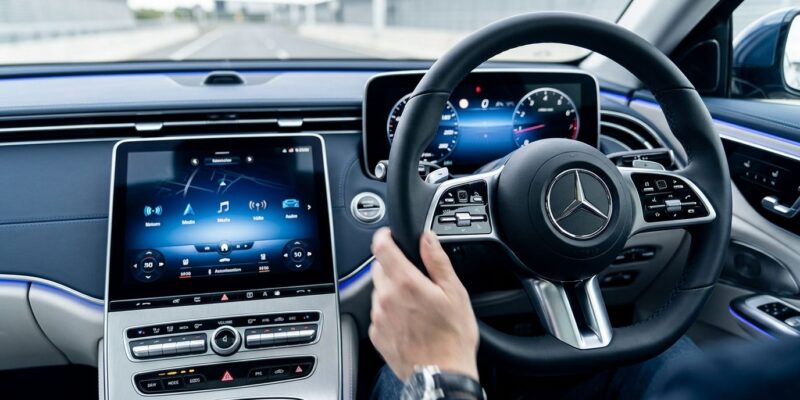
The 2026 GLC will be the first Mercedes model to get the new treatment, but the company is redesigning steering wheels across its entire lineup. Physical dials and rockers are coming back for adaptive cruise control, audio management, and climate controls—the functions drivers actually use while driving. Mercedes isn’t abandoning touchscreens entirely; the massive 39.1-inch MBUX Hyperscreen stays. They’re going hybrid: buttons for critical functions, touchscreens for everything else.
This shift isn’t optional. Euro NCAP’s 2026 safety protocols now require physical controls for five essential functions to earn a five-star safety rating: turn signals, hazard lights, horn, windshield wipers, and emergency SOS. Vehicles must hit 60% compliance this year, 70% in 2027, and 80% by 2028. The message is clear: touchscreen-only interfaces are a safety liability.
Why Touchscreens Are Dangerous
The data backs this up. Research on touchscreen safety shows drivers using touchscreens spend five seconds with their eyes off the road for every twenty seconds of driving, compared to just one second with physical buttons. That’s five times more distraction for the same task.
Climate control is particularly bad. Forty-one percent of glances to touchscreen climate controls exceed two seconds—the threshold Euro NCAP identifies as doubling crash risk. With physical buttons? Only 27% of glances cross that line. Some infotainment tasks demand up to 40 seconds of eyes-off-road interaction. Meanwhile, lane drift increases 42% when drivers interact with touchscreens, and lane departures jump 40%. One RAC survey found that a quarter of crash victims cited touchscreen systems as a contributing distraction factor.
The regulatory pressure exists because the stakes are life and death. Drivers with high distraction levels are 240% more likely to crash. Euro NCAP’s logic is simple: if a task takes twice as long on a touchscreen and pulls your eyes from the road five times longer, it doesn’t belong behind the wheel.
The Industry Follows
Mercedes isn’t alone. Volkswagen’s design chief Andreas Mindt went even further: “We will never, ever make this mistake any more.” His team is bringing back physical buttons for volume, fan speed, seat heating, cabin temperature, and hazard lights. Mindt’s philosophy? “It’s a car, not a phone.” Audi is ditching capacitive touch-sensitive controls, BMW is increasing physical buttons, and Porsche and Hyundai are expected to follow suit by the end of the year.
Tesla remains the notable holdout. The Model 3 and Model Y still route almost every function through the center touchscreen, including climate control, audio, and even windshield wipers. The company has faced NHTSA investigations over touchscreen reliability failures that disabled backup cameras, defrosters, and other safety-critical systems. When the touchscreen dies, so does access to basic vehicle controls. Tesla’s design-first philosophy hasn’t shifted, even as competitors reverse course.
What Went Wrong
The automotive industry spent the 2010s chasing smartphone aesthetics. Touchscreens were modern, minimalist, and cheaper to manufacture than physical buttons. They were also software-updatable, infinitely configurable, and eliminated “cluttered” dashboards. Physical buttons became stigmatized as dated, old-fashioned, not tech-forward enough.
But the tech industry’s digital-first dogma ignored fundamental truths about driving. Operating a vehicle isn’t like browsing Instagram. Safety-critical functions demand tactile feedback, instant recognition, and eyes-free operation. Touchscreens require visual confirmation for every action. There’s no haptic response when you adjust the temperature, no physical click when you change the volume. You have to look, find the button on a flat glass surface, press it, and verify the action succeeded. Every single time.
Consumer complaints started piling up around 2020. Drivers reported frustration, usability issues, and safety concerns. Studies confirmed what felt obvious: touchscreens increased cognitive load and eyes-off-road time. European regulators noticed crash data linking touchscreen distraction to accidents. The 2026 Euro NCAP deadline forced a reckoning the industry could no longer ignore.
The Tech Community Weighs In
The Mercedes announcement trended on Hacker News with 618 points and 354 comments, landing as the #5 story on May 4th. The overwhelming sentiment? Finally. Comments celebrated tactile feedback, safety-first design, and data-driven decisions. A minority defended touchscreens for their flexibility and aesthetics, but the dominant view supported physical controls for critical functions. Many called for a hybrid approach—exactly what Mercedes is delivering.
The discussion extended beyond cars. If touchscreens failed in automotive contexts, what about smart homes, appliances, and industrial equipment? The lesson resonates across the tech industry: not every physical interface should be replaced with a touchscreen. Some tasks benefit from tactile feedback, instant access, and eyes-free operation. Digital-first isn’t always user-first.
What Happens Next
Euro NCAP’s compliance deadlines will accelerate adoption across the industry. By 2027, expect nearly every major automaker to offer physical controls for essential functions. Mercedes is leading, but Volkswagen, Audi, BMW, and others are close behind. The pendulum is swinging back from touchscreen maximalism to hybrid pragmatism.
This is a rare moment where data, regulation, and consumer preference aligned to force change. The automotive industry spent a decade optimizing for aesthetics and cost over usability and safety. Magnus Östberg’s quote captures the shift perfectly: “The data shows us physical buttons are better.” Sometimes the simplest answer is the right one.