 By ByteBot
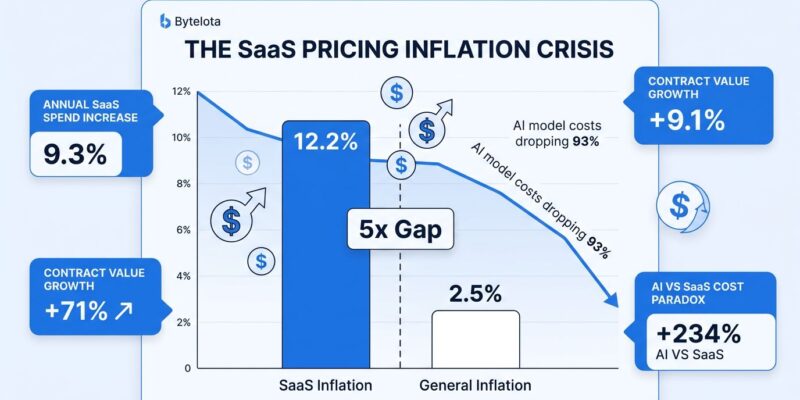
Software vendors are raising prices at 12.2% annually—nearly 5 times faster than the 2.5% general inflation rate in G7 countries. Microsoft is increasing M365 prices by 9-33% starting July 2026, ServiceNow charges 25-60% premiums for AI add-ons, and companies are now spending an average of $1.2M on AI-native apps (a 108% year-over-year increase). Here’s the paradox: AI model costs have dropped 93% in two years (ChatGPT API from $0.03 to $0.002 per 1K tokens), yet software suites embedding those models are getting exponentially more expensive. This isn’t market dynamics—it’s vendor exploitation.
The Software Inflation Tax: 12.2% vs 2.5%
SaaS inflation hit 13.2% in March 2026, up 2 percentage points from March 2025, according to Vertice’s SaaS Inflation Index tracking over $30 billion in global spend. Per-employee SaaS costs reached $9,100 in 2025, up 15% from $7,900 in 2023. Consequently, companies are paying 12% more for software while getting 2.5% value from actual economic inflation—the other 9.5% is pure vendor margin expansion.
This “software inflation tax” diverts funds from innovation to maintenance. A typical organization now spends $1 in every $8 on SaaS, and 70% of IT budgets go to “keeping the lights on” rather than building new capabilities. Meanwhile, 60% of vendors deliberately mask their price increases through shrinkflation—reducing value without corresponding price decreases. Moreover, Vertice found 28% of Q4 2025 renewals reflected reduced features, downgraded support, or tightened SLAs without any pricing relief.
The gap isn’t subtle. Technology budgets are shrinking in real terms while nominal spending climbs. CFOs justify larger IT budgets to boards, but the purchasing power declines annually. This is vendor tax extraction, not value creation.
AI Models Get 93% Cheaper, Software Gets 15% More Expensive
The AI pricing paradox exposes the exploitation. ChatGPT API pricing dropped from $0.03 per 1,000 tokens in 2024 to $0.002 in 2026—a 93% cost reduction, according to AI Empire Media’s 2026 pricing analysis. OpenAI cut GPT-4 API prices by 60%, Anthropic slashed Claude 3.5 Sonnet by 50%, and Google made Gemini 1.5 Pro nearly free for developers. Furthermore, infrastructure costs followed: H100 GPU hours dropped from $5+ to $3.
Yet Microsoft is raising M365 prices 9-33% across commercial plans (July 2026), ServiceNow charges 25-60% premiums for AI features, and Adobe bundles Firefly AI into Creative Cloud with no opt-out. The cost structure gap is glaring: vendors’ AI infrastructure costs are plummeting 40-70% while they raise customer prices 12%+. They’re pocketing the savings instead of passing them through.
Microsoft’s justification? “This change reflects the significant innovation delivered over the last several years and the expanded value customers will gain with new additions to the suites, including major advancements in security and IT management.” Translation: we’re bundling AI features you didn’t ask for and charging 15% more whether you use them or not. ServiceNow won’t even sell you AI add-ons unless you upgrade your entire deployment to Pro Plus first—a forced 40-60% upsell before the AI premium even kicks in.
The “AI enhancements” narrative is profit maximization dressed as innovation. Customers pay 5x inflation rates for features built on 93% cheaper infrastructure. Follow the money.
78% Report Unexpected Charges: The Token-Based Pricing Trap
Consumption-based pricing was marketed as “pay for what you use,” but 78% of IT leaders now report unexpected charges according to Zylo’s research. What looks fair on paper becomes budget chaos in practice. Here’s the trap: vendors set “generous” included limits at contract signing, customers use 80% in year one (no overages), then usage grows to 120% in year two triggering automatic tier jumps and 40% cost spikes.
Adobe Firefly demonstrates the pattern. Creative Cloud Pro includes 4,000 generative credits per month. However, power users average 6,000. The overage: 2,000 credits at $0.005 each equals $10/month, or $120/year per user. Multiply by 100 designers and that’s $12,000 in annual costs that weren’t budgeted. Token-based pricing eliminates predictability—companies budgeting $50K for API usage get billed $73K with no warning or caps.
Consumption pricing now dominates: 77% of large SaaS providers use token or usage-based models. The pitch was flexibility; the reality is vendors optimizing for higher consumption revenue through tier traps and overage fees. Next renewal, those limits tighten (“our pricing model evolved”), forcing permanent tier upgrades. Pay for what you use becomes pay more than you budgeted.
Why You Can’t Just Walk Away: The $2-5M Switching Cost Problem
Switching costs for enterprise SaaS range from $2-5M plus 12-18 months of migration work. Vendors know this and price accordingly. Microsoft 365 for 10,000 users currently costs $9.6M/year ($80/user/month). The July 2026 increase (13% average) pushes that to $10.85M/year—an additional $1.25M annually. Switching to alternatives costs $2-3M in migration plus business disruption. Microsoft knows you’re trapped, so they price like it.
ServiceNow weaponizes lock-in through pricing tiers. Want AI features? You can’t buy Now Assist on Standard or Pro editions. You must upgrade your entire deployment to Pro Plus first (40-60% premium), then pay the AI add-on ($15-25/user/month additional). Total increase for AI access: 85-128%. If you’ve built ITSM workflows on ServiceNow for five years, you’re not switching—and they know it.
Auto-renewal clauses compound the problem. 80% of SaaS contracts auto-renew with price increases baked in, and notification windows are 60-90 days. Additionally, major vendors have rewritten renewal price protection clauses to undermine traditional customer safeguards, according to UpperEdge’s contract analysis. Lock-in gives vendors pricing power, and they exploit it at every renewal.
Negotiation Strategies That Actually Work
Despite vendor leverage, customers can push back effectively. Start renewal negotiations 12-18 months early—not 90 days before expiration. Document unused license waste: the average organization wastes 45.7% of SaaS licenses. Use that data to right-size contracts. “We pay for 10,000 seats but 4,570 are unused. Right-size to 5,500 or we evaluate alternatives.”
Calculate switching costs transparently and use them as negotiation leverage. “Migration costs us $500K. Your increase is $1M/year. We’ll switch unless you reduce the price.” This makes switching viable in year two, forcing vendors to compete on price. Companies that negotiate typically secure 10-30% discounts, but 60% of organizations don’t negotiate at all—they accept vendor pricing as fixed. It’s not.
Demand unbundling of AI features. “We’ll pay for Copilot when our users actually use it, not as a mandatory tax on the base product. Show us usage data proving AI value or separate it from the subscription.” Challenge every “AI enhancement” justification with ROI evidence. If vendors claim AI features justify 15% increases, demand measurable business outcomes.
Negotiate price escalation caps in multi-year contracts: 3-5% maximum annual increases. This prevents vendors from imposing 20%+ hikes in year two. The 2-3 year contract with escalation caps beats 5+ year locks that give vendors unlimited pricing power.
Key Takeaways
- SaaS inflation (12.2%) is 5x higher than general inflation (2.5%)—a “tax” on tech budgets that diverts funds from innovation to maintenance.
- AI models are 93% cheaper, but software suites are 15% more expensive—vendors’ costs are dropping 40-70% while they raise customer prices 12%+. This is profit maximization, not value creation.
- Consumption pricing creates hidden costs: 78% of IT leaders report unexpected charges. Token-based models eliminate budget predictability through tier traps and automatic escalations.
- Lock-in gives vendors pricing power: Switching costs ($2-5M, 12-18 months) make alternatives prohibitive. Vendors exploit this leverage at every renewal.
- Negotiate early and aggressively: Start 12-18 months before renewal, document license waste (45.7% average), demand price caps (3-5%), and challenge AI bundling. 10-30% discounts are typical for those who push back.
The software inflation tax isn’t inevitable—it’s negotiable. Vendors count on customers accepting “AI enhancements” without scrutiny. Don’t. Push back.