 By ByteBot
Zed editor released Parallel Agents TODAY, April 22, 2026, enabling developers to orchestrate multiple AI agents running concurrently in the same window. This makes Zed the first and only AI code editor with native parallel agent support. While Cursor, Windsurf, and other competitors remain single-threaded—blocking your workflow when one agent is busy—Zed lets you run multiple agents simultaneously: one refactoring backend architecture, another updating frontend components, a third writing tests. All at Zed’s trademark 120fps performance.
How Parallel Agents Work: The Threads Sidebar
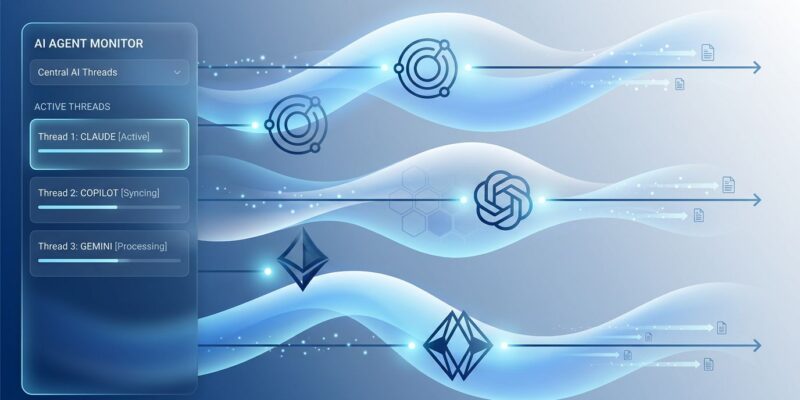
The Threads Sidebar is Zed’s control center for managing concurrent AI agent threads. Open it with option-cmd-j on macOS or ctrl-option-j on Linux and Windows. From here, you can launch new threads, assign different agents to each thread, set folder and repository permissions, and monitor all executions in real-time.
Here’s the power: mix and match agents per thread. Run Claude Code on your backend refactoring, GitHub Copilot CLI on frontend work, and Gemini CLI on documentation—all simultaneously. Zed supports any agent compatible with the Agent Client Protocol (ACP), an open standard under Apache license. No vendor lock-in, no proprietary nonsense.
Worktree isolation prevents conflicts. Each agent operates in its own context—you control which folders and repositories it can access. Zed has successfully tested “hundreds of threads” running concurrently while maintaining 120fps responsiveness. That’s not a typo: hundreds of threads, buttery smooth performance. Compare that to Cursor or Windsurf, which block your entire workflow when their single agent is thinking.
Real-World Use Cases: Why You Need This
Single-threaded AI editors force you into sequential workflows. You ask Cursor to refactor your API routes, and while it grinds away for three minutes, you’re stuck waiting. With Zed parallel agents, that’s over.
Concrete scenario: You’re building a new feature across backend and frontend. Launch three threads. Agent 1 refactors your Express API routes to handle the new data model. Agent 2 updates your React components to consume the new API shape. Agent 3 writes integration tests covering both changes. All three run concurrently. When you check back in five minutes, you have a complete, tested feature ready for review—not one-third of it with two agents queued.
Another use case: multiple solution exploration. Feed the same complex architectural problem to three agents in parallel—Claude 4, GPT-5, and Gemini—and compare their approaches side-by-side. This isn’t theoretical. One developer rebuilt a Game Boy emulator on web using five parallel agents in 48 hours: four Codex agents tackling core emulation tasks, one dedicated to testing, with a continuous review-and-merge loop. Try that workflow in a single-threaded editor.
Background task execution eliminates interruptions. Start a complex refactoring in one thread and let it run in the background while you continue coding in your foreground thread. No blocking, no context switching, no productivity loss. For monorepo workflows, assign one agent per package or service, each isolated in its own worktree. Changes merge cleanly back into main without conflicts.
Competitive Landscape: Zed’s Unique Advantage
Zed is currently the ONLY AI code editor with native parallel agent support. Cursor? Single-threaded. Windsurf? Single-threaded. Antigravity, Kiro, all the rest? Single-threaded. If you need concurrent agent workflows in April 2026, Zed is your only option.
The performance gap is massive. Zed’s Rust-native architecture delivers 0.4-second startup time and 2-millisecond input latency. It maintains 120fps even with multiple agents executing. One developer on Hacker News described it: “Multibuffer editor and 120fps resizing is orgasmic.” Cursor and Windsurf, both VS Code forks, can’t match this—they’re hamstrung by Electron’s architecture.
Cursor offers the best all-around integrated experience for single-threaded workflows, particularly for large codebases with its @codebase indexing and Composer multi-file edits. Pricing runs $20 to $60 monthly depending on usage. Windsurf features Cascade, the most autonomous agent available, but reliability issues persist—developers report recurring Cascade errors that push them away. Zed takes a different approach: free editor, bring your own external agent (Claude Code, Copilot CLI, etc.). Total cost runs around $200 monthly if you’re using Claude Code heavily, but you get unmatched performance and the only parallel agent implementation available.
Agentic Engineering: Human Plus AI, Not AI Replaces Human
Nathan Sobo, Zed’s co-founder and former Atom creator, champions “agentic engineering”—combining human craftsmanship with AI tools rather than pursuing full automation. His three rules: plan first so you know what you’re building, stay engaged so you never lose the thread, and review the output so you can stand behind what ships.
This philosophy directly opposes competitors’ approaches. Windsurf’s Cascade markets itself as “the most autonomous AI agent”—it tries to do everything for you. Zed positions you as the conductor and agents as your orchestra. You orchestrate multiple agents on different tasks while maintaining oversight. The difference matters. As Sobo puts it: “Engineers are solely responsible for the quality of what they build. Must develop judgment about when AI improves outcomes and when it doesn’t.”
Parallel agents amplify this philosophy. You’re not delegating control to one autonomous agent and hoping it makes good decisions. You’re directing multiple specialized agents, each focused on a specific task you’ve designed, each operating within constraints you’ve defined. Focus on the thinking; let agents do the typing.
Industry Trend: Multi-Agent Workflows as 2026 Standard
Parallel agents aren’t a niche power-user feature. They’re part of 2026’s defining trend: multi-agent architectures as the standard for AI coding. Anthropic’s 2026 Agentic Coding Trends Report identifies multi-agent orchestration as a core pattern, where orchestrators coordinate specialized agents working in parallel, each with dedicated context, synthesizing results into integrated output.
Applications like Conductor and Verdent AI explicitly support running tasks in parallel—define a task, let an LLM execute it in the background while starting a new task. Community adoption is accelerating. When Opus 4.5 released, developers reported that “parallel agents stopped needing so much babysitting—now running 3-4 at once.” Best practices are emerging from thousands of hours of experimentation.
The future direction is clear: IDEs will evolve from text editors into control centers for managing autonomous engineering agents. Zed released parallel agents first, in April 2026, positioning itself as the early mover. Its open-source, agent-agnostic approach via the Agent Client Protocol creates an ecosystem advantage—any agent can plug in, no proprietary barriers. Performance matters more as agent count increases, and Zed’s Rust architecture handles concurrency better than Electron-based competitors ever will.
Get Started Today
Zed parallel agents are available now in the latest release. Download Zed, open the Threads Sidebar with option-cmd-j, and launch your first set of parallel agents. Start with a simple test: run two agents on different parts of your codebase simultaneously and watch them execute concurrently at 120fps. Then scale up. The “hundreds of threads” ceiling is far beyond what most developers will ever need.
Other editors will eventually add parallel agent support—Cursor and Windsurf can’t ignore this capability forever. However, Zed has first-mover advantage, the performance architecture to handle it best, and an open ecosystem that lets you choose any agent you want. If you’re serious about agentic workflows in 2026, this is where the industry is heading. Zed just got there first. Check out this detailed comparison of AI code editors to see how Zed stacks up against competitors.