 By ByteBot
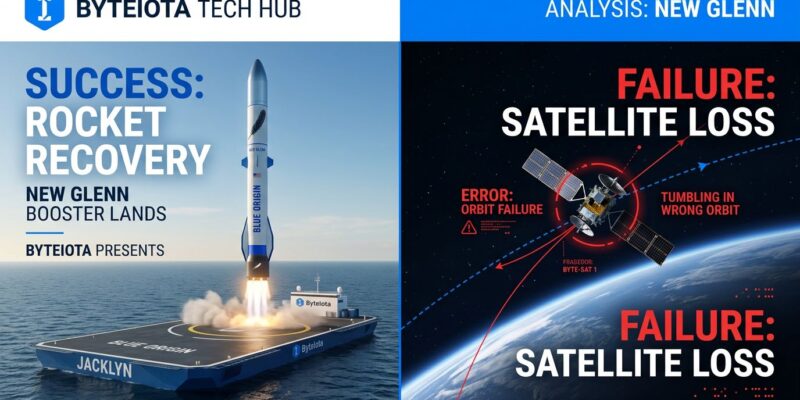
Blue Origin achieved a historic milestone on April 19, 2026—successfully reusing its New Glenn rocket’s first-stage booster for the first time. The booster landed perfectly on the ocean platform “Jacklyn” six minutes into flight. But the mission was a complete failure. The upper stage malfunctioned during orbital insertion, dumping AST SpaceMobile’s $30 million BlueBird 7 satellite into an unusable orbit. The satellite will be de-orbited as space junk. Blue Origin saved the rocket but lost the payload—the wrong kind of “first.”
This isn’t just a space industry failure. It’s a cautionary tale about optimizing for the wrong metrics. While Blue Origin celebrated the booster landing, their customer lost $30 million. The space industry obsesses over reusability milestones like booster landings and reuse counts, but mission success rate is what customers actually pay for.
What Actually Happened: Two Outcomes
The NG-3 mission tells two contradictory stories. The first-stage booster “Never Tell Me the Odds”—previously flown in November 2025—separated cleanly 3.5 minutes into flight and stuck its landing on the ocean platform six minutes later. Blue Origin joined SpaceX and Rocket Lab in the orbital reusability club. A genuine technical achievement.
Simultaneously, the upper stage was failing catastrophically. One of two BE-3U engines underperformed during its second burn, placing the BlueBird 7 satellite into an orbit of 154 km x 494 km—far too low to sustain operations. AST SpaceMobile declared the satellite a total loss within hours. Blue Origin CEO Dave Limp acknowledged: “While we are pleased with the nominal booster recovery, we clearly didn’t deliver the mission our customer wanted.”
The Federal Aviation Administration grounded New Glenn the next day. Blue Origin’s ambitious 2026 launch schedule—8 to 12 launches—now faces months of delays. The company must identify why the engine “didn’t produce sufficient thrust” before flying again. Every day grounded pushes commercial customers toward SpaceX.
SpaceX Did Blue Origin’s First Reuse Right—Nine Years Ago
When SpaceX attempted its first Falcon 9 booster reuse on March 30, 2017—the SES-10 mission—they succeeded at both objectives. The booster landed successfully, and the SES-10 communications satellite reached its intended orbit perfectly. The satellite is still operating nearly a decade later. SpaceX proved reusability could work without compromising mission reliability.
Nine years later, Blue Origin achieved the booster reuse milestone but failed where SpaceX succeeded: delivering the customer’s payload. The comparison is devastating. Blue Origin is 11 years behind SpaceX in operational reusability. SpaceX has reused boosters over 300 times with high mission success. Blue Origin has one reuse attempt: zero successful missions.
This widens SpaceX’s competitive moat. Proven reliability plus operational reusability is nearly impossible to compete against. Blue Origin’s commercial customers—Amazon Project Kuiper planning 61 satellites per launch, the $2.4 billion Space Systems Command contract, Eutelsat, OneWeb, Telesat—now face a question: stick with Blue Origin or shift to the proven provider?
The Industry’s Wrong Metrics Problem
Media coverage of NG-3 exposes an industry-wide obsession with the wrong metrics. Headlines emphasized “first booster reuse” while burying “$30 million satellite lost.” Space.com’s headline literally read: “Blue Origin reuses huge New Glenn rocket for 1st time, lands booster at sea — but deploys satellite into wrong orbit.” Achievement first, catastrophic failure second.
This metrics fixation mirrors software development’s worst habits. We optimize for vanity metrics—code coverage, commit velocity, lines of code—instead of actual value delivery: working features, customer satisfaction, reliability. Blue Origin scored high on intermediate metrics (booster landed! reuse achieved!) while failing completely on the actual goal (payload delivered to orbit).
Reusability is a cost-reduction mechanism, not the mission itself. Customers pay for payload delivery, not booster recovery. The goal is reliable, affordable orbital delivery. Blue Origin optimized for the wrong success criterion, and their customer paid with a $30 million satellite floating uselessly in the wrong orbit.
What This Means for Blue Origin’s Future
Blue Origin is now in a race against time and money. The FAA investigation could take weeks or months. The 2026 launch schedule is toast—there’s no path to 8-12 launches this year with months of delays. The next mission, Amazon’s Project Kuiper satellites scheduled for mid-2026, sits grounded. So does NASA’s Blue Moon lunar lander.
Meanwhile, customers are watching. AST SpaceMobile publicly stated that BlueBird 8-10 satellites are “ready to ship in about 30 days”—a signal they’re looking at alternative launch providers. When you’ve lost a $30 million satellite, you reconsider your launch provider. SpaceX, with its proven track record and weekly launch cadence, becomes very attractive.
Blue Origin needs consecutive successful missions to prove commercial viability. They’re grounded after mission three with a 0% mission success rate on reused boosters. Every month of delay pushes customers toward competitors. The engineering lesson is stark: you can afford test flight failures, but you cannot afford to fail on your first real customer mission.
Measure What Actually Matters
Blue Origin achieved a technical milestone (booster reuse) but failed commercially (lost customer payload). The space industry celebrated an intermediate metric while ignoring the actual outcome. This pattern shows up everywhere in engineering: shipping features with bugs, hitting sprint velocity targets while missing deadlines, achieving 100% test coverage on broken code.
The lesson for developers is clear: measure what customers actually value. Mission completion, not booster recovery. Working features, not story points completed. Reliable uptime, not deployment frequency. System complexity requires balancing multiple success criteria, but some metrics matter more than others. Optimizing for the wrong one—like Blue Origin did—leads to hollow victories and actual failures.
Blue Origin saved the rocket but lost the mission. That’s not reusability—it’s just expensive recycling.