 By ByteBot
Ursa Ag, an Alberta-based startup gaining traction this week, is selling agricultural tractors with zero electronics at roughly half the price of competitors—$95,000-$146,000 versus $200,000+ for comparable John Deere models. Their tractors feature 12-valve Cummins diesel engines with mechanical fuel injection that any mechanic can repair, no proprietary software required. The story climbed to 889 points on Hacker News yesterday because developers recognize the parallel: microservices consolidating back into monoliths, cloud costs driving infrastructure rethinking, and framework bloat forcing teams to question whether adding technology solves problems or creates maintenance debt. The timing couldn’t be better. John Deere just settled a $99 million right-to-repair lawsuit on April 9, 2026, and 42% of organizations are consolidating their microservices back into modular monoliths. Sometimes removing technology creates more value than adding it.
The Business Model: Zero Electronics at Half Price
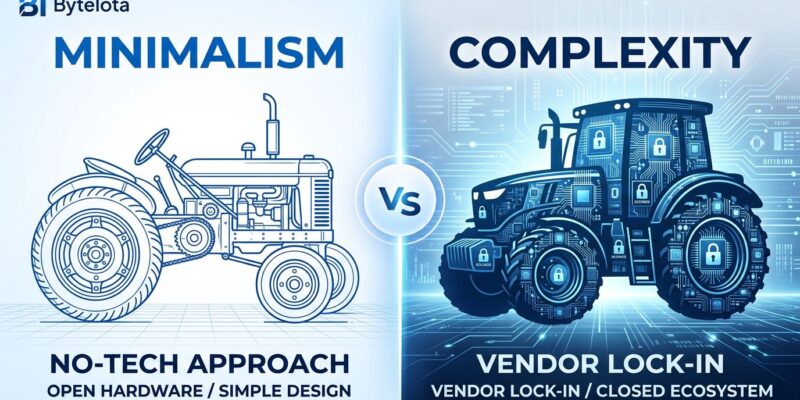
Ursa Ag’s no-tech tractors eliminate every electronic system. No proprietary software. No electronic diagnostics. No computer-controlled components. Every control—hydraulics, steering, throttle—is mechanically connected. The result: equipment serviceable by any diesel mechanic, not just authorized dealers with manufacturer-specific laptops.
The pricing proves tech minimalism can win commercially. Their 150-horsepower model sells for $95,156 USD, the 180-hp for $109,807, and the 260-hp for $146,434. These tractors cost roughly half what John Deere charges for comparable models. The engines are remanufactured 12-valve Cummins units—1990s technology with aftermarket parts available everywhere. Owner Doug Wilson’s philosophy: equipment should be “affordable and serviceable by third-party shops.” Following media coverage, the company received over 400 US inquiries and plans to produce more tractors in 2026 than its entire company history combined.
The comparison to software architecture is striking. Complexity isn’t free. Every abstraction layer, every microservice, every framework adds operational overhead. Ursa Ag stripped that overhead and cut costs in half.
The John Deere Problem: When Tech Becomes Lock-In
John Deere controls 90% of the tractor market alongside CNH Industrial, and they’ve used proprietary software to prevent farmers from repairing their own equipment. The backlash culminated in a $99 million class-action settlement announced April 9, 2026—just two weeks ago. The settlement forces John Deere to provide repair tools to farmers for the next 10 years. The FTC lawsuit filed in January 2025 continues through discovery.
The problem runs deeper than legal battles. Farmers can’t diagnose error codes without dealer-only software. During critical harvest windows when every hour of downtime costs thousands of dollars, they wait days for factory technicians with laptops to arrive. As one Hacker News commenter put it: “Downtime—the thing that actually costs a farmer money during planting or harvest—shrinks dramatically when you don’t need a factory technician with a laptop.”
Vendor lock-in isn’t theoretical. It’s a $99 million liability. For developers, the lesson is clear: proprietary systems that prevent user control create long-term backlash. Open, repairable solutions win when users value autonomy over features.
Related: Adobe Firefly AI Assistant: Creative Agents and Lock-In
Developer Parallels: Microservices to Monoliths, Complexity to Simplicity
The no-tech tractor story mirrors 2026 software architecture trends. Forty-two percent of organizations are consolidating microservices back into modular monoliths to reduce complexity and operational overhead. Teams are questioning cloud costs, framework bloat, and whether adding another abstraction layer solves problems or creates maintenance debt. The Hacker News discussion’s 889 points prove developers see the connection: sometimes removing complexity is progress.
Modular monoliths gained traction because they deliver “the simplicity of one codebase and runtime while avoiding the extra load of a distributed system.” Organizations discovered the hard way that microservices add operational overhead—monitoring 47 services instead of one codebase, debugging distributed failures, managing service mesh complexity. The architectural pendulum swung back toward simplicity.
One Hacker News commenter captured the philosophy perfectly: “Computers and software enable lock-in because of their flexibility. Removing them makes vendor lock-in much more difficult or even impossible.” The insight applies beyond agriculture. Before adding another microservice, framework, or cloud service, ask: does this add value or maintenance burden?
Strategic Minimalism: The Modular Approach Wins
The winning strategy isn’t rejecting all technology. It’s making technology optional rather than mandatory. Ursa Ag provides a simple mechanical base that farmers can retrofit with open-source precision agriculture systems like AgOpenGPS via tablets. This modular approach lets users control what technology to add instead of being forced into vendor ecosystems.
The Hacker News discussion revealed farmers already retrofit older equipment with open-source systems. One commenter observed: “Low-tech tractors could become a hotbed for open source experimentation.” Another asked: “How many third parties might be able to bring upgrades and modifications to a ‘dumb’ tractor versus only being able to buy from one vendor?” The answer: dozens instead of zero. Farmer autonomy replaces vendor dependency.
For developers, the parallel is direct. Instead of bundling everything into a monolithic vendor approach, provide simple foundations with optional add-ons. Users value control over forced features. This is why modular monoliths are winning over mandated microservices. Build the simple core. Let teams add services when they clearly deliver value, not because the architecture demands it.
When Tech Minimalism Makes Sense: A Decision Framework
Tech minimalism wins when maintenance matters more than features, longevity trumps cutting-edge capabilities, repairability adds tangible value, and users want control instead of vendor dependence. Ursa Ag tractors are expected to last 50+ years. One Hacker News commenter put it simply: “This tractor will last 50 years and maybe more. Your grandchildren will be able to still use it.” Meanwhile, modern John Deere electronics become obsolete in 10-15 years.
The trade-off is stark. Farmers choosing Ursa Ag pay off equipment in 5-6 years instead of 15 for John Deere financing. They accept fewer features—no auto-steer, no telemetry, no precision agriculture out of the box—for independence. The 1940s-1970s tractors still operational today prove the model: one commenter’s in-laws use a 1939-1954 Farmall H that “just runs” with only oil changes.
For software teams, apply the same framework. Choose modular monoliths over microservices when maintenance costs exceed scalability benefits. Choose on-premises over cloud when operational overhead outweighs architectural benefits. Choose simple frameworks over complex ones when team size doesn’t justify the learning curve. Ursa Ag’s commercial success provides the decision template: strip complexity until you hit the minimum viable architecture that solves the actual problem.
The $99 million John Deere settlement and the 42% microservices consolidation rate tell the same story. The industry is re-learning that complexity has costs. Strategic minimalism isn’t anti-progress. It’s asking whether this technology adds value or maintenance debt before adding it to production.