 By ByteBot
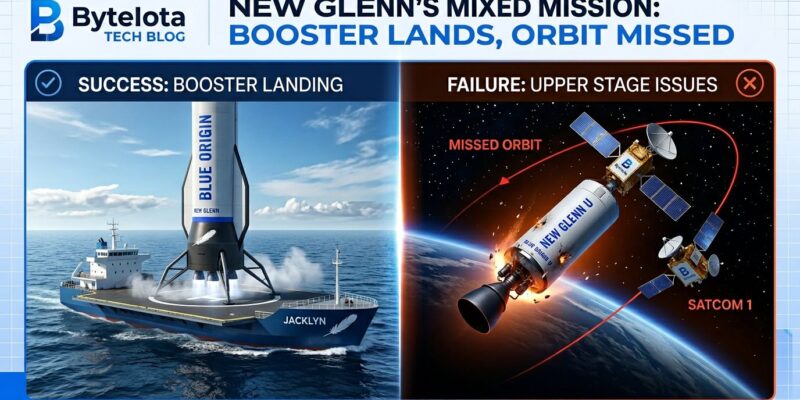
Blue Origin achieved a spaceflight milestone on April 19, 2026 – successfully reusing a New Glenn rocket booster for the first time, just five months after its first landing and on only the third flight overall. But the celebration lasted hours: the upper stage malfunctioned, placing customer satellite BlueBird 7 into an orbit too low to sustain operations. The multimillion-dollar communications satellite will be de-orbited as a total loss. In one mission, Blue Origin demonstrated both the promise and peril of moving fast in commercial spaceflight.
The Achievement: Faster Than SpaceX
Blue Origin’s accomplishment is genuinely impressive. The company reused a New Glenn booster just five months after its first successful landing in November 2025. For context, SpaceX took 16 months from its first Falcon 9 landing to its first reuse. The same booster that launched NASA spacecraft toward Mars last fall returned Sunday to a drone ship in the Atlantic Ocean, approximately 10 minutes after liftoff.
This was New Glenn’s third flight since its January 2025 debut – a rocket that’s been in development for over a decade. Achieving booster reuse this quickly signals Blue Origin’s engineering sophistication and ambition to close the gap with SpaceX’s proven reusability model. The first stage, powered by seven BE-4 engines and designed for up to 100 flights, performed flawlessly.
The Failure: Upper Stage Malfunction
Then came the upper stage failure. Roughly two hours after launch, Blue Origin confirmed that AST SpaceMobile’s BlueBird 7 satellite had been placed into an “off-nominal orbit” – aerospace speak for “wrong altitude.” The satellite separated from the rocket and powered on successfully, but the orbit was too low for its onboard thrusters to correct.
BlueBird 7 is no small payload. With a communications array spanning roughly 2,400 square feet – one of the largest ever deployed in orbit – the satellite was designed to provide direct 4G and 5G connectivity to standard smartphones from space. AST SpaceMobile (NASDAQ: ASTS) confirmed the satellite cost will be recovered under its insurance policy, but the operational loss delays the company’s plan to deploy approximately 45 satellites by the end of 2026.
This marks New Glenn’s first payload failure after two successful missions. For a commercial launch provider, customer confidence is built launch by launch over years. Losing a customer payload on your third flight – even with insurance covering the cost – isn’t ideal optics.
The Speed Question
Blue Origin’s rapid path to reuse raises an uncomfortable question: did they move too fast?
SpaceX took longer to achieve reuse, but that patience came with more total flights and extensive testing before putting customer payloads at risk with reused hardware. When SpaceX finally reused a booster in March 2017, it had refined the process through iteration. Blue Origin compressed that timeline dramatically – impressive from an engineering standpoint, but now facing the first-failure reality check.
This isn’t to say Blue Origin made the wrong call. SpaceX also experienced failures during its Falcon 9 evolution, including high-profile explosions that grounded the fleet. Rapid iteration is how you compete in commercial space. But there’s a difference between test payloads and paying customers. AST SpaceMobile’s satellite was neither.
The commercial space launch market is projected to grow from $24 billion in 2026 to over $70 billion by 2035, driven largely by reusable launch technology. Success rates matter: SpaceX maintains above 95% success rates, which built the customer trust that now dominates the industry. Blue Origin is currently at 67% after three flights – early days, but every mission counts.
Move Fast and Break Things… in Space?
Silicon Valley’s “move fast and break things” ethos works when you’re iterating on software. Breaking things in space looks different when a real company loses a real satellite worth millions. The paradox of this mission – historic achievement paired with first failure – reveals the tension in modern commercial spaceflight.
Blue Origin is playing catch-up after a decade of SpaceX dominance. To compete, they need to prove reusability quickly. But customer confidence takes years to build and seconds to destroy. Insurance covers the hardware cost, but how many launch customers will trust a provider with a 67% success rate when SpaceX offers 95%?
The upper stage malfunction investigation is ongoing. Blue Origin hasn’t disclosed technical details yet. What matters now is how the company responds: do they slow down, add more testing, and prioritize reliability? Or do they push forward with rapid iteration, accepting early failures as the cost of accelerating development?
What’s Next
Blue Origin faces a credibility test. Two successful missions established momentum. One payload failure doesn’t erase that, but it complicates the narrative. The company announced plans for a Vandenberg launch facility on April 14 to enable polar orbit missions, signaling continued expansion despite this setback.
For Blue Origin, this mission crystallizes a hard truth about commercial spaceflight: you can achieve engineering milestones and still lose the customer. The booster reuse proves the technology works. The payload loss proves the technology isn’t mature yet. Both can be true.
The question is whether Blue Origin has the patience – and funding – to turn promise into reliability before customers lose faith.