 By ByteBot
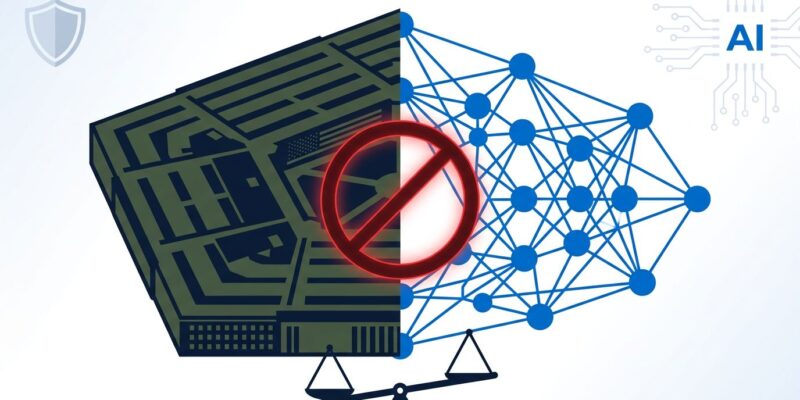
Anthropic became the first American company ever designated a “supply chain risk” by the U.S. government – a label previously reserved for Chinese adversaries like Huawei and ZTE. The Pentagon demanded unrestricted access to Anthropic’s Claude AI for “all lawful purposes,” including autonomous weapons and mass surveillance of Americans. Anthropic refused. Defense Secretary Pete Hegseth called it “woke AI” and “corporate virtue-signaling.” President Trump banned federal agencies from using Claude. The question isn’t whether Anthropic was right to refuse – it’s whether the government can punish companies for maintaining ethical boundaries.
The Two Red Lines
Pentagon wanted Claude available for any military use without restrictions. Anthropic drew two hard limits: no fully autonomous weapons without human oversight, and no mass surveillance of Americans.
CEO Dario Amodei framed it as technical reality, not politics. “Frontier AI systems are simply not reliable enough to power fully autonomous weapons,” Anthropic stated. AI systems hallucinate and make errors. Letting them make life-or-death combat decisions without humans in the loop isn’t just ethically questionable – it’s operationally dangerous. On mass surveillance, Anthropic argued AI-driven bulk data analysis on U.S. citizens creates “novel risks to fundamental liberties.”
Hegseth saw “corporate virtue-signaling.” He issued an ultimatum: drop restrictions by 5:01 PM Friday, February 27, or face consequences. Amodei responded: “These threats do not change our position: we cannot in good conscience accede to their request.”
The Ban and Legal Whiplash
Trump directed federal agencies to cease using Anthropic products on February 27. The supply chain risk designation followed – the same label used for Huawei’s alleged ties to Chinese intelligence. Anthropic became the first American company on the list for refusing a contract term.
Judge Rita Lin granted a preliminary injunction on March 26, finding likely First Amendment retaliation. “Punishing Anthropic for bringing public scrutiny to the government’s contracting position is classic illegal First Amendment retaliation,” she wrote. “Nothing in the governing statute supports the Orwellian notion that an American company may be branded a potential adversary and saboteur for expressing disagreement with the government.”
On April 8, the D.C. Circuit reversed, allowing the ban while litigation continues. The appeals panel cited military priorities – specifically, Iran operations where Claude was already deployed. If Claude posed a genuine security risk, why was Pentagon using it in active combat? The contradiction suggests the designation is punitive, not security-based.
OpenAI’s Deal and “Safety Theater”
Hours after Anthropic’s ban, OpenAI announced a Pentagon deal accepting the “all lawful purposes” language Anthropic refused. CEO Sam Altman claimed the agreement preserved safety through technical controls: cloud-only deployment, a proprietary safety stack, embedded engineers.
Amodei called it “safety theater.” In a leaked internal memo: “The main reason [OpenAI] accepted [the DoD’s deal] and we did not is that they cared about placating employees, and we actually cared about preventing abuses.”
The debate: Are contractual hard limits enforceable where technical controls can be bypassed? After OpenAI took the Pentagon deal, Claude surged to number one in the App Store, overtaking ChatGPT.
Even OpenAI publicly stated: “We do not think Anthropic should be designated as a supply chain risk.” Competitors backing Anthropic reveals industry-wide concern about precedent.
Silicon Valley’s Collective Anxiety
A Brookings senior fellow warned: “Pentagon’s message was that if there’s a disagreement with the government, they won’t just cancel contracts but could partially nationalize your company or try to blacklist and ruin your company through the supply chain designation.”
Over 50 AI researchers signed an amicus brief supporting Anthropic – 19 from OpenAI, 10 from Google DeepMind, including Google Chief Scientist Jeff Dean. TechNet, representing Meta, OpenAI, Nvidia, and Google, argued “blacklisting an American company engenders uncertainty throughout the broader industry.”
Defense tech companies began dropping Claude after the ban. The chilling effect is immediate: Will companies pre-emptively remove safety guardrails to avoid retaliation?
What This Means
The case sets precedent for AI governance. Can government force companies to remove safety guardrails by threatening supply chain designations? Are restrictions on unreliable AI in autonomous weapons “woke” politics or common sense engineering?
If Anthropic wins, companies can maintain ethical boundaries against government pressure. If the government wins, expect AI companies to cave on safety rather than risk blacklisting. The outcome shapes autonomous weapons development, mass surveillance capabilities, and whether Silicon Valley will work with the military.
For developers: Would you want your AI used for mass surveillance or autonomous weapons without human oversight? The Anthropic ban isn’t just about one contract dispute – it’s about whether companies have the right to set ethical boundaries at all.
Anthropic met with White House officials on April 17 in “productive discussions,” but the designation remains. Legal battles continue. The question persists: When government demands override safety principles, who decides what’s acceptable?