 By ByteBot
UK self-driving startup Wayve secured $60 million from AMD, Arm, and Qualcomm on April 15, 2026, positioning itself as the first serious challenger to Waymo’s dominance using a fundamentally different approach. While Waymo relies on expensive HD maps that require weeks of prep work for each new city, Wayve uses end-to-end neural networks that learn driving patterns from data alone—enabling deployment to 500 cities without pre-mapping. With all major chip vendors now invested (AMD, Arm, Qualcomm, NVIDIA), Wayve solves automakers’ biggest fear: single-vendor lock-in.
The Technical Paradigm Shift: Mapless vs HD Maps
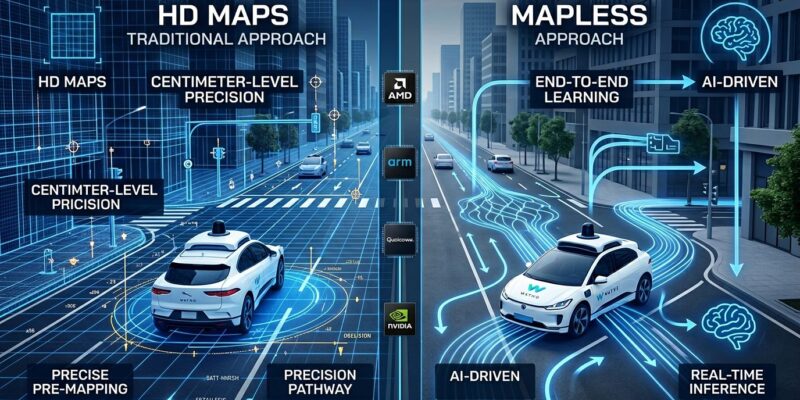
Wayve’s end-to-end neural network architecture ditches the traditional modular “sense-plan-act” pipeline and Waymo’s expensive HD maps entirely. Instead of pre-mapping cities at centimeter-level precision—which takes Waymo weeks per city—Wayve’s AI learns driving behavior from diverse data and generalizes to new environments with minimal local training. Moreover, the company has already demonstrated operation in 500 cities globally, compared to Waymo’s handful of pre-mapped locations (Phoenix, San Francisco, Los Angeles).
The deployment speed difference is stark. Waymo spends weeks just creating HD maps before vehicles can operate safely. Wayve deploys in weeks total, skipping the mapping bottleneck. Furthermore, this isn’t just faster—it’s fundamentally cheaper. HD-mapping infrastructure requires constant updates as roads change, traffic patterns shift, and construction zones appear. Wayve’s AI adapts in real-time, learning from its environment like a human driver adjusting to a new city.
For developers building autonomous systems, this represents a paradigm shift: train on diverse data and generalize (like humans) versus pre-program every scenario (traditional robotics). Consequently, the implications extend beyond cars—drones, warehouse robots, delivery bots could all adopt this approach if Wayve proves it works at scale.
Hardware-Agnostic Strategy: Breaking NVIDIA’s Potential Monopoly
Wayve now has investment relationships with all major chip vendors—AMD (x86), Arm (ARM architecture), Qualcomm (Snapdragon), and NVIDIA (from an earlier round). This isn’t accidental. Additionally, automakers desperately want to avoid single-vendor lock-in, and Wayve’s hardware-agnostic AI runs on any platform without optimization trade-offs.
“What’s exciting for us is it gives our customers choice of which silicon platform they want to work with,” Wayve CEO Alex Kendall told TechCrunch. “And it lets us work with what’s already being used across the industry.” The strategic value is clear: automakers gain supply chain flexibility and negotiating leverage. Chip vendors benefit equally, breaking NVIDIA’s potential stranglehold on autonomous compute. Developers get platform choice without performance penalties.
The breadth of chip vendor support is unprecedented. Wayve’s AI Driver pre-integrates on Qualcomm’s Snapdragon Ride Platform, runs on dual NVIDIA DRIVE AGX Thor processors (as seen in the Nissan robotaxi prototype at GTC in March), and supports AMD and Arm chips via hardware-agnostic design. Industry analysts call this “a practical answer to supply risk” as automaker boards ask how to avoid single-supplier exposure.
Commercial Reality Check: Tokyo Robotaxis Test the Technology in 8 Months
Wayve’s mapless approach faces its first real-world test in late 2026 when Nissan robotaxis launch in Tokyo via Uber. This matters because Wayve is unproven at scale compared to Waymo’s 8+ years of operations. Therefore, success or failure in eight months will determine if the mapless paradigm is viable beyond theory.
The Tokyo pilot uses Nissan LEAF vehicles with Wayve AI Driver, available through the Uber app. Initial deployments will have trained safety operators in the car—a gradual autonomy scaling approach rather than full autonomous from day one. The timeline is aggressive: late 2026 for robotaxis (pending regulatory approval), fiscal year 2027 for Nissan’s ProPILOT ADAS in consumer vehicles. Mercedes-Benz and Stellantis partnerships add to the commercial validation, though deployment timelines aren’t specified.
The stakes are high. Tokyo presents a challenging environment—dense urban traffic, complex intersections, unpredictable pedestrian behavior. If Wayve’s AI handles it well, the mapless approach gains credibility and could scale rapidly to other cities (no HD-mapping bottleneck). However, if edge cases prove problematic, it validates skeptics who argue Waymo’s proven approach is worth the deployment speed trade-off.
Related: Factory AI Hits $1.5B: Autonomous Coding Agents Go Enterprise
The Trade-Offs: What Wayve Gives Up vs Waymo
Wayve’s approach isn’t strictly better than Waymo’s—it’s a different set of trade-offs. Waymo prioritizes proven safety through redundancy and precise localization (HD maps provide predictable context). Wayve prioritizes scalability and learning through data (AI generalizes to new environments). The debate: is edge case safety worth deployment speed constraints?
Waymo’s eight years of safe operations provide a proven track record. Wayve is untested at scale—the Tokyo pilot will be its first commercial deployment. Waymo’s HD maps enable explicit rules for every scenario (stop signs, traffic signals, lane markings are pre-mapped). In contrast, Wayve relies on neural network generalization, which works until it encounters scenarios outside its training distribution.
Developers building autonomous systems face the same trade-off. Rule-based systems are interpretable and debuggable but brittle and expensive to scale. Learning-based systems generalize better but introduce “black box” decision-making that regulators may resist. Automakers can choose: prioritize safety and accept slower scaling (Waymo), or bet on rapid deployment and accept higher validation requirements (Wayve).
Key Takeaways
- Paradigm shift: Wayve’s mapless approach using end-to-end neural networks challenges Waymo’s HD-map orthodoxy. If successful in Tokyo late 2026, it validates faster, cheaper autonomous vehicle deployment.
- Hardware-agnostic wins: Investment from AMD, Arm, Qualcomm, and NVIDIA signals industry recognition that automakers need supply chain flexibility. Single-vendor lock-in is a dealbreaker at board level.
- Unproven at scale: Wayve’s technology looks promising on paper and in demonstrations (500 cities), but the Tokyo robotaxi pilot in eight months is the real test. Waymo has eight years of operations; Wayve has theory and investment.
- Beyond cars: If mapless AI works for autonomous driving, the approach reshapes any system navigating unstructured environments—drones, warehouse robots, delivery bots. The paradigm: learn from data and generalize, not pre-program every scenario.