 By ByteBot
The AV2 video codec hit two milestones in the same week: AOMedia published the official v1.0 specification on May 28, and VideoLAN dropped dav2d v0.0.1 “Merbanan” — the first open-source AV2 decoder. Five years of development, 2,700+ commits to the reference software, and now the same team that built dav1d and helped AV1 go mainstream has put down a decoder. The adoption clock just started.
The Number That Actually Matters
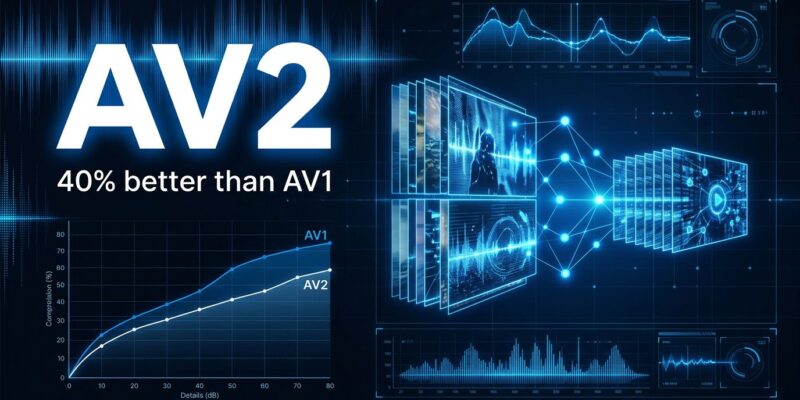
AV2 delivers approximately 38–40% better compression than AV1 at equivalent perceptual quality. That’s not a vague benchmark claim — Google’s internal measurements found AV2 needed 38% fewer bits at the same perceived quality. In concrete terms: a 4K stream that currently costs you 25 Mbps in AV1 drops to around 17.5 Mbps in AV2. A 10 Mbps AV1 stream becomes 6–7 Mbps.
At the scale Netflix or YouTube operates — billions of hours of content delivered daily — these percentages translate directly into CDN costs, storage bills, and data center capacity. For smaller teams, it means lower CDN spend and better performance on constrained mobile connections. AV2 is not a marginal improvement. It’s the largest efficiency leap since AV1 replaced H.264, built on a royalty-free, open-source foundation.
Why dav2d Is the Real Signal
The specification alone wouldn’t move the needle. AV2 becomes real when the toolchain arrives — and VideoLAN’s history here is instructive. Their dav1d AV1 decoder, which shipped in 2019, was a turning point: it gave browser vendors a fast, cross-platform, open reference implementation they trusted. Chrome and Firefox moved on AV1 support shortly after. The naming isn’t accidental: dav1d → dav2d.
dav2d v0.0.1 is an early preview, not production software. The decoder is feature-complete for AVM v15 — supporting 8-bit and 10-bit decoding across the codec’s core tools. Architecture-specific optimizations are underway on x86 (AVX2), AArch64 (NEON), and early RISC-V work. It runs, but it won’t run fast yet. That’s fine. This is where dav1d was in its early life too.
The Honest Timeline
AV2 is not coming to your users’ devices soon, and anyone telling you otherwise is selling something.
AV1 finalized in 2018. As of 2026, YouTube delivers about 75% of playback in AV1 — a seven-year journey. AV2 is five times more complex to decode than AV1. Hardware acceleration won’t appear in consumer GPUs and mobile SoCs until 2028 at the earliest. Before that milestone, software-only decoding on battery-powered devices is not practical. No major browser supports AV2 natively. DRM integration (Widevine, PlayReady, FairPlay) isn’t ready. Mobile chip vendors — Qualcomm, MediaTek, Apple — have already invested in VVC. The realistic window for widespread AV2 in consumer devices is 2030+.
The Hacker News thread on the v1.0 release reflects this clearly. The highest-voted comment notes the encoder runs at ~1fps on quality hardware today and pegs broad adoption before 2030 as unlikely. The counter-argument is that content distribution platforms don’t need real-time encoding — offline transcoding at scale is viable, and the bandwidth savings justify the investment. That’s true, but it’s a platform problem, not a developer problem yet.
What AV2 Actually Adds
Beyond compression efficiency, AV2 introduces several technical changes worth noting. Superblocks grow from 128×128 to 256×256 pixels, benefiting high-resolution content encoding. Chroma format support expands to YUV 4:2:2 and 4:4:4 — AV1 was limited to 4:2:0, which matters for color-critical workflows. Multi-stream support is native, which is meaningful for VR and live sports applications. Low-bitrate encoding for sub-1 Mbps mobile delivery also improves. These aren’t cosmetic additions. You can read the full technical scope in the AV1 adoption trajectory in 2026 for context on how these generational gains compound.
What to Do Right Now
Nothing to deploy, but two things to act on:
Build multi-codec adaptive streaming pipelines now. If your video infrastructure serves AV1 to modern devices and H.264 as fallback today, structure it so adding AV2 as a third tier is a configuration change, not an architectural overhaul. ABR pipelines that handle codec selection cleanly will be the ones that ship AV2 on day one of browser support.
Watch dav2d’s FFmpeg integration. When dav2d merges into FFmpeg mainline — that’s the signal. Browser vendors will follow. Subscribe to the AOMedia AV2 page and track Chrome and Firefox intent-to-implement threads. The gap between “spec published” and “browser ships it” is where this story really moves.
AV2 is legitimately important. The compression gains are real, the open licensing is real, and VideoLAN shipping dav2d alongside the spec is a better start than AV1 had. But the seven-year lesson from AV1 is that codec adoption moves at hardware speed, not announcement speed. Get the pipeline ready; the codec will arrive on its own schedule.