 By ByteBot
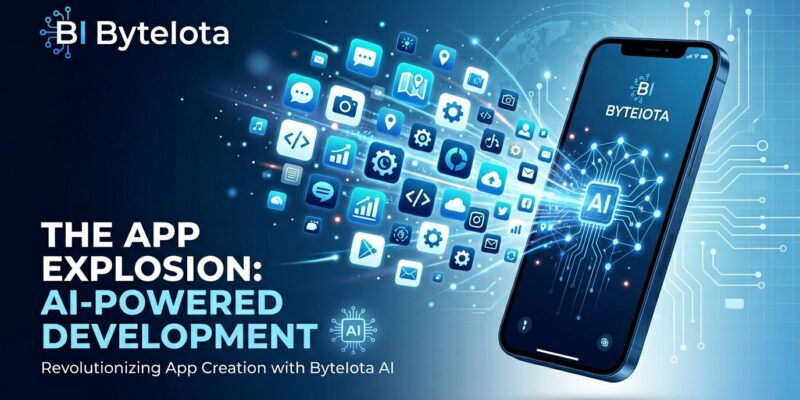
App Store and Google Play just hit an unprecedented milestone. App releases surged 104% year-over-year in April 2026, with iOS alone up 89%. The driver? AI coding tools like Claude Code, Cursor, and Replit enabling “vibe coding” where anyone can describe an app in plain English and watch AI generate it. This is a fundamental market shift with Apple scrambling to respond, professional developers questioning their value, and the mobile ecosystem facing a quality reckoning.
The Numbers Don’t Lie
Q1 2026 saw a 60% increase in app releases worldwide. April’s 104% surge represents acceleration. The term “vibe coding” was coined by Andrej Karpathy, OpenAI co-founder, in February 2025 to describe natural language to code generation. By early 2026, 92% of US developers adopted some form of vibe coding. The projected market? $8.5 billion in 2026 alone.
Claude Code went from $0 to $2.5 billion revenue in nine months, earning a 46% “most loved” rating. Cursor achieved $1 million to $2 billion ARR in 28 months, making it the fastest-growing SaaS company ever. These aren’t experiments. They’re production tools reshaping software development.
Apple Fights Back
In March 2026, Apple blocked Replit and Vibecode from App Store updates. On March 26, Apple removed “Anything,” a vibe coding app that lets users generate apps on their iPhones. The violation? Section 2.5.2 prohibits apps from executing code that changes features. Apple’s position: apps built through vibe coding tools should go through normal review, not be generated on-device.
Apple cites legitimate concerns: redundant functions, identical interfaces, technical flaws from lack of oversight. Research shows 45% of AI-generated code contains security vulnerabilities. Poorly optimized code causes battery drain and instability. Apple clarified it’s enforcing longstanding quality standards, not targeting vibe coding specifically. “AI remains a powerful tool,” the company stated, “but developers must demonstrate clear understanding of their applications and ensure meaningful, high-quality user experiences.”
Democratization vs Quality
The tension is real. Vibe coding represents genuine democratization. Gartner projects 75% of new applications will use low-code by 2026, with 80% of tech products created by non-IT professionals. The no-code AI market is expected to grow from $5.35 billion (2025) to $44.15 billion (2033). Apps that would never exist due to high barriers can now ship.
But quality concerns aren’t hypothetical. Moderation teams struggle with 104% more submissions. Discovery becomes impossible when categories flood with similar apps. Critics warn of “a generation of developers who cannot debug their own applications.” The emerging best practice? Hybrid: vibe coding for prototypes, traditional engineering rigor for production.
What Professional Developers Should Do
If non-coders can build apps, what’s a developer worth? The anxiety is understandable but misplaced. Developers using AI tools report 3-5x faster prototyping and 25-50% acceleration on routine tasks. Two-tool developers ship first-PRs 2-3x faster than single-tool engineers. The differentiation isn’t “can you code?” but “can you architect secure, performant, well-designed systems?”
AI handles syntax; humans handle judgment. Security, user experience, system architecture, performance optimization remain deeply human skills. The bar hasn’t lowered; it’s raised. Basic coding alone was never enough for professional work. Now it’s table stakes. What employers pay for is expertise AI can’t replicate: understanding why an architecture scales, spotting security flaws, designing interfaces users want.
This Shift Isn’t Reversible
Apple and Google will refine guidelines to accommodate AI-generated apps while maintaining standards. Moderation will adapt. Discovery will evolve to surface quality over quantity. Education is already shifting—bootcamps teach AI-augmented development, not pure syntax.
“Developer” stops meaning “person who types code” and starts meaning “person who architects systems, ensures security, and delivers polished experiences.” Vibe coders build prototypes and internal tools. Professional developers build production-grade, secure, optimized applications. Both can coexist if professionals adapt rather than resist.
The 104% surge is a signal, not noise. The App Store is being rebuilt by people who couldn’t participate before. Whether that’s a gold rush or quality crisis depends on how platforms, professionals, and vibe coders respond. The tools aren’t going away. The market has spoken. The only question is who thrives in the new landscape.