 By
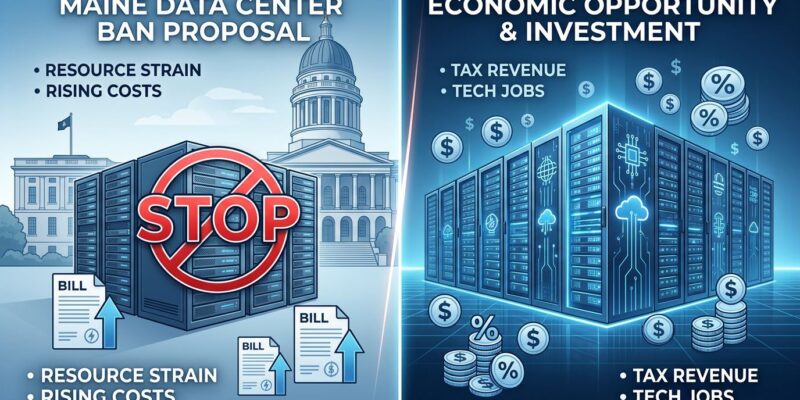
By Maine just became the first state in the nation to ban large AI data centers. On April 14, the Legislature passed LD 307, prohibiting any municipality or state agency from approving data centers larger than 20 megawatts until November 2027. The bill now sits on Governor Janet Mills’ desk—and eleven other states are watching to see if her signature turns Maine’s pause into a template for a national movement.
This isn’t symbolic protest. It’s the first concrete legislative victory for communities revolting against AI infrastructure after watching their utility bills spike 36% since 2020. The question driving Maine’s action: who pays for AI’s explosive growth—tech companies or ratepayers?
Who Pays for AI’s $64 Billion Buildout?
Residential electricity prices have jumped from 12.76 cents to 17.44 cents per kilowatt-hour since 2020. In Baltimore, residents saw bills spike $17 per month after a PJM power auction hit record highs, with another $4 monthly increase coming mid-2026. Maryland’s Baltimore Gas & Electric zone now faces 73% higher capacity fees than the rest of the PJM grid.
Data centers are driving much of this increase. Near heavy data center concentrations, wholesale electricity costs have surged 267% over five years. Northern Virginia’s “Data Center Alley” alone consumes 40% of the state’s total electricity. Meanwhile, the Maryland Office of People’s Counsel fields 50 calls per week about soaring energy bills and recently hired additional staff just to manage the outcry.
Maine’s bill sponsor, Rep. Melanie Sachs, put the core issue bluntly: “The tradeoffs have not been shown to be of benefit to our ratepayers, water usage or community benefit in terms of economic activity.” While tech companies secure tax breaks to build data centers, local ratepayers foot the bill for grid upgrades and capacity increases. That cost-shifting is creating the political backlash now threatening to reshape where cloud infrastructure can be built.
What Maine’s LD 307 Actually Does
LD 307 bans data centers larger than 20 megawatts until November 2027—an 18-month hard stop on major AI infrastructure. The threshold captures all hyperscale facilities while allowing smaller operations to proceed. Moreover, the bill creates the Maine Data Center Coordination Council to study impacts on ratepayers, grid reliability, natural resources, and local communities.
Governor Mills, currently running for US Senate, has not decided whether to sign. Activists are urging her to approve this “nation-leading” legislation while she’s outlined concerns about the bill’s specifics. Furthermore, her decision carries weight beyond Maine’s borders: if she signs, expect a wave of copycat bills in the states already considering moratoriums.
This Isn’t Just Maine—It’s a National Revolt
At least twelve states filed data center moratorium bills this legislative session. A March Quinnipiac poll found 65% of Americans oppose building AI data centers in their communities, with 72% of opponents citing electricity costs as their primary concern. Additionally, organized opposition has blocked or delayed $64 billion worth of projects over the past two years—$18 billion blocked outright, $46 billion stuck in limbo.
The movement is sophisticated and bipartisan. Some 142 activist groups across 24 states are coordinating to block data center construction. On the federal level, Bernie Sanders and Alexandria Ocasio-Cortez introduced the AI Data Center Moratorium Act on March 25, proposing a nationwide freeze. The bill is unlikely to pass, but it signals how far progressive concern has escalated.
Virginia, Maryland, New York, Georgia, Michigan, and six other states are all considering similar legislation. In fact, Maine isn’t an outlier—it’s the leading edge of a movement the tech industry can’t dismiss as NIMBYism when two-thirds of Americans oppose nearby data centers.
NIMBYism or Democratic Accountability?
The tech industry argues moratoriums kill jobs, limit innovation, and risk leaving states behind economically. The Information Technology & Innovation Foundation called the Sanders-AOC federal bill misguided, warning it would cripple AI development.
However, the counter-argument is more compelling. Data centers create minimal local jobs and typically receive generous tax breaks. Many states don’t even track the revenue losses from these incentives, according to a recent Good Jobs First study. Communities bear the costs—higher utility bills, water consumption, environmental impacts—while tech companies capture the benefits. Consequently, Sanders framed the federal bill as giving “democracy a chance to catch up” with AI’s breakneck pace.
The industry’s “economic development” argument rings hollow when ratepayers subsidize infrastructure that primarily benefits distant shareholders. Maine’s approach—pause, study impacts, then decide—represents democratic accountability, not obstruction. Therefore, if tech companies won’t address cost-shifting voluntarily, expect more states to force the issue through legislation.
Mills’ Decision Could Trigger a Domino Effect
Governor Mills’ signature would validate the moratorium strategy and embolden activists in the two dozen states already organizing opposition. Virginia’s HB 1515 was killed this session, but budget debates continue over eliminating sales tax exemptions for data centers. Maryland’s HB 120 remains under consideration. Indeed, the momentum is with the moratorium movement, and Maine’s success would accelerate it significantly.
For developers, the practical impact is straightforward: if moratoriums spread, cloud infrastructure gets concentrated in fewer states, potentially creating regional chokepoints and increasing costs. Goldman Sachs projects electricity prices will continue rising on AI demand, with some estimates suggesting a 40% increase by 2030 compared to 2025 levels.
The alternative—tech companies addressing cost-shifting and working with communities—could produce better outcomes for everyone. Nevertheless, right now, the path of least resistance for states is following Maine’s playbook: ban first, negotiate later. Mills’ decision in the coming days will show whether that playbook becomes the standard.