 By
By Mozilla’s Thunderbird team announced Thunderbolt on April 16, 2026—an open-source, self-hostable enterprise AI client positioned as the “sovereign” alternative to Microsoft Copilot, ChatGPT Enterprise, and Claude Enterprise. The timing couldn’t be more strategic: enterprises face mounting data sovereignty pressures from the EU AI Act (effective August 2, 2026), vendor lock-in costs reaching 20-40% premiums, and no legal mechanism for EU-to-US data transfers after the Data Privacy Framework collapsed in late 2025. Thunderbolt earned 557 GitHub stars in three days, signaling developers are hungry for an alternative to Big Tech’s AI stranglehold.
The Lock-In Tax: Enterprises Pay 20-40% More for AI
Locked-in customers pay 20-40% more than new customers for identical features, according to industry reports published this month. Switching providers requires “extensive code rewrites, re-testing, and months of engineering effort”—a reality that keeps enterprises trapped even as costs balloon. Meanwhile, average enterprise AI spending hit $1.2 million in 2026 (up 108% year-over-year), yet locked-in architectures prevent cost optimization.
The numbers are damning: 93% of U.S. executives are redesigning their data stacks because cloud-first architecture has become a regulatory and cost liability. Single-supplier strategies lead to 80% unnecessary expenses in some cases, yet enterprises can’t pivot without massive rewrites. Mozilla CEO Ryan Sipes put it bluntly: “When you rely on these big proprietary providers, you’re just renting a critical part of your organization’s operations.”
Thunderbolt’s model-agnostic architecture solves this. Swap from OpenAI to Anthropic to local Llama 3.1 models without code changes. This isn’t just about avoiding future price hikes—it’s insurance against vendor consolidation, service shutdowns (OpenAI killed Sora in March 2026), and strategic dependencies on Big Tech.
EU AI Act Deadline: August 2026, €35M Penalties
The EU AI Act takes full effect on August 2, 2026—just 3.5 months away—with penalties up to €35 million or 7% of global revenue. The collapse of the EU-U.S. Data Privacy Framework in late 2025 left organizations without legal grounds to transfer EU personal data to U.S.-based AI services like ChatGPT Enterprise or Microsoft Copilot. At least 34 countries have enacted data localization requirements affecting AI deployment, making self-hosted solutions a compliance necessity rather than a preference.
Healthcare, finance, and government organizations can’t legally use cloud AI for EU citizen data under current regulations. FedRAMP and HIPAA compliance require on-premises deployment with full data control—exactly what Thunderbolt provides. This isn’t paranoia; it’s avoiding €35M fines. Moreover, 68% of privacy professionals now handle AI governance responsibilities, a dramatic expansion from traditional compliance roles as AI regulation intensifies.
Related: EU Awards €180M Sovereign Cloud: SEAL-3 Blocks US CLOUD Act
Sipes didn’t mince words: “Do you really want to build your AI workflows on top of a proprietary service from OpenAI or Anthropic… not to mention having all your internal company data flowing through their systems?” For regulated industries, that’s not a philosophical question—it’s a legal red line.
Model Context Protocol: The Open Standard All Major AI Providers Use
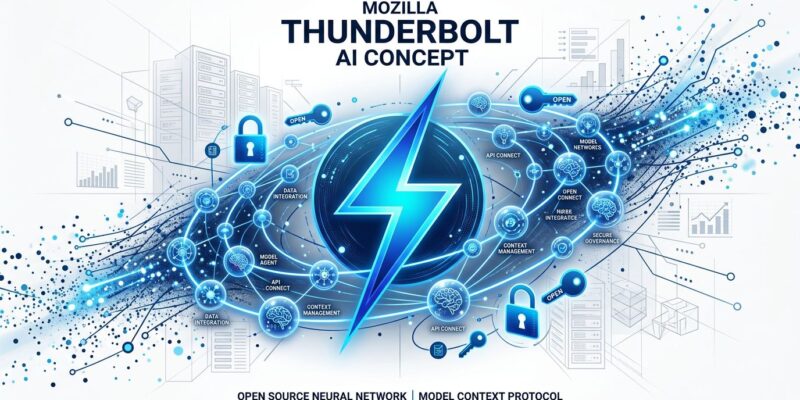
Thunderbolt integrates with Model Context Protocol (MCP), the industry standard donated to the Linux Foundation by Anthropic, OpenAI, and others in December 2025. This gives access to 10,000+ active MCP servers and 97 million monthly SDK downloads across Python and TypeScript. All major providers—OpenAI, Microsoft, Google, Amazon—adopted MCP by March 2026, making it the de facto protocol for AI-data integration.
The partnership with deepset’s Haystack framework provides production-grade retrieval-augmented generation (RAG), multimodal pipelines, and enterprise orchestration out-of-box. Thunderbolt’s technology stack—TypeScript (97.7%), Tauri for desktop apps, Docker/Kubernetes deployment—runs on web, iOS, Android, Mac, Linux, and Windows. Model flexibility covers OpenAI, Anthropic, Mistral, and OpenRouter cloud providers, plus Ollama and llama.cpp for local inference.
Related: Microsoft Agent Framework 1.0 Ships: MCP + A2A Converge
This matters because Thunderbolt isn’t building a proprietary ecosystem—it’s leveraging the open standard all major AI providers already use. It’s the Unix philosophy applied to enterprise AI: small, composable tools connected via standard protocols. The gap between on-premise Llama 3.1 405B and cloud GPT-4 has narrowed to 85-90% capability parity for most enterprise use cases, making architecture more important than the underlying model.
Early Stage But Strong Developer Interest
Thunderbolt is under active development with a security audit in progress and not yet production-ready. Authentication and search still require connectivity—the promised “offline-first” experience isn’t fully delivered. Enterprise deployment guides are under development, and Mozilla’s managed hosting tier remains in the planning stages.
However, the early traction validates the problem space. The project hit #1 on GitHub trending with 557 stars in three days, and media coverage spanned The Register, Phoronix, and LinuxIAC. Mozilla has a track record with Firefox and Thunderbird email of shepherding open-source alternatives to Big Tech dominance. If they commit resources, Thunderbolt could become the de facto open enterprise AI standard.
Mozilla’s commercial model—professional services, support contracts, future managed hosting—suggests long-term commitment beyond pure open source. Sipes emphasized openness: “We can help folks get it deployed and set up agents, but if they just want to use it internally without any relationship to us—that’s great too.” This philosophy differentiates Mozilla from vendors whose revenue depends on usage dependencies.
Sovereignty vs. Convenience: The Real Trade-Off
Thunderbolt doesn’t compete on convenience. Microsoft Copilot’s M365 integration, ChatGPT Enterprise’s polish, and Claude Enterprise’s accuracy all win on ease-of-use. Microsoft’s Wave 3 (March 2026) even added multi-model selection including Claude. Copilot costs $30/user/month with deep Office integration, ChatGPT Enterprise offers custom pricing with the largest user community, and Claude Enterprise provides zero-retention policies with FedRAMP/HIPAA certification.
Thunderbolt targets organizations where data sovereignty, vendor independence, and control justify the DevOps complexity of self-hosting. A 10-person startup should use ChatGPT Team. A European bank with 10,000 employees and GDPR/AI Act compliance requirements might have no legal alternative to Thunderbolt. The decision matrix is binary: can you legally send data to U.S. cloud providers? If no, Thunderbolt or similar self-hosted solutions become your only option.
The infrastructure costs aren’t trivial. Local model hosting requires GPU capacity—Llama 3.1 405B needs significant compute—and DevOps expertise. Self-hosting is complex and expensive at small scale. However, at enterprise scale with regulatory pressures, the economics flip: avoiding 20-40% lock-in premiums and €35M fines justifies the investment.
Key Takeaways
- Mozilla announced Thunderbolt on April 16, 2026, as the first credible open-source alternative to Microsoft Copilot, ChatGPT Enterprise, and Claude Enterprise—targeting enterprises where data sovereignty and vendor independence justify self-hosting complexity
- Vendor lock-in costs enterprises 20-40% premiums on identical features, with switching requiring months of rewrites—Thunderbolt’s model-agnostic architecture (swap OpenAI, Anthropic, local Llama freely) eliminates this tax
- EU AI Act effective August 2, 2026 (€35M penalties), collapsed EU-U.S. Data Privacy Framework, and 34+ countries’ data localization laws make self-hosted AI a compliance necessity for regulated industries
- Model Context Protocol (MCP) integration—adopted by all major providers—gives access to 10,000+ servers and 97M monthly downloads, positioning Thunderbolt as standards-based rather than proprietary
- Early development stage (security audit pending, not fully offline) but strong traction (557 GitHub stars in 3 days) and Mozilla’s track record suggest this could become the de facto open enterprise AI standard
The trade-off is clear: Thunderbolt won’t match cloud AI convenience, but for organizations facing regulatory pressure or strategic vendor risk, sovereignty isn’t optional—it’s survival.