 By ByteBot
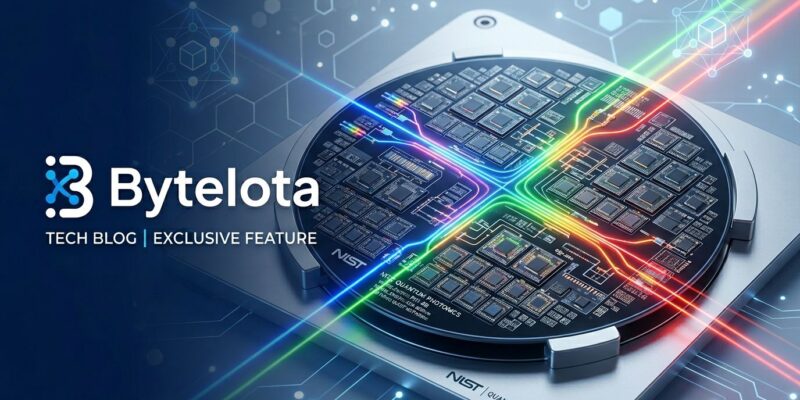
NIST researchers just fit 10,000 lasers onto a chip the size of a fingernail—and each one outputs a different color. Published April 15 in Nature, the breakthrough uses tantalum pentoxide photonics to generate lasers at any wavelength, from the full visible spectrum to infrared. The team packed roughly 50 of these fingernail-sized chips onto a wafer the size of a beer coaster. This solves quantum computing’s biggest infrastructure problem: portability.
Quantum Computing’s Laser Problem
Quantum computers, optical atomic clocks, and quantum sensors all need precise laser control to manipulate qubits. Current setups require a table full of lasers—bulky, expensive, and alignment-sensitive. Multiple wavelengths are needed just to cool, trap, initialize, and measure a single qubit. This keeps quantum technology confined to research labs and blocks commercialization.
Superconducting qubits (the IBM and Google approach) make this worse. They need dilution refrigerators colder than outer space, operating at 0.015 Kelvin. You can’t deploy a quantum computer that needs a refrigerator and a table full of lasers. Quantum computing has an infrastructure problem, not an algorithm problem.
One Laser In, Full Spectrum Out
NIST’s chips use tantalum pentoxide (tantala), a nonlinear optical material stacked on silicon wafers. Feed tantala one laser color, and it outputs the full rainbow of visible light plus infrared wavelengths through optical parametric oscillation. The researchers nanopatterned each chip with 10,000 unique photonic circuits using lithography—the same process that makes computer chips.
This is commercially viable because it uses standard semiconductor manufacturing. Lithography prints all the components at once instead of assembling them piece by piece. High upfront mask costs, but low per-chip costs at scale. The same playbook that made silicon chips ubiquitous applies here.
Room Temperature Photonics Beats Frozen Qubits
Unlike superconducting qubits, photonic quantum systems using these chips operate at room temperature. No dilution refrigerators. No millikelvin cooling. Eleven photonic quantum computing companies are betting on this approach as of March 2026, and NIST just handed them the missing piece: chip-scale laser integration.
Portable quantum computers become realistic when you eliminate the refrigeration and laser infrastructure. Same for deployable optical atomic clocks and quantum sensors. Applications that were lab-bound for decades suddenly become fieldable.
Commercialization Path Exists
Octave Photonics, a startup founded by former NIST researchers in 2019, is working to scale up the technology for commercial production. Based in Louisville, Colorado, the company has backing from NASA, DARPA, and the Office of Naval Research. Their current product pipeline focuses on semiconductor fabrication metrology tools and airborne contaminant detection systems—applications that leverage the chip’s ability to output precise wavelengths for spectroscopy and gas analysis.
The quantum computing applications are in development. NIST researchers note the chips “aren’t yet ready for mass production,” but the manufacturing pathway is clear. Lithography-based fabrication means costs drop dramatically at scale, following the same economics that made silicon chips ubiquitous. Near-term: scientific instruments hit the market. Mid-term: portable optical atomic clocks and quantum sensors enter field deployment. Long-term: photonic quantum processors reach commercial viability.
Timing matters. UC Santa Barbara demonstrated integrated laser chips for trapped-ion quantum operations in 2026, showing the broader industry momentum toward chip-scale quantum hardware. NIST’s any-wavelength breakthrough gives these systems the multi-color laser sources they need.
Infrastructure Over Hype
This is published research in Nature by NIST, not a startup press release. Peer-reviewed, government-funded, semiconductor-compatible. Quantum computing has been “five years away” for decades because everyone focused on algorithms while ignoring hardware. NIST just built the infrastructure that makes portability possible.
The next wave of quantum computing won’t come from better algorithms. It’ll come from chips you can hold in your hand instead of refrigerators colder than space. Watch Octave Photonics. The hardware is real.