 By ByteBot
Four major developer surveys conducted between October 2025 and March 2026—surveying over 55,000 developers combined—reveal a striking paradox. Claude Code leads at 28% primary adoption, with Cursor close behind at 24%, according to Digital Applied’s survey of 2,847 developers across 320 organizations. These two tools captured 52% combined market share in roughly one year. Yet Sonar’s State of Code survey found 96% of developers don’t fully trust AI-generated code, and Stack Overflow’s survey of 49,000+ developers shows 46% actively distrust AI accuracy. More striking: developers now spend more time reviewing AI code (11.4 hours/week) than writing new code (9.8 hours/week)—a fundamental reversal from 2024.
Review Time Now Exceeds Writing Time
Digital Applied’s Q1 2026 data reveals developers spend 11.4 hours per week reviewing and verifying AI-generated code versus only 9.8 hours per week writing new code. That’s a 31% year-over-year increase in review time. This represents a fundamental shift from 2024, when writing time exceeded review time.
The Sonar State of Code survey captures the essence: “The burden of work has moved from creation to verification and debugging.” AI didn’t eliminate work—it transformed it. Developers now receive complete blocks of code and must reverse-engineer the logic to verify correctness, rather than building mental models line-by-line as they write.
The quality impact is measurable. AI-assisted pull requests are 18% larger, have 24% more incidents, and show 30% higher change failure rates. Despite using AI in 60% of their work, engineers can fully delegate only 0-20% of AI-assisted tasks. That means 80-100% still requires human oversight. Stack Overflow’s survey found 66% of developers frustrated by “almost right” solutions requiring extensive debugging.
Claude Code and Cursor Capture 52% Combined Market Share
Claude Code’s 28% primary adoption and Cursor’s 24% give these two tools 52% of the market—achieved in roughly one year. GitHub Copilot, despite 26M+ total users, dropped 4 percentage points to 17% primary adoption. However, Copilot maintains 58% “any-use” adoption, meaning developers use it as a secondary tool even when something else is their main driver.
Tool satisfaction mirrors adoption. Claude Code scores +58 Net Promoter Score, Cursor +51, and GitHub Copilot just +14. Nitor’s survey found Cursor leads all tools with a 75% net like ratio, while Claude Code tops terminal-native tools at 70%. Microsoft Copilot scored -20% net like ratio—among the most disliked technologies surveyed.
The market didn’t consolidate to one winner. It specialized. Digital Applied’s research found “workflow fit beats benchmark leadership.” Backend developers prefer Claude Code (34% choose it) for multi-file reasoning, while frontend developers favor Cursor (31%) for in-editor flow. Data engineers pick Gemini Code Assist (18%) due to Vertex AI integration. Tool stacking is normal: developers average 2.4 (agency) to 3.1 (enterprise) tools each. These aren’t competing versions of the same thing—they’re different paradigms for different workflows.
Trust Gap: 96% Don’t Fully Trust AI-Generated Code
Sonar’s survey delivers the most striking finding: 96% of developers don’t fully trust AI-generated code accuracy. Stack Overflow’s data confirms this: only 3.1% “highly trust” AI outputs, while 45.7% actively distrust them (26.1% somewhat, 19.6% highly).
Experienced developers show the most skepticism. Veterans report the lowest “highly trust” rates at 2.6% and highest “highly distrust” rates at 20%. This creates an inverted benefit: the developers best positioned to save time (experienced engineers) trust AI least and spend the most time verifying. Beginners trust more but need verification more.
Yet 84% of developers use or plan to use AI tools, with 47.1% using them daily. Professional developers hit 51% daily usage. High adoption despite low trust creates the verification burden. Professional accountability drives this—developers can’t ship unverified AI code to production, regardless of how accurate it looks.
Productivity Gains Plateau at 37% After 60 Days
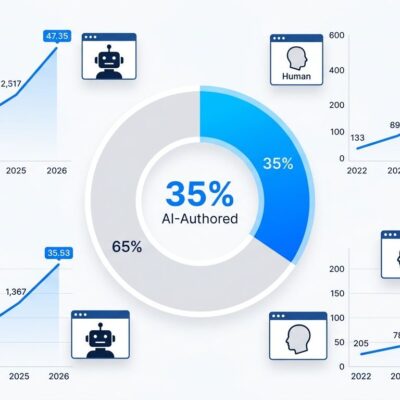
Digital Applied found developers report a 35% productivity boost at 60 days. But this plateaus quickly—reaching only 37% by 180 days. That’s just a 3-point gain over four months. Most productivity improvements happen fast, then stabilize. This isn’t a hockey stick growth curve—it’s a step function.
Gains are task-specific, not universal. AI achieves 78% effectiveness on boilerplate code, 64% on test writing, and 59% on unfamiliar languages. But only 18% effectiveness on architectural decisions and 16% on security-sensitive code. Sonar’s survey found 54% of developers report higher job satisfaction from AI use—they focus on interesting work while AI handles repetitive tasks.
The quality cost matters. Teams using AI without quality guardrails see 35-40% higher bug density within six months. Productivity gains don’t mean quality gains. Verification remains essential, and that’s where the time goes.
The Code Review Capacity Crisis
Industry analysts project a 40% quality deficit for 2026—more code entering the pipeline than reviewers can validate with confidence. AI exponentially increased code production velocity, but human review capacity remains finite and linear. This creates a critical risk zone where output volume outstrips verification ability.
The math is stark. Pull requests are getting 18% larger. Incidents per PR increased 24%. Change failure rates jumped 30%. Developers spend 11.4 hours per week on review—and that time is growing. As one industry analysis states: “While generative AI has exponentially increased the velocity of code production, human review capacity remains finite and linear, creating a critical risk zone where the sheer volume of output outstrips the ability to verify it.”
This isn’t just a team problem—it’s an industry-level challenge. AI-assisted code review tools will become essential to scale verification capacity. Without them, the quality gap widens as AI adoption increases.
Key Takeaways
- AI tools hit mainstream adoption with Claude Code (28%) and Cursor (24%) capturing 52% combined market share, but 96% of developers don’t fully trust AI output—creating a verification burden that now exceeds writing time (11.4h vs 9.8h/week)
- Work shifted, not eliminated: AI transformed software development from code creation to code verification, with developers spending more time reviewing than writing for the first time
- Choose tools by workflow fit, not benchmarks: Claude Code (terminal-native) serves backend developers, Cursor (IDE-native) fits frontend workflows, and GitHub Copilot ($10 vs $20/mo) remains viable for budget-conscious teams
- Productivity gains are real but limited: 35% boost at 60 days plateaus at 37% by 180 days, with effectiveness concentrated in boilerplate (78%) and tests (64%), not architecture (18%) or security (16%)
- Budget for verification time: Teams can fully delegate only 0-20% of AI-assisted work, and those without quality guardrails see 35-40% higher bug density within six months
The paradox is real. AI coding tools deliver measurable productivity gains while simultaneously increasing verification burden. The industry is still figuring out how to balance creation velocity with review capacity. Teams adopting AI tools need to plan for both the gains and the costs.