 By ByteBot
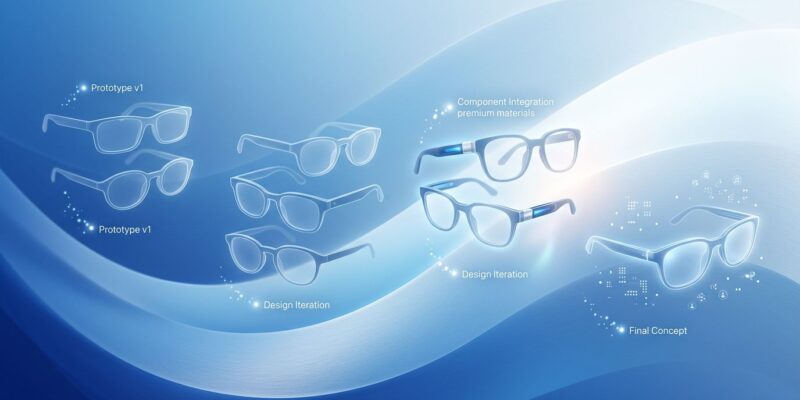
Apple is testing four distinct smart glasses designs with premium acetate frames, Bloomberg reported this week, targeting a spring 2027 launch into a market Meta currently dominates with an 82% share. The designs include large and slim rectangular styles—one matching Tim Cook’s personal glasses—plus large and small oval frames, all using acetate instead of standard plastic to compete on build quality rather than price.
This marks Apple’s serious entry into wearable AI, betting that premium materials and ecosystem integration can overcome Meta Ray-Ban’s 18-month head start and 7 million+ units sold.
Four Frame Styles: Design Over Mass Market
Apple’s testing four frame options: a large rectangular Wayfarer-style design, a slim rectangular frame similar to Tim Cook’s glasses, and large/small oval shapes. All use acetate, a plant-based material that’s more durable, ages better, and feels more premium than injection-molded plastic.
Meta Ray-Ban also uses acetate—from Italian supplier Mazzucchelli with a 30-day curing process—but Apple’s offering multiple styles to match different face shapes signals a design-first strategy. Colors under exploration include black, ocean blue, and light brown. The vertical oval camera lenses with LED indicator lights create a distinct look from Meta’s circular design.
This approach reveals Apple’s positioning: compete on aesthetics and variety, not price. While Meta Ray-Ban sells for $299-379, Apple’s acetate frames and style diversity suggest $500-700 pricing. That’s betting consumers will pay double for premium build quality and seamless iPhone integration.
Dual Cameras: AI Assistant You Wear, Not Just a Face Camera
The glasses pack two cameras: a 1080p shooter for photos and videos, plus a second computer vision camera feeding environmental context to Siri and Apple Intelligence. That second camera enables real-time object identification, translation in 20+ languages, and contextual awareness like “Where did I park?”
This builds on iOS 27’s Visual Intelligence features—nutrition label scanning, phone number detection, text extraction—extending them to a wearable form factor. The computer vision camera runs continuously to provide context without explicitly recording, similar to how Apple Watch tracks activity in the background.
Apple’s positioning smart glasses as an AI assistant you wear, not just a camera you mount on your face. The LED recording indicators address privacy concerns with transparent operation versus hidden recording—critical differentiation from Meta’s data collection reputation.
Meta’s 82% Market Share Creates Uphill Battle
Meta commands 82% of global smart glasses shipments after selling 7 million+ Ray-Ban units in 2025. Apple won’t launch until spring 2027—giving Meta an 18-month head start, prescription lens options launching this week (April 14, 2026), and proven market fit at half Apple’s expected price.
The market’s growing fast: 110% YoY to 8.7 million units in 2025, projected to hit 15 million in 2026. Meta’s prescription models signal a shift from “tech gadget” to “everyday eyewear”—solving adoption by ensuring glasses fit your face and your life. Google and Samsung are entering late 2026/2027, creating a three-way showdown by Apple’s launch.
Can premium design and ecosystem lock-in justify paying double when Meta already owns the market and offers prescription options? The answer determines whether Apple legitimizes wearable AI like iPhone did for smartphones, or becomes an expensive also-ran.
Privacy as Competitive Moat
48% of consumers are wary of AI wearables, citing “quiet overcollection” concerns—recording more than users and bystanders realize, according to Gartner surveys. Harvard students demonstrated Meta Ray-Ban footage could connect to facial recognition systems to identify strangers in public.
Meta stores voice recordings in the cloud for up to a year by default to improve AI, with no opt-out beyond manual deletion. Apple’s track record of on-device processing and privacy-focused features like App Tracking Transparency positions them to win privacy-conscious buyers, even if Meta offers more features.
The market is moving faster than etiquette—social norms for wearable cameras don’t exist yet. Apple can define those norms if they ship privacy-first features: on-device processing, transparent indicators, no cloud storage by default. This becomes a competitive moat Meta can’t easily replicate given their business model depends on data collection.
What’s Next for Apple Smart Glasses
Production starts December 2026 with public launch spring/summer 2027. Apple’s betting design quality, privacy focus, and ecosystem integration beat Meta’s market dominance and head start. Whether consumers pay $500-700 for acetate frames and Siri when Meta offers similar features for $299 determines if Apple legitimizes wearable AI or joins Google Glass in the failed-product graveyard.
The stakes are high: Tim Cook calls AR glasses Apple’s “highest strategic priority.” Smart glasses could become the post-smartphone platform—or another overhyped category that never escapes early adopters. Apple’s design-first approach will tell us which.