 By ByteBot
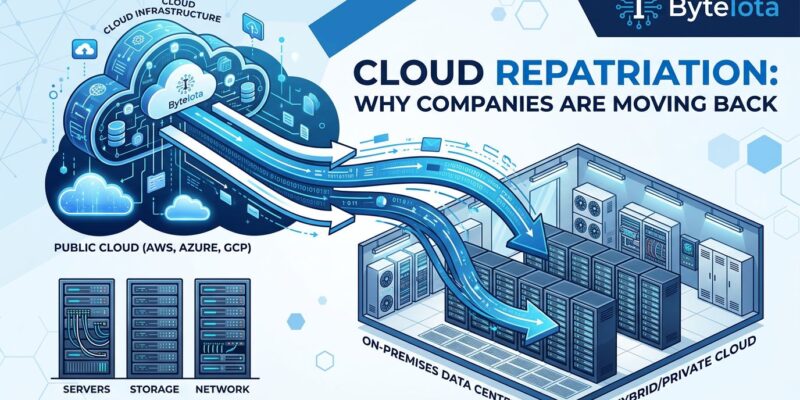
Eighty percent of enterprises are bringing workloads back from the cloud in 2026. After a decade of “cloud-first” evangelism, the pendulum is swinging hard in the opposite direction. This isn’t cloud failure—it’s strategic recalibration driven by economics that cloud providers can’t escape.
The cloud-first dogma always oversimplified infrastructure decisions. “Move everything to AWS” ignored cost structures, regulatory requirements, and workload characteristics. Now companies are paying the price—literally. And they’re responding by selectively repatriating workloads to on-premises infrastructure.
The Economics Are Brutal
Cloud costs are crushing software companies. According to Andreessen Horowitz analysis, public cloud spending averages 50% of cost of revenue for many software companies. One company reported cloud spend hitting 80% of revenue. When your infrastructure costs half your revenue, you don’t have margins—you have a crisis.
The math behind repatriation is compelling. 37signals, makers of Basecamp, invested $600,000 in servers and will save $7 million over five years compared to staying on AWS. Their annual costs dropped from $2.3 million on cloud to $840,000 on-premises. CTO David Heinemeier Hansson called cloud prices “grotesque”—and the numbers prove him right.
Dropbox made a similar move in 2016, shifting from public cloud to custom infrastructure. Result: gross margins jumped from 33% to 67% within two years, saving $75 million. The a16z analysis estimates $100 billion in market value has been lost among the top 50 public software companies due to cloud’s impact on margins. For every dollar of gross profit saved through repatriation, market caps rise an average of 24-25x.
On-premises infrastructure delivers 40-50% lower TCO for steady-state workloads. Cloud’s “pay for what you use” promise became “pay for what you use plus egress fees plus cross-zone traffic plus storage tier inflation plus API calls plus…” The hidden costs spiraled out of control.
AI Workloads Accelerate the Trend
AI adoption is making cloud economics even worse. On-premise AI infrastructure offers up to 18x cost advantage per million tokens compared to cloud APIs. Cloud AI pricing ranges from $15-60 per million tokens, with massive variance between providers. For high-utilization inference workloads, on-prem breaks even in under four months.
The threshold is clear: above 500,000-1 million tokens per day, on-premises becomes mathematically superior. Deloitte found that on-premise AI delivers 50%+ cost savings over three years compared to cloud API alternatives. As AI adoption explodes across enterprises, companies running inference at scale can’t afford cloud pricing. On-prem becomes mandatory, not optional.
Data Sovereignty Forces the Issue
Even when economics don’t force repatriation, regulations do. The Nutanix Enterprise Cloud Index 2026 reports that 57% of IT leaders need infrastructure within a single country. GDPR combined with the US CLOUD Act creates an impossible conflict—US cloud providers remain subject to American legal demands regardless of where data physically resides.
The EU Data Act, enforced since September 2025, explicitly blocks unlawful foreign government access to data. Gartner predicts 75% of enterprises will have digital sovereignty strategies by 2030. Compliance frameworks like DORA in the EU and HIPAA in the US demand documented control and auditable infrastructure—not vendor promises.
You can negotiate with vendors. You can’t negotiate with regulators.
The Hybrid Reality
Before declaring this a cloud exodus, understand the nuance: only 8% of companies are moving entire workloads off cloud. The Barclays survey found 83% plan to repatriate some workloads—not everything. Gartner reports 40% of enterprises are adopting hybrid architectures for mission-critical workloads.
This isn’t cloud versus on-premises. It’s intelligent workload placement. Each workload earns its location based on characteristics:
- Steady-state, predictable workloads: On-prem wins on cost
- Variable demand, geographic distribution: Cloud wins on flexibility
- Compliance-heavy workloads: Usually forces on-prem or specific regions
- Experimental projects: Cloud makes sense for rapid iteration
The intelligent approach is strategic placement based on workload characteristics, not ideology. Stop asking “cloud or on-prem?” Start asking “which workload characteristics favor which environment?”
What Developers Need to Know
This shift creates opportunities for developers who understand infrastructure economics. The end of the “just deploy to cloud” era means infrastructure fundamentals—bare metal operations, private cloud management, network design—are valuable again.
Cost awareness is now a core developer competency. Understanding TCO analysis and FinOps practices matters as much as knowing APIs. Developers who can justify infrastructure decisions to board level with economic reasoning will win. Cloud-only skillsets are becoming a liability. Hybrid architecture expertise is in high demand.
The repatriation trend reveals something important: cloud providers priced themselves into this situation. When costs hit 50% of revenue, companies don’t have a choice. They repatriate or die.
The ByteIota Take
The pendulum had to swing back. Cloud became the new mainframe—vendor lock-in, opaque pricing, “nobody gets fired for choosing AWS” replacing “nobody gets fired for buying IBM.” The cloud-first era trained developers to ignore infrastructure economics. That was always unsustainable.
Hybrid is the only rational answer. Cloud excels at variable workloads, geographic distribution, and rapid experimentation. On-prem excels at steady-state workloads, cost control, and compliance. Nobody needs 100% of either.
The winners in 2026 aren’t the cloud evangelists or the on-prem purists. They’re the engineers who understand when each approach makes sense—and can prove it with math.