 By ByteBot
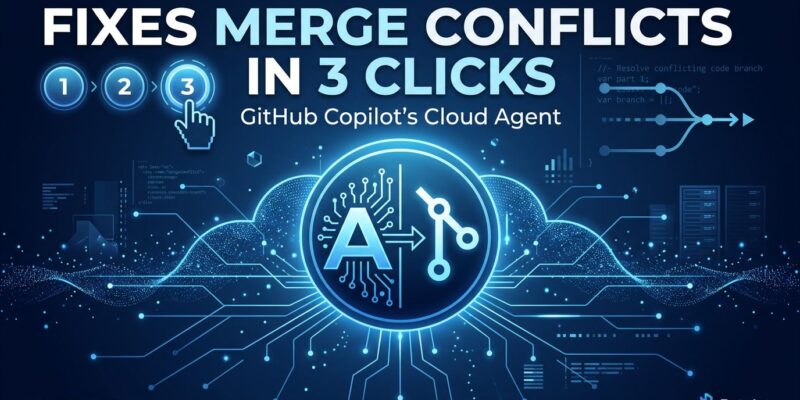
GitHub just turned the 30-minute merge conflict nightmare into a 3-click fix. The “Fix with Copilot” button went live April 13, 2026, powered by Copilot cloud agent running in GitHub’s infrastructure. Click once to invoke the feature, Copilot resolves conflicts in its cloud environment, verifies builds and tests pass, then pushes changes—all without leaving github.com.
The 3-Click Workflow
When a pull request hits merge conflicts, click “Fix with Copilot.” GitHub prepopulates a comment requesting Copilot’s help. Submit it. Done.
Copilot cloud agent resolves conflicts in its ephemeral development environment, runs builds and tests to confirm nothing broke, then pushes the resolved changes. The workflow happens entirely in GitHub’s cloud, meaning you can fix merge conflicts from a phone browser. No local git setup, no IDE context switching, no manual test runs.
This matters because merge conflicts are not edge cases. One in five merges cause conflicts in large projects, and traditional resolution takes hours to days. Seventy-five percent of conflicts require deep logic understanding to resolve correctly. Code with merge conflicts is twice as likely to contain bugs, jumping to 26 times more likely for semantic conflicts where logic is entangled.
GitHub’s automation eliminates the context switching, manual testing, and cognitive load that make conflict resolution painful. The 3-click workflow is not just faster—it’s a fundamentally different approach.
Cloud Agent Architecture
Copilot cloud agent is not a chatbot offering suggestions. It’s a full development environment powered by GitHub Actions. GitHub spins up an ephemeral environment on a GitHub-hosted runner where the agent explores code, makes changes, executes tests and linters, and verifies results.
Security and quality validation happen automatically: CodeQL for security analysis, secret scanning, the GitHub Advisory Database, and Copilot code review checks. As of April 10, these tools run in parallel, cutting validation time 20%. If the agent finds problems, it attempts to resolve them before requesting human review.
Beyond merge conflicts, mention @copilot in pull requests to fix failing GitHub Actions workflows, address code review feedback, or add unit tests. GitHub is positioning this as a general-purpose autonomous agent for developer workflows, with merge conflicts as the wedge feature.
Enterprise Adoption Requires Policy Decisions
The feature is available with all paid Copilot plans, but Copilot Business or Enterprise administrators must enable cloud agent before developers can use it. This policy gate exists because automated conflict resolution requires trusting AI to make autonomous code decisions.
Enterprises must answer: Who’s responsible if the cloud agent introduces bugs? How do audit trails work for AI-generated merges? GitHub offers US and EU data residency, but code execution happens in GitHub-controlled infrastructure, not customer environments.
GitHub Copilot is deployed at 90% of Fortune 100 companies, with 4.7 million paid subscribers and 75% year-over-year growth. Half of all GitHub code is now AI-generated or AI-assisted. But there’s a difference between AI suggesting code humans review and AI autonomously merging code that ships to production. That’s the shift enterprises are evaluating.
Part of the Agentic Workflow Shift
This feature is a wedge, not the endgame. GitHub is betting developers want agents to handle tedious tasks while humans focus on architecture and product decisions. Merge conflicts are ideal starting points: universally painful, clearly scoped, with objective success criteria.
The broader trend supports this strategy. Eighty-four percent of developers are using or planning to adopt AI coding tools, and the market is shifting from code completion to autonomous agents. GitHub’s vertical integration creates lock-in—cloud agent only works in GitHub’s ecosystem—but enables optimizations third-party tools can’t match.
The vision is “issue to production” automation where developers describe requirements and agents implement them. Merge conflicts are just the first autonomous decision point. The question is whether reliability holds up as scope expands.
Caveats and Limitations
This is not magic. Some developers report the cloud agent claiming victory without actually resolving conflicts. Complex semantic conflicts where logic is deeply entangled may still require human understanding AI can’t replicate.
The feature is limited to paid plans. And while GitHub’s cloud agent handles many cases well, alternative AI tools with larger context windows like Claude and Gemini may handle complex logical merging better. GitHub’s advantage is integration, not necessarily the best AI.
Approach this with “trust but verify” skepticism. The cloud agent can speed up conflict resolution, but automated merges still need code review. The risk is that 3-click convenience encourages skipping verification, leading to subtle bugs introduced during conflict resolution.
The Real Takeaway
GitHub automated a task affecting 1 in 5 merges that costs developers hours to days. The 3-click workflow and cloud execution are genuine UX improvements. But the bigger story is what this represents: the first mainstream autonomous code decision where AI merges to production without human intervention.
Adoption depends on reliability. If the cloud agent consistently resolves conflicts without introducing bugs, it becomes indispensable. If early reliability concerns persist, it becomes another AI feature developers try once and abandon.
For enterprises, enabling Copilot cloud agent means accepting AI as a code contributor, not just a suggestion engine. GitHub is at 90% of Fortune 100 companies, so they have distribution. The question is whether they have the reliability to justify the trust.