 By ByteBot
California Assembly Bill 2047, introduced February 17, 2026, mandates state-approved “firearm blocking technology” on all 3D printers sold in California. The Electronic Frontier Foundation published a damning analysis on April 13, calling the legislation “dangerous censorship” that’s technically impossible to implement. The bill has ignited fierce debate on Hacker News—400 points, 366 comments—with developers unanimously skeptical. Desktop printers lack the computational power for geometry detection, bad actors will bypass restrictions in minutes, and the real casualties will be educators, makers, and researchers facing criminal penalties for using open-source firmware.
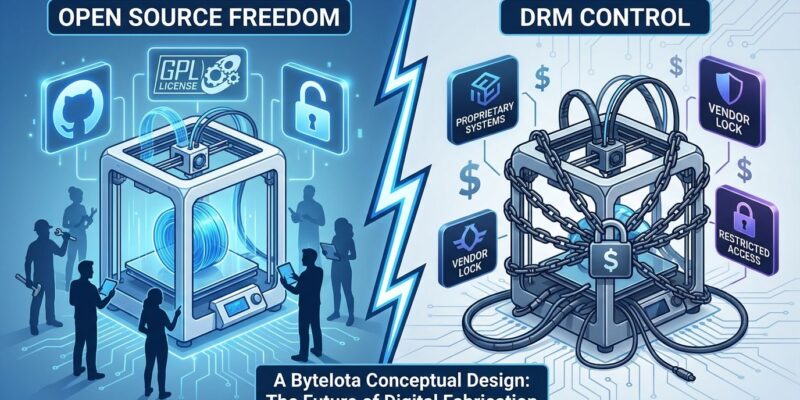
This isn’t just about firearms. California is criminalizing Marlin and Klipper, the open-source firmware powering millions of consumer 3D printers. The EFF predicts an HP-style DRM future: vendor lock-in, proprietary slicer software, subscription models. The bill represents security theater that solves nothing while threatening the open-source ecosystem that built consumer 3D printing.
Geometry Detection is Computationally Intractable
Desktop 3D printers run on 8-bit or 32-bit microcontrollers with minimal RAM—computational power comparable to early 2000s computers. AB 2047 requires these devices to perform real-time geometry analysis, comparing print jobs against a database of prohibited firearm designs. The EFF is blunt: printers have “very limited computational and storage ability” that makes this technically impossible. A Hacker News commenter noted that determining 3D geometry from G-Code files “remains unsolved in the industry” despite obvious commercial value.
Cloud-based detection creates worse problems. Printers would require constant internet connectivity, introducing latency, privacy violations, and making offline printing impossible. Meanwhile, 3D printing advocate Michael Weinberg cuts to the core issue: “A gun safety switch looks very similar to a switch for a door when viewed out of context.” Geometry alone can’t determine intent—CAD software can’t tell if a mechanical part is dangerous or benign based solely on shape.
The technical reality is stark: “It takes very little skill for a user to make slight design tweaks to evade detection,” the EFF explains. A minor dimensional change alters the digital signature while preserving functionality. Print components separately and assemble later. Manipulate G-Code directly. Bad actors bypass detection instantly; the only victims are legitimate users blocked by false positives.
Criminalizing Marlin and Klipper Firmware
AB 2047 makes it a misdemeanor to “disable, deactivate, or circumvent” firearm blocking technology. Translation: installing open-source firmware becomes a criminal act. Marlin, with 100,000+ GitHub stars, powers most consumer 3D printers. Klipper, with 10,000+ stars, delivers high-performance printing via Raspberry Pi. Both are GPL-licensed—users expect and legally have the right to modify them.
The bill creates a DMCA-style anti-circumvention provision for hardware. Hacker News developers are livid: “Criminalizes open source—I run Klipper on all my printers.” Users install custom firmware for legitimate reasons: speed improvements, new features, hardware compatibility, bug fixes. Flashing new firmware takes five minutes. The 3D Printing Industry notes that “workarounds would be easy to develop, distribute, and implement.” No internet required, no technical expertise necessary—just a USB cable and firmware file.
Bad actors flash new firmware instantly and continue manufacturing illegal items. Law-abiding educators teaching CAD, researchers prototyping medical devices, and makers building RC vehicles face misdemeanor charges. The bill accomplishes the opposite of its stated goal: criminals bypass effortlessly while innovation dies.
The HP Ink Subscription Model for 3D Printing
The EFF sees California’s future clearly: HP’s printer DRM playbook applied to 3D printing. HP’s Instant Ink subscription remotely disables cartridges when you cancel—even if ink remains. Dynamic security firmware updates block third-party cartridges. Disconnecting an HP+ printer from the internet renders it useless. HP’s CFO admitted the subscription model creates “20% uplift on customer value” by “locking that person, committing to a longer-term relationship.” This is the endgame.
AB 2047’s “approved” printer list—maintained by the DOJ—creates the infrastructure for vendor lock-in. The EFF predicts manufacturers will implement proprietary slicer software with cryptographic signing, forcing users into specific vendors and materials. Large manufacturers absorb compliance costs and capture market share. Small manufacturers and DIY builders exit California entirely. Consumers face subscription fees, planned obsolescence, and no second-hand market (resale could be criminal under the bill).
Tom’s Hardware demonstrated HP’s ink DRM can be bypassed with man-in-the-middle attacks—consumers driven to hacking devices they own. The same pattern will emerge for 3D printing: technical users bypass restrictions, average users pay the tax, and the law criminalizes device ownership while solving nothing.
What Comes After Firearms?
The bill offers “no guardrails to keep this constantly expanding blacklist limited to firearm-related designs,” the EFF warns. Database scope creep is inevitable. Copyright infringement next—Disney characters flagged, trademarked shapes blocked? Patented designs banned? “Illegal” replacement parts that threaten manufacturer revenue? The infrastructure for censorship expands once established.
False positives are guaranteed. Film props “often closely resemble real firearms or firearm components” according to the EFF. Cosplay replicas blocked. Educational models flagged. Historical reconstructions rejected. Medical prototypes delayed. Meanwhile, the bill creates surveillance infrastructure with zero transparency: what gets logged, who accesses the data, how long is it retained?
Enforcement is impossible. How does California detect non-compliant printers? Interstate commerce makes bans trivial to evade—buy in Nevada, use in California. DIY kit printers have no manufacturer to certify. The bill doesn’t cover CNC mills (which can make firearm parts), 3D printing pens, or traditional machining. Bad actors pivot to unregulated methods; the law only harms compliant citizens.
Why This Matters to Developers
California is setting a precedent for regulating software in hardware. If the state can mandate detection algorithms for 3D printers, what’s next? Code repositories blocking “illegal” programs? Compilers detecting prohibited logic? CAD software with built-in censorship? This is a First Amendment issue—code is speech, and AB 2047 criminalizes running software the state hasn’t approved.
The technical community sees this clearly. Hacker News commenters frame it as “security theater that won’t work.” California is mandating vaporware—technology that doesn’t exist, can’t exist given hardware constraints, and wouldn’t work even if it did. The DOJ must publish detection algorithm standards by July 2027, but the industry hasn’t solved geometry detection despite obvious commercial incentives. The state is gambling on impossible technology while criminalizing the open-source ecosystem.
Key Takeaways
- Technical impossibility: Desktop printers lack processing power for real-time geometry detection. Cloud-based alternatives require constant connectivity and create privacy issues. Determining firearm parts from 3D geometry remains an unsolved problem.
- Open-source threat: Marlin (100K+ stars) and Klipper (10K+ stars) firmware become illegal to install. The bill criminalizes device modification for legitimate purposes while bad actors bypass restrictions by flashing new firmware in minutes.
- DRM precedent: California enables HP’s printer subscription model for 3D printing—vendor lock-in, proprietary software, planned obsolescence. The DOJ “approved” list creates barriers for small manufacturers while favoring incumbents.
- Scope creep risk: Database expansion from firearms to copyrighted designs, trademarks, patents, or “illegal” replacement parts is inevitable. Infrastructure for censorship expands once established. Surveillance implications unaddressed.
- Security theater: Bad actors bypass instantly using firmware mods, out-of-state purchases, or unregulated manufacturing methods (CNC mills, printing pens). Legitimate users—educators, researchers, makers—face criminal penalties and false positives.
The Electronic Frontier Foundation is calling on California to reject AB 2047 before it’s too late. Developers should contact state legislators and support digital rights organizations fighting this bill. The precedent California sets today determines whether device ownership and open-source software survive tomorrow.