 By ByteBot
Your tech stack is a resume project, not a product strategy. Research confirms 82% of developers believe using trending technologies makes them more employable, and 20% admit they’ve chosen technologies they knew were inappropriate for their projects. The result: startups drowning in complexity, burning $4,000 per month on Kubernetes clusters running at 30% utilization, while Stack Overflow serves 6,000 requests per second on a 15-year-old monolith.
Consequently, this tension between career building and product shipping is costing startups real money, velocity, and sometimes survival. The “boring stack” movement in 2026 is developers pushing back.
What Resume-Driven Development Actually Means
Resume-driven development happens when technology choices get made in a vacuum. Nobody asked “what are we trying to accomplish in the next six months?” Nobody checked whether the existing stack actually failed or was merely unfashionable. Moreover, the pitch was “this is better” without defining better for whom, by what measure, over what time horizon.
One developer put it bluntly: “If a project didn’t involve Kubernetes, three different cloud providers, a message queue, and a framework that was released last Tuesday, I wasn’t interested.” That’s the problem in one sentence.
Academic research backs this up. Sixty percent of hiring professionals admitted that technology trends influence their job advertisements. Furthermore, among software professionals, 82% believed that using trending technologies would make them more attractive to future employers. One fifth admitted they’ve already used trending technology despite knowing it wasn’t the most appropriate choice.
Boring Tech Scales Better Than You Think
Stack Overflow handles over 6,000 requests per second. It serves 2 billion page views per month. Page render time averages 12 milliseconds. The architecture? A 15-year-old monolithic application running on nine web servers and a single SQL Server with one hot standby. That’s it.
Shopify processes 32 million requests per minute and handles 11 million MySQL queries per second. The core application? A Ruby on Rails modular monolith with 2.8 million lines of code. However, when Kylie Jenner’s product drop crashes one pod, the other 100,000 stores don’t even notice. That’s how Shopify scales globally without fragmenting into hundreds of microservices.
These aren’t toy projects. Consequently, they’re massive production systems serving millions. The “you need microservices to scale” argument is empirically false. Complexity is a tax you keep paying forever, and boring tech wins because it lets you reason about your system, move fast, and actually sleep at night.
The Kubernetes Reality Check
Sixty-eight percent of enterprises report significant complexity challenges with Kubernetes implementation. Moreover, the average Kubernetes cluster runs at just 30-50% utilization, representing 50-70% waste. Infrastructure costs jump from $200-400 per month for simple deployments to $4,000+ for Kubernetes.
For startups with three developers and no dedicated DevOps team, Kubernetes isn’t a learning curve—it’s a permanent tax on velocity. Teams spend entire sprints debugging Kubernetes instead of building features. Consequently, product velocity tanks.
Multiple startups published “break-up stories” in 2025 documenting their moves from Kubernetes back to simpler alternatives. The consensus in 2026: Kubernetes is overkill for 90% of companies. If your application serves a few thousand users, Docker Compose is enough.
The Career Argument is Wrong
The fear is real: “If I use boring tech, will I be unemployable in three years?” However, the strongest developers in 2026 aren’t those who know every framework. They’re those who learn quickly, communicate clearly, and ship reliable software for real users.
Product-minded engineers understand that technology choices are means to an end. Choosing the latest JavaScript library doesn’t matter if no one uses the product. Moreover, in the AI era, if AI can generate features in days and still two-thirds of them don’t move the needle, the problem was never “too slow coding”—it was “building the wrong things.”
The market is shifting. As AI commoditizes coding velocity, product judgment becomes the differentiator. Furthermore, learn trends on side projects, not production systems. Resume-driven developers are optimizing for the wrong metric.
When to Choose Boring vs Trendy
Default to boring. Choose trendy only when justified by actual needs, not theoretical scale. The test: “Will this help us ship faster or just look good on LinkedIn?”
Choose boring tech for startups, MVPs, early-stage products, small teams under 50 engineers, and proven products serving thousands of users. However, choose trendy tech when actual scale needs are justified by data, when specific problems exist that simpler tools genuinely can’t handle, or when infrastructure complexity is already real, not projected.
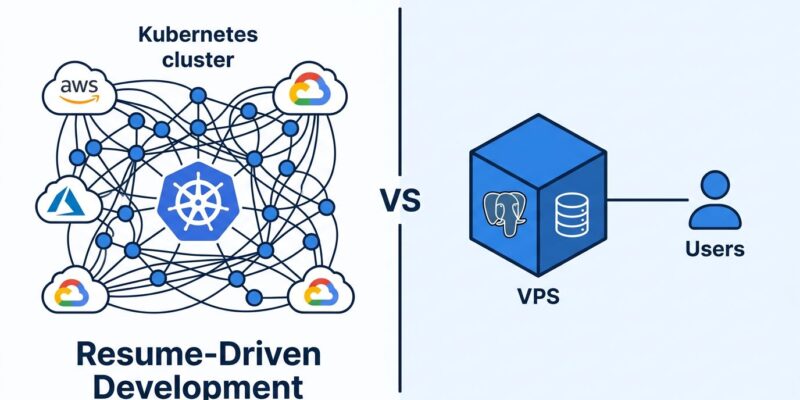
Kubernetes makes sense when managing dozens of services across environments with strict security controls. That describes 10% of companies, not 90%. For everyone else, a VPS, PostgreSQL, and a monolith will ship products faster and cheaper than the resume-optimized alternative.