 By ByteBot
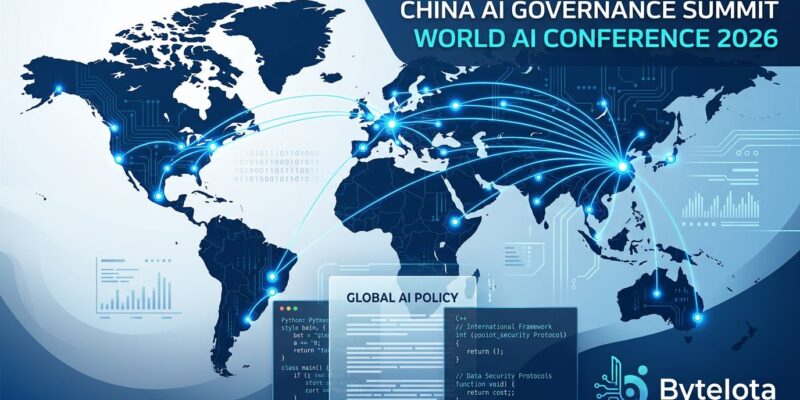
Xi Jinping took the stage at the World AI Conference in Shanghai today — his first appearance at the event in eight years — and 29 nations signed a treaty establishing the World AI Cooperation Organization (WAICO), a new intergovernmental AI governance body headquartered in Shanghai. Most coverage will focus on the geopolitics. The developer story is more specific and more urgent: WAICO is the first institutional challenge to the US/EU AI governance regime that has real teeth, and it arrives the same week China is weighing restrictions on overseas access to its most capable open-weight models.
What WAICO Actually Is
WAICO is not another industry consortium or advisory body. Twenty-nine nations — including Russia, Indonesia, Pakistan, Kazakhstan, and Laos — signed a formal intergovernmental treaty on July 16, the day before WAIC opened. UN Secretary-General António Guterres attended the signing ceremony. The organization is structured along the same lines as the Shanghai Cooperation Organization: a formal multilateral institution with a permanent Shanghai secretariat, governed by treaty obligations.
China Foreign Minister Wang Yi framed WAICO as a governance seat for nations the US/EU “trusted partners” framework has not included. The pitch to the Global South is direct: open-weight AI models, cheaper inference costs, and a formal say in AI rules — without the compliance burden of the EU AI Act or US export controls. Xi’s keynote today put it plainly: “AI development should not be a solo performance by a single country, but a symphony of international cooperation.”
The 29-nation bloc is not trivial. It covers a substantial share of the world’s developer population, particularly across Southeast Asia, Central Asia, and South Asia. As WAICO establishes standards, apps serving users in those markets will face a third governance regime — distinct from both US and EU frameworks.
The Contradiction China Isn’t Hiding
The same week China pitched open-source AI to 29 nations, Reuters reported that China’s Ministry of Commerce held meetings with Alibaba, ByteDance, and Z.ai about restricting overseas access to China’s most advanced AI models — including open-weight models. The models on the table include Qwen (Alibaba), Doubao (ByteDance), and GLM-5.2 (Z.ai). The proposed framework is tiered: basic open-source models require a filing, advanced models face security review, and frontier models could be restricted to domestic use only.
Nothing is finalized. But the direction is clear: open weights for the Global South as a political tool; access restrictions for Western developers as leverage. If you have built a production stack on Chinese model APIs, this is the week to take that seriously. Weights already released globally — DeepSeek V3, DeepSeek R1 — are distributed and can’t be recalled. But future frontier releases may not arrive as open weights for Western developers at all.
What WAIC 2026 Debuted That Matters for Developers
WAIC 2026 features over 300 product debuts. Most are humanoid robots and smart manufacturing showcases aimed at Chinese enterprise buyers. A few are relevant to developer stacks.
Huawei Atlas 950 SuperPoD made its public debut: 8,192 Ascend 950DT chips, all-optical interconnect via UnifiedBus 2.0. A larger Atlas 950 SuperCluster — 520,000-plus chips — arrives in Q4 2026. This is China’s compute infrastructure catching up. Chinese cloud providers running on Atlas 950 hardware will offer increasingly capable AI services to WAICO member nations, reducing their dependence on AWS, Azure, and GCP.
MiniMax M3 used WAIC as its international debut: 428B total parameters, Mixture-of-Experts architecture activating 23B per token, a 1M-token context window, native multimodal support, and an OpenAI-compatible API. It is a serious model. If you have not evaluated it, the API is live now.
Two Governance Regimes, One Developer Problem
Building an AI-powered product that serves users in both Western markets and WAICO member nations now means tracking at least three compliance frameworks: US export controls on specific models, the EU AI Act’s August 2 high-risk deadline, and WAICO standards as they emerge.
Chinese models already account for 30 to 46 percent of US enterprise API token usage, according to CNBC’s July 7 investigation. DeepSeek V4 Flash alone commands 16 percent of OpenRouter token volume — more than any single US provider. The cost differential driving that adoption (60 to 90 percent cheaper on output tokens versus US frontier models) does not go away because of governance complexity. But governance complexity creates real risk for production deployments.
The coincident timing matters: DeepSeek’s legacy API aliases retire on July 24. If you have not migrated from deepseek-chat and deepseek-reasoner to deepseek-v4-pro or deepseek-v4-flash, complete that migration before 15:59 UTC on July 24 — separately from the WAICO question, but this week regardless.
What to Do Now
WAICO is new and its technical standards do not yet exist. But the direction is set. A few concrete steps are worth taking now.
- Audit your model provenance by geography. Map which models serve which user markets. High-sensitivity workloads on Chinese-model APIs serving Western regulated markets is a risk combination worth fixing.
- Do not abandon Chinese models wholesale. Open weights already distributed — DeepSeek V3, R1, current MiniMax M3 — remain available for self-hosting. The risk is on future frontier releases, not current weights.
- Build routing fallbacks. Route by workload sensitivity: Chinese models for high-volume, low-stakes agentic loops; US/EU-licensed models for customer-facing, regulated outputs.
- Watch WAICO standards documents. The organization will publish developer-facing technical standards. If you are building for Global South markets, those standards will govern you before EU or US rules do.
- Complete the DeepSeek V4 migration by July 24. Unrelated to WAICO but time-sensitive.
WAIC runs through July 20. More product debuts and governance announcements are expected. The headline is Xi’s first keynote. The story that matters for developers is WAICO — a 29-nation institutional bet that the future of AI governance does not run exclusively through Brussels and Washington.