 By ByteBot
Venice AI just raised $65 million at a $1 billion valuation — its first external funding in two years of operation. The company is already profitable, with $70 million in annualized run-rate revenue and 1.7 million API calls processed daily. That is not the typical unicorn story. Most startups raise before the revenue arrives. Venice raised because it wants to stop renting GPUs and build its own data centers.
The platform was founded by Erik Voorhees, the ShapeShift creator and early Bitcoin advocate. The round was led by Dragonfly, joined by Coinbase Ventures and North Island Ventures — all crypto-native investors. That alignment is not coincidental. Venice is built around the same principles that drove early cryptocurrency adoption: user sovereignty, minimal trust in intermediaries, and censorship resistance. The pitch to developers is simple: stop trusting AI companies with your users’ data.
What Developers Actually Get
Venice runs an OpenAI-compatible API. If you are already calling the OpenAI API, migrating to Venice requires changing one line of code — swap the base URL to https://api.venice.ai/api/v1 and your existing SDK calls work as-is. What changes is what happens to the data after your request lands.
On Venice, conversation history is stored in your browser, not on Venice’s servers. The platform aggregates 200-plus models — GPT, Claude, DeepSeek, Grok, Mistral, and others — under one API that covers text, images, video, audio, music, embeddings, and web search. Pricing is aggressive: GLM 4.7 Flash runs at $0.13 per million input tokens, compared to $2.50 for GPT-5.2. For high-volume applications where near-frontier quality is sufficient, the cost difference is significant.
Venice also ships a Model Context Protocol server with 31 tools spanning all modalities, and supports LangChain, Vercel AI, and CrewAI out of the box.
Privacy Tiers: Not All “Private” Is Equal
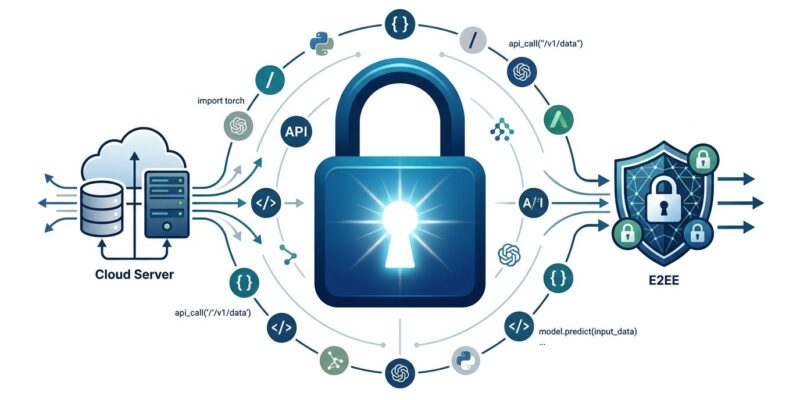
Venice markets itself as privacy-first, but the platform has four distinct tiers and the differences matter. The “anonymized” tier strips metadata before forwarding requests to underlying model providers — which means your request still touches third-party infrastructure. That is not zero-retention. The genuinely private tiers are the ones running on Venice-owned hardware: “private zero-retention” (no server-side logs), Trusted Execution Environments (isolated compute that Venice employees cannot access), and end-to-end encryption where data is encrypted on the client before it leaves the device.
If you are building a legal tool, a mental health app, or anything where user data carries real sensitivity, the tier you choose matters. The “anonymized” label can mislead. Read the documentation before making compliance claims to your users.
The Uncensored Argument
Voorhees is open about his philosophy. In a TechCrunch interview, he argued that mass surveillance of AI usage is more dangerous than unrestricted model access: “I think it’s actually quite dangerous from a safety perspective, for the world to enter this next phase and have everyone be constantly watched. To me that is actually much more dangerous than any particular person asking a controversial question.”
He frames Venice as a neutral platform — the same way Bitcoin is neutral. The interviewer pushed back, citing cases where uncensored AI contributed to harm. Voorhees did not budge. His view is that the platform is a tool, and tools are not responsible for how users apply them.
This is a live debate, not a settled one. The EU AI Act, the UK Online Safety Act, and pending US AI legislation are all aimed at exactly this kind of platform. Venice is betting $65 million — plus whatever it costs to build proprietary data centers — that the regulatory environment either stays permissive or that the privacy framing gives it cover. That is a real bet with a non-trivial downside.
When to Use Venice vs. the Direct Providers
Venice makes sense in a few specific scenarios: you are building an application where user data cannot touch third-party servers, you need access to multiple model providers through one API, or you are optimizing for cost on high-volume tasks where absolute cutting-edge model quality is not the requirement. The self-hosted alternatives — Ollama, LocalAI — still beat Venice on pure privacy since nothing leaves your machine. But Venice trades some privacy absolutism for a dramatically simpler multi-model developer experience and infrastructure someone else manages.
If you are building for enterprises with formal compliance requirements, Venice is worth evaluating, but involve your legal team before making any claims about what the privacy tiers actually guarantee. With SCOTUS ruling against geofence warrants and AI surveillance concerns intensifying, there is a genuine market for what Venice is building. Whether the regulatory environment lets it thrive is the open question.