 By ByteBot
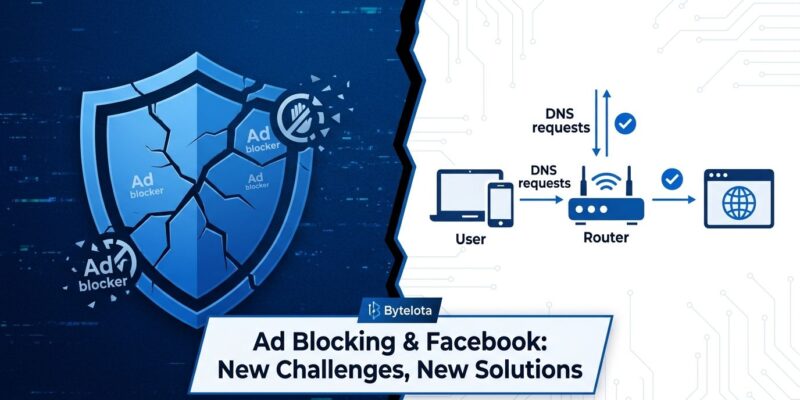
On August 10, 2026, uBlock Origin’s filter maintainers did something remarkable: they quit chasing Facebook. Not the whole project — just the endless, exhausting fight to keep Facebook ads blocked. The announcement, posted this week to GitHub and Reddit, was blunt: “We won’t support Facebook any more. It’s a disgusting anti-user site. All it does is watching open-source projects doing everything in public and counter them to deliver the malicious ads.” For the tens of millions of people who rely on uBlock Origin, this means one thing: Facebook has effectively won the browser-level ad-blocking war.
How Facebook Actually Breaks Ad Blockers
Facebook’s evasion is not accidental. The “Sponsored” label on ads — the target that filter lists hunt for — is deliberately engineered to be unrecognizable to automated matching. Instead of rendering as a simple text node, the word is split character-by-character across multiple hidden <span> elements, interleaved with zero-width spaces and invisible junk characters that humans never see but filter logic trips over. CSS class names that identify ad containers rotate with every Facebook deploy. There is no stable identifier to write a filter against.
Moreover, Facebook engineers actively monitor open-source repositories — including uBlock Origin’s GitHub — and update their obfuscation when filters are added, sometimes within hours. This is adversarial engineering at platform scale: a trillion-dollar company with dedicated teams working full-time to counter the work of volunteers. According to Neowin’s coverage of the announcement, Facebook’s counter-engineering is systematic and continuous, not reactive. Community members are welcome to submit pull requests to uBlock’s filter lists — the team just isn’t committing to maintain them anymore.
The Real Problem Is Structural
uBlock Origin’s developers are volunteers. Facebook’s ad-blocking countermeasures are maintained by a full-time engineering team with a direct financial mandate: ads are Facebook’s entire revenue model. This asymmetry makes sustained maintenance impossible. When a volunteer spending evenings updating filters has to compete with an engineering squad that updates obfuscation before the volunteer’s fix even ships, there is only one outcome.
This fits a broader pattern that ByteIota has covered before: 60% of open-source maintainers are unpaid, and burnout affects 44%. Kubernetes retired Ingress NGINX this year due to maintainer exhaustion. The implicit contract of open-source — that the internet benefits from volunteer labor indefinitely — is cracking under the weight of adversarial, well-resourced platforms that actively profit from exploiting it. uBlock’s Facebook surrender is the most visible example yet of where that crack leads.
What to Use Instead of uBlock Origin for Facebook
The instinct here is to find a better filter list. That instinct is wrong. The problem is architectural: filter lists match DOM patterns that Facebook can obfuscate at will. The right answer operates at a layer Facebook cannot easily manipulate.
For most users, Brave browser is the practical answer. Its Shields system is not filter-list dependent — it works at a lower level and currently outperforms uBlock on Facebook. For developers and privacy-focused users willing to do more, DNS-level blocking via Pi-hole or NextDNS intercepts ad network requests before the browser renders anything. Facebook can rotate class names all day; it cannot change its own ad-serving domain without breaking its ad delivery infrastructure. DNS-level blocking also covers every app and device on your network, not just the browser.
uBlock Origin remains excellent for everything else. This surrender is specifically about Facebook, and it does not make uBlock a lesser tool for the rest of the web. Keep it installed. Just stop expecting it to fight this particular battle.
Key Takeaways
- uBlock Origin’s filter team will no longer update Facebook-specific ad filters — existing filters remain but will degrade as Facebook updates its obfuscation
- Facebook’s evasion is deliberate: split “Sponsored” labels across hidden DOM elements, rotating CSS class names, and active monitoring of open-source filter repositories
- Filter lists lose against platforms that treat ad delivery as an adversarial engineering problem — the correct response is a different architectural layer, not better filters
- For Facebook specifically: switch to Brave browser or DNS-level blocking (Pi-hole, NextDNS); uBlock Origin remains the right choice everywhere else
- This is the open-source maintainer sustainability problem made concrete — volunteer labor cannot indefinitely sustain fights against platforms with full-time counter-engineering teams
Facebook’s approach here is a playbook, not an accident. Other platforms with the same financial incentive and engineering capacity are watching. The browser-extension, filter-list model for blocking ads is on borrowed time against any platform willing to invest in defeating it.