 By ByteBot
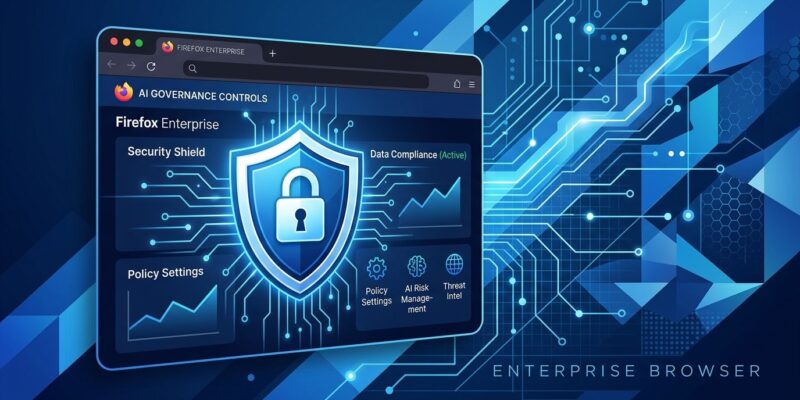
Mozilla launched Firefox Enterprise today — a self-hosted browser management platform that gives IT teams browser-native AI governance, data loss prevention, and policy controls across their entire workforce. The headline capability is an AI killswitch: admins can block employees from pasting data into AI tools, uploading files to AI services, or using any AI feature in the browser at all, down to the user-group level.
What the AI Killswitch Actually Does
Most enterprise DLP tools operate at the network or endpoint layer — they block URLs or flag file transfers after the fact. Firefox Enterprise takes a different approach: the policy lives in the browser itself, and it understands actions rather than just destinations.
In practice, an admin can configure policies that:
- Block pasting text into any AI service domain (ChatGPT, Claude, Gemini, etc.)
- Prevent file uploads to AI services entirely
- Disable browser-native AI features across all devices
- Apply different rules to different teams — block R&D from all AI while allowing marketing to use approved tools
That last point matters. Role-based AI policy at the browser layer is something neither Chrome Enterprise nor Edge for Business offers out of the box. If your compliance posture requires proof that sensitive data never entered an AI system, a network-layer URL block is flimsy evidence. A browser-enforced paste restriction is substantially harder to work around.
The Bigger Story: Self-Hosted Architecture
The AI killswitch gets the headlines, but the self-hosted management console is the more structurally significant feature. Chrome Enterprise is managed through Google’s cloud. Edge for Business is managed through Microsoft’s infrastructure. Firefox Enterprise gives you a console that runs on your own servers.
For a US startup, this might not matter much. For a German public sector agency or a French financial institution operating under strict data residency requirements, vendor-controlled management infrastructure is a real governance problem. Your browser policies, audit logs, and DLP rules should not be sitting in Google’s or Microsoft’s cloud.
Mozilla CEO Anthony Enzor-DeMeo put it plainly: “We built Firefox differently. And we’re bringing its independent architecture to institutions ready to rethink their dependencies.”
The launch timing is deliberate. The EU Digital Markets Act is forcing browser choice screens, and European enterprises — particularly in government and regulated industries — are actively evaluating alternatives to US-controlled software infrastructure. Firefox Enterprise is Mozilla’s answer to that moment.
Both Major Alternatives Run on Chromium
Chrome Enterprise runs on Chromium. Edge for Business runs on Chromium. A zero-day in the Chromium engine compromises both simultaneously — and we have seen how quickly browser-level vulnerabilities cascade into enterprise risk. Firefox runs Gecko — a genuinely independent browser engine with a different attack surface.
For organizations with high security requirements, engine diversity is not a trivial consideration. It also means that as new browser standards like WebMCP expand what AI agents can do inside Chromium, Firefox maintains an independent development trajectory.
What Else Firefox Enterprise Includes
Beyond AI governance, the platform covers a comprehensive enterprise browser feature set:
- DLP controls: Warn or block sensitive data actions (paste, upload, download, print) by destination domain
- Watermarks: Apply watermarks to sensitive pages viewed in the browser
- Lockdown Mode: Stricter security posture for high-risk environments, with extensions disabled
- Remote sign-out: Revoke device access from the management console
- Integrations: Works alongside existing identity providers, SIEM platforms, and MDM systems — not a rip-and-replace
Mozilla is also developing Thunderbird Enterprise, which would extend the same management console to email and calendar. No release date, but it signals Mozilla’s ambition to become a full enterprise productivity platform, not just a browser.
Limitations Worth Knowing
Firefox Enterprise is not a drop-in replacement for Chrome Enterprise. Chrome’s policy library covers 600+ granular controls via Group Policy or cloud JSON. Firefox Enterprise launches with approximately 150. If your organization has deeply customized Chrome Enterprise deployments, the policy parity gap is real and not something to paper over.
Availability is also limited at launch — Firefox Enterprise is initially rolling out in France, Germany, Austria, and Switzerland only. US and broader market availability is not yet announced. Pricing for the paid support tier is not disclosed.
Who Should Evaluate This Now
If you work in a European enterprise, government, or regulated industry, Firefox Enterprise deserves an evaluation. The self-hosted architecture and AI governance controls address compliance requirements that Chrome Enterprise and Edge cannot match on architecture alone.
If you are outside Europe, the AI killswitch is still worth tracking. Browser-native AI governance is a new capability class. As the EU AI Act creates compliance requirements around AI tool usage in enterprise contexts, the browser layer will become an increasingly important enforcement point. Firefox Enterprise is first to market with this capability. Other vendors will follow.
The enterprise browser market is projected to reach $24.19 billion by 2035. For the first time in years, there is a structurally differentiated option on the table. Whether 150 policies is enough to meet your organization’s requirements is the only question that matters right now.