 By ByteBot
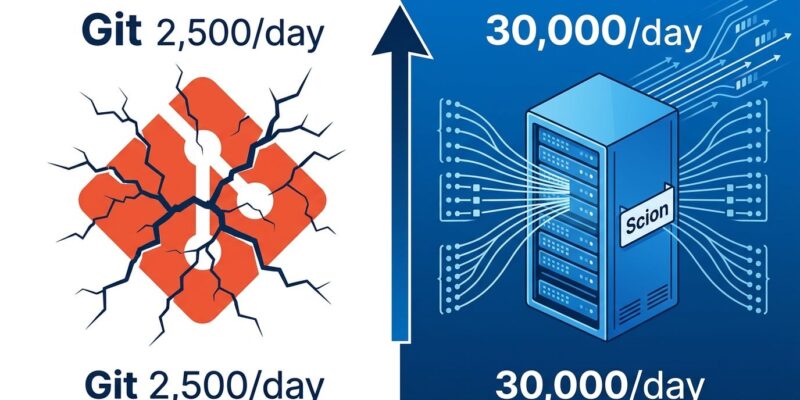
Yesterday, Anthropic published an engineering post revealing it has fully replaced Git across its monorepo with an in-house system called Scion — because Claude wrote so much code that Git broke. Between May and September 2026, AI coding agents drove daily merges from 2,500 to over 30,000, a 12x surge in four months. A seven-person team built Scion and a companion code review tool called Antique, then migrated the entire monorepo in five months. Anthropic warns this class of infrastructure problem will become “more commonplace over the next 6–12 months” as AI coding tools proliferate across engineering orgs.
The Numbers That Killed Git
Git was built for humans working at human pace, often offline. Its distributed model gives every client a full local copy of the repository — a property that made Git revolutionary for open source collaboration and remote teams. At Anthropic’s scale, however, that same design became catastrophic. With 25 million CI checkouts per day against a 100GB repository history and 25GB compressed working copies, maintaining Git’s model would have generated over 600 petabytes of daily traffic. That’s not a performance problem you tune your way out of — it’s an architectural mismatch.
The root issue is simpler than the numbers suggest. Git assumes clients might be offline. Anthropic’s AI agents are never offline. According to the engineering post, “the properties that make git excellent for distributed, offline work were actively undermining our ability to scale.” When your heaviest committer is a machine that’s always connected, offline capability isn’t a feature — it’s overhead you pay for constantly.
Related: GitHub Rewrote Copilot in Rust Using Copilot: What Actually Happened
How Scion Source Control Works
Scion’s core insight is moving everything to the server. Instead of Git’s commits — full directory snapshots — Scion uses changesets: write-ahead log entries that record only changed files with content-addressed pointers. Clients maintain sparse, virtualized checkouts and fetch only the files they actually need. Commits, merges, blame queries, and history all happen via remote procedure calls, not local operations.
The results are stark. Scion’s infrastructure footprint is 200x smaller than Anthropic’s previous Git mirror fleet. Checkout times dropped from minutes to seconds. CI reclaimed 25% of its CPU capacity. Cache hit rates across three tiers — local daemon, regional servers, authoritative Spanner storage — stay above 99%. For a company running 25 million CI checkouts per day, these aren’t marginal gains.
The tradeoff is real and Anthropic doesn’t hide it: Scion is centralized. No offline support. No distributed copies. Structurally closer to Subversion or Perforce than Git. That’s not a regression in principle — it’s a deliberate choice for an environment where always-online agents dominate the commit history. For everyone else, it would be a significant workflow disruption.
AI Built Its Own Replacement
The meta-story here is worth sitting with. Claude agents wrote so much code that Git collapsed under the load, so Anthropic turned to Claude agents to build the replacement. According to the engineering post, Claude produced most of Scion’s implementation. Engineers set architecture, defined scaling targets, and enforced system invariants — “the role of the engineers was to tell Claude ‘no.’” An early Claude Mythos Preview instance specifically rewrote the Git-to-Scion data ingestion pipeline, cutting memory usage 20x and improving speed 4x.
The pattern is consistent with tsc-rs, the Rust TypeScript compiler built with Claude for $24k — small teams shipping infrastructure-grade tools in compressed timelines because AI handles implementation. Seven engineers, five months, full monorepo migration. That timeline would have been implausible three years ago.
What This Means for Your Team
Scion is closed source. Anthropic explicitly says it “is by no means a suitable replacement for git for general use” and that adoption would require extensive changes across an organization’s entire development toolchain. You can’t use it. However, that’s not really the point. Anthropic is signaling that it wants to work with GitHub, GitLab, and the open-source community to bring Scion’s architectural ideas upstream — server-side operations, sparse virtual checkouts, concurrent merge strategies.
Meanwhile, the Hacker News discussion on Scion (579 points, sharply divided) surfaces the uncomfortable question: are 30,000 merges per day real engineering value, or is this what AI churn looks like at scale? It’s a fair challenge. However, the question somewhat misses the point. Uber’s engineering team independently published GitFarm, a Git-as-a-Service approach that hit similar bottlenecks in 2025 — keeping Git compatibility while adding server-side operations. Two companies, different architectures, same underlying problem.
You likely won’t hit 30,000 merges per day. But if your team is shipping with AI coding agents at any meaningful scale, Git’s assumptions are going to start creaking. The question isn’t whether this hits your infrastructure. It’s when.
Key Takeaways
- Anthropic replaced Git with Scion after Claude-driven agents pushed merges from 2,500 to 30,000+ per day in four months — Git’s offline-first design became the bottleneck
- Scion uses changesets instead of commits, moves all operations server-side, and achieves 200x smaller infrastructure, 100x faster checkouts
- Claude built most of Scion; engineers spent their time on architecture and constraints, not implementation — a preview of AI-native developer infrastructure
- Scion is closed source and unsuitable for general use, but Anthropic plans to bring the concepts to GitHub, GitLab, and open-source Git
- Uber independently hit the same Git scaling problem in 2025 — this is not a one-company edge case; it is a pattern arriving at AI-forward engineering orgs