 By ByteBot
Self-hosting surged 40% since 2023, with Vaultwarden password manager search interest jumping 83% year-over-year. This isn’t hobbyist tinkering anymore. Conversations in self-hosting communities evolved from “what should I run?” to sharing sophisticated infrastructure stacks that rival small business setups. Cloud fatigue is real—subscription exhaustion, price creep, feature removal, and service sunsets are driving developers back to self-hosted infrastructure. The 2026 homelab stack has standardized around specific technologies that prove cloud isn’t always the answer.
Cloud Fatigue is the Driver
The self-hosting surge isn’t just about cost. It’s about control, privacy, and escaping vendor lock-in. Developers are tired of subscription exhaustion—password managers, cloud storage, media streaming, and VPNs add up to $336-840 annually for services you can replace with self-hosted alternatives. Moreover, price creep hits after you’re locked in. Features that were free get paywalled. Services you depend on get sunset because they weren’t profitable enough.
Trust is dying in major tech companies. Google, Backblaze, and Cal.com are all trust stories in 2026. Consequently, the migration destination is overwhelmingly self-hosted open-source alternatives. Vendor lock-in feels less risky when the vendor is you.
The 2026 Technology Stack
The 2026 homelab stack has clear winners. These aren’t arbitrary choices—specific technologies won for concrete reasons.
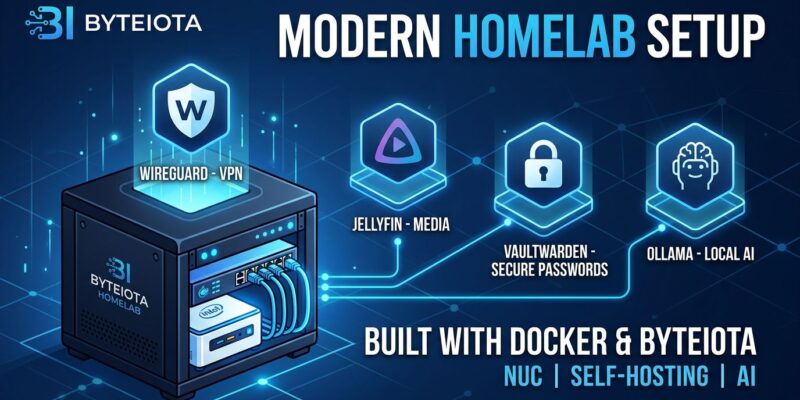
WireGuard replaced OpenVPN as the standard for remote access. The speed difference is noticeable, and configuration is dramatically simpler. You set up WireGuard in minutes instead of hours.
Jellyfin won the media server wars. Plex’s increasingly aggressive monetization pushed users toward this fully open-source alternative. Jellyfin’s plugin ecosystem exploded in 2026, closing feature gaps that previously kept Plex competitive. When you start paywalling features users expect, they leave.
Vaultwarden overtook self-hosted Bitwarden for password management. The resource difference is extreme: Vaultwarden uses 50 MB of RAM compared to Bitwarden’s 2+ GB. That’s 40 times lighter. Vaultwarden is a single container with SQLite—no external database required. It runs on a Raspberry Pi and works with all official Bitwarden clients. For 99% of self-hosters, Vaultwarden is the obvious choice.
Gitea surpassed GitLab for personal git hosting due to lower resource usage. GitLab is enterprise-grade and brings enterprise-grade resource demands. Gitea delivers lightweight Git hosting with enterprise-level version control on minimal hardware.
AdGuard Home replaced Pi-hole for network-wide ad blocking. Same functionality, modern interface, better user experience.
AI Integration: 2026’s Biggest Shift
Local AI is the most significant 2026 homelab development. Ollama made running large language models trivially easy. Hardware requirements dropped dramatically—the phi model runs on 4GB of RAM, perfect for homelab automation. Ollama + Open WebUI became the standard stack for local LLMs.
Use cases went beyond experimentation. Homelabbers integrated local AI into document search, photo tagging, and code completion. Home Assistant runs intent detection and natural language commands without cloud dependencies. n8n workflow automation connects to Ollama for prompts and responses. You get a ChatGPT-style interface via Open WebUI, but the model runs on your hardware. No cloud API calls. Complete privacy.
This matters. When you send code or documents to cloud LLM APIs, you’re handing your data to companies with opaque data retention policies. Local AI means your data stays local. Privacy isn’t a feature—it’s the architecture.
Cost Comparison: Cloud vs VPS vs Home
Real cost comparison matters. Cloud services for password management, storage, media, and VPN run $336-840 per year. Those are services you can self-host.
A Hetzner VPS with 2 vCPU, 4 GB RAM, and 60 GB SSD costs €7 per month. MassiveGRID offers similar specs for $8-12 monthly. A beefier 4 vCPU, 8 GB RAM setup runs $25-35 per month. That’s fixed, predictable pricing with included bandwidth.
Home hardware is a one-time cost. An old laptop, a NUC, or a Raspberry Pi works. Electricity is minimal for low-power devices. Internet is already paid for.
Hidden time costs are real but often overstated. Initial setup takes 4-8 hours. Routine maintenance is 1-2 hours per month. Adding a new service with AI-assisted deployment takes 20-30 minutes. If you value your time at $75/hour, the opportunity cost is $1,500-$2,600 annually. For most developers, that’s acceptable when weighed against control, privacy, and learning.
Trade-Offs You Need to Know
Self-hosting isn’t perfect. Uptime is your responsibility. Power outages take services down unless you add a UPS. Monitoring is manual. Backup strategies are often neglected—single NVMe drives without RAID are common. Complexity is higher than cloud managed services.
However, the benefits matter. You control your data and infrastructure. Privacy is architectural, not promised. You learn how systems work deeply. Costs are predictable—no surprise bills from usage spikes. And tinkering is fun. The homelab philosophy in 2026 is pragmatic: “Perfection isn’t the goal—understanding how things work is. That’s the real value.”
When cloud services are convenient until they’re not—when features disappear, prices jump, or services shut down—self-hosting looks less like a hobby and more like infrastructure sovereignty.
Key Takeaways
- Self-hosting surged 40% since 2023, driven by cloud fatigue, subscription exhaustion, and desire for data ownership.
- The 2026 stack has clear winners: WireGuard (VPN), Jellyfin (media), Vaultwarden (passwords), Gitea (git hosting), Ollama (local AI).
- Local AI integration is 2026’s biggest shift. Ollama + Open WebUI became standard for running LLMs locally with complete privacy.
- Cost comparison favors self-hosting for predictable workloads: VPS costs €7-35/month vs $336-840/year for cloud services you can replace.
- Cloud still wins for variable traffic and auto-scaling, but the “cloud-first” dogma is facing correction. For many developers, owning infrastructure beats vendor lock-in.