 By
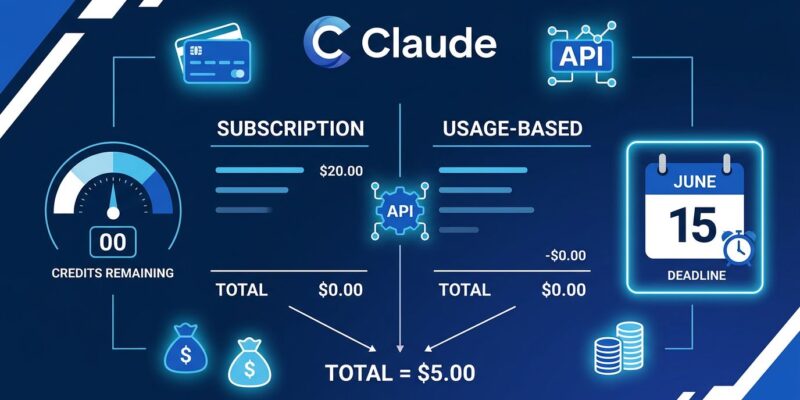
By Anthropic is splitting Claude’s billing on June 15. If you use the Agent SDK, claude -p, Claude Code GitHub Actions, or third-party tools like Zed, Conductor, or OpenClaw tied to your subscription, you have 11 days to understand what changes — and to claim the credit that replaces what you had. Miss the window and your automated workflows may simply stop.
What Moves, What Stays
The split draws a clean line between interactive and programmatic use. Everything automated moves to the new credit pool on June 15. Everything you type manually stays on your existing subscription limits.
| Usage Type | After June 15 |
|---|---|
| Claude.ai (web/desktop/mobile chat) | Subscription — unchanged |
| Claude Code in terminal (interactive) | Subscription — unchanged |
| Claude Cowork | Subscription — unchanged |
| Claude Agent SDK | Agent SDK Credit Pool |
claude -p (non-interactive CLI) | Agent SDK Credit Pool |
| Claude Code GitHub Actions | Agent SDK Credit Pool |
| Zed, Conductor, OpenClaw, Jean, T3 Code | Agent SDK Credit Pool |
If you are not sure whether your setup qualifies as “programmatic,” a practical test: did Claude run without you typing a prompt in real time? Then it was programmatic, and it will now draw from the credit pool.
The Credits
Anthropic is adding a fixed monthly “Agent SDK Credit” to each paid plan. The credits are billed at standard API rates — not subscription rates — and they expire at the end of each billing cycle.
- Pro ($20/month): $20 in Agent SDK credit
- Max 5x ($100/month): $100 in Agent SDK credit
- Max 20x ($200/month): $200 in Agent SDK credit
Credits are per-user. They do not pool across a team. They do not roll over. And they are billed at full API list prices: Sonnet 4.6 runs at $3 per million input tokens and $15 per million output tokens. That $200 monthly credit on a Max 20x plan buys roughly 5,000 to 6,500 average-length agent responses — and far fewer if you are running long-context or multi-step reasoning chains.
The Math No One Wants to Do
The compute arbitrage era for Claude subscriptions is over. A $20 Pro subscription was, for heavy users, generating $200 to $600 or more in actual API compute per month. Theo Browne, creator of T3 Code, calculated a 25x effective price reduction for programmatic access. Boris Cherny, head of Claude Code at Anthropic, described the reality bluntly: “Third-party tools operating outside the cache system are really hard to do sustainably.”
This was always going to happen. The question was when, not if. For the developers building production agent pipelines on a $20 subscription, the answer is June 15.
How to Claim Your Credit
Anthropic is sending eligible users a credit-claim email on or around June 8. You must claim the credit manually through your Claude account settings. After the first claim, it auto-refreshes each billing cycle. It is worth doing this promptly — if the June 15 cutover hits before you have claimed, your programmatic usage may be interrupted until you do.
The official Anthropic Help Center article has the step-by-step claiming instructions once the email arrives.
If You Exceed the Credit
You have two options when the monthly credit runs dry. In your account settings, you can enable “usage credits” — overages continue at full pay-as-you-go API rates, which can compound fast during active agent sessions. Or you can leave usage credits disabled — programmatic usage stops when the credit is exhausted, and your interactive Claude access remains untouched either way.
Choose based on your risk tolerance for unexpected bills, not on optimism about your agent’s efficiency.
Reduce Costs Before June 15
Three techniques cut effective token costs significantly within the new credit pool:
- Prompt caching: Cache hits cost 10% of the standard input price. Any repeating system prompts, few-shot examples, or tool definitions should be cached.
- Batch API: If your workload can tolerate async processing within 24 hours, the Batch API offers 50% off both input and output tokens.
- Stack them: Both discounts apply together. Highly cacheable batch workloads can achieve 90%+ effective cost reduction.
Before June 15, run your usage dashboard and get an honest estimate of your monthly token volume. The canonical pricing analysis by MagnaCapax documents real-world scenarios ranging from 12x to 175x effective cost increases by workload type — a useful calibration if your pipelines are not already cache-optimized.
What to Do Right Now
Check whether any of your workflows — personal scripts, GitHub Actions, third-party integrations — call Claude via the Agent SDK or claude -p. If yes: watch for the June 8 claim email and claim your credit before June 15. Audit your token usage, enable prompt caching where applicable, and decide whether you want automatic overage billing or a hard stop when the credit runs out.
For a detailed breakdown of which third-party tools are affected and how their teams are responding, Zed’s blog post on the change is worth reading, as is the Codersera developer action guide.