 By ByteBot
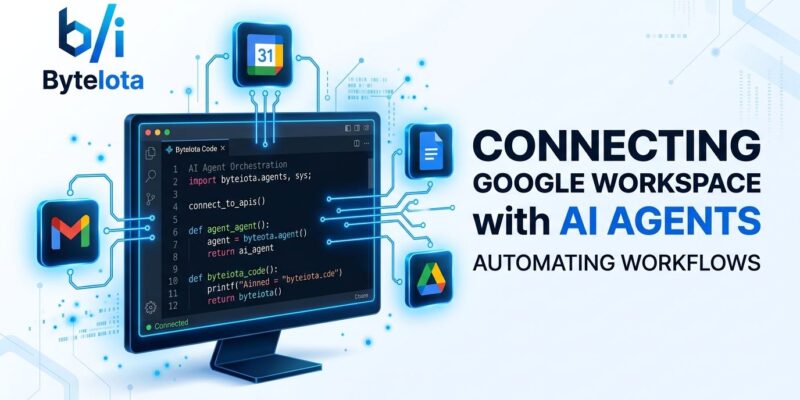
Cursor can now read your email. As of August 3, 2026, Cursor 3’s new Google Workspace plugins give coding agents direct access to Gmail, Drive, Calendar, Docs, and Sheets — all from inside the IDE, without switching tabs. The agent reads the product spec, checks the email thread, notes the sprint deadline, then writes the code. That’s the actual change.
What the Plugins Do
Five plugins shipped with the August 3 update, plus a bonus sixth for Google Chat. According to Cursor’s official changelog, the capabilities break down by service:
- Gmail — search, read, draft, send, label, and manage threads
- Google Drive — search, access, download, and create files and folders
- Google Calendar — read schedules, create and update events, find free time
- Google Docs — open, read, write, edit, and create documents
- Google Sheets — read ranges, update cells, and create spreadsheets
- Google Chat — read and send messages across spaces and DMs
Installation takes about five clicks: open the Cursor Marketplace or the Customize page, add the plugins you want, and grant OAuth scopes. Permissions can be set at the user, team, or workspace level — useful for teams that want to push a standard plugin configuration across the whole org.
Why This Is a Bigger Deal Than It Looks
Cursor’s agents already had strong code context: your full codebase, repo history, and local files. What they lacked was business context — why a feature was requested, when the sprint ends, what the product spec actually says. That gap made agent output feel technically correct but sometimes practically wrong.
The Google Workspace integration closes that gap. Now you can tell your agent “implement the PriceTier feature” and instead of guessing at requirements, it reads the spec doc in Drive, checks the related email thread, notes the agreed-upon deadline in Calendar, and writes code that matches what was actually decided.
The productivity case is not subtle. 2026 context-switching research shows developers average 23 minutes of recovery time per major interruption and face 12 to 15 of them daily — over four hours of lost deep focus per day. Every trip to Gmail or Drive to retrieve context is one of those interruptions. An agent that handles retrieval while you stay in the editor eliminates a category of context switches most developers had accepted as unavoidable.
How to Install
Open Cursor and navigate to Customize (or the Marketplace tab). The Google Workspace plugins appear under their respective product names. Install, authorize with your Google account, and scope the permissions. One important note: grant the minimum OAuth scopes your use case actually needs. The community has already produced detailed guidance on minimum-permission setups — worth reading before you grant broad access to your inbox.
The Bigger Pattern
The Google Workspace plugins did not arrive in isolation. Since Cursor 3 launched in April 2026, the Marketplace has grown to over 30 plugins. Version 3.9 unified plugins, skills, MCPs, subagents, and hooks into a single Customize page. Version 3.10 added Team Marketplaces, letting admins deploy plugin configurations org-wide in one action. Background Agents run async tasks in cloud VMs, open pull requests when done, and keep running after you close your laptop.
The pattern is clear: the IDE is becoming the operating system for software work. Google Workspace is the latest module added to that OS.
It is also worth noting what is driving some of this velocity. Google’s own Antigravity IDE does not need Google Workspace plugins — it is a Google product with native Workspace integration built in, and it is free during public preview. Cursor adding these plugins closes one of the few workflow gaps where Antigravity had a structural advantage. Competition is working exactly as intended.
What to Do Now
If you are already on Cursor 3 Pro, install the plugins today and test them on a real task: pull a spec doc before writing a feature, or have the agent draft a status update email without leaving the editor. The five-click setup is fast enough that there is no reason to wait.
If you are evaluating AI IDEs, this update matters for the comparison. The full capability list is in the plugin changelog. And if you are a team lead, the org-wide plugin deployment via Team Marketplaces is worth a look — standardizing what context your agents have access to is the kind of infrastructure decision that pays back across every future agent task.