 By ByteBot
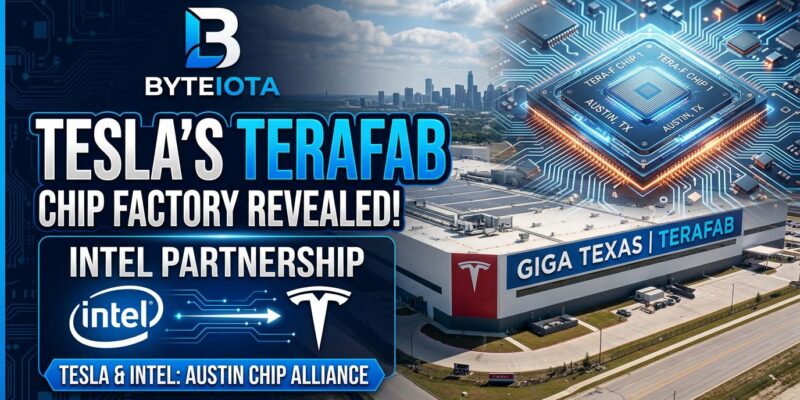
Tesla announced Terafab, a $20-25 billion vertically integrated semiconductor fabrication facility on March 21, 2026, claiming it will produce 1 terawatt of AI compute capacity annually—50 times the combined output of all current advanced chipmakers. On April 7, Intel officially joined the project as manufacturing partner, lending credibility to one of the most ambitious vertical integration bets in semiconductor history. The facility, located at GigaTexas in Austin, targets 2-nanometer process technology at 100,000 wafer starts per month—matching TSMC’s scale despite Tesla having zero semiconductor manufacturing experience.
The Intel partnership raises a critical question: Does it legitimize Tesla’s vision or reveal that Tesla can’t actually build this alone?
Intel’s Role: Manufacturing Partner or Tesla’s Admission?
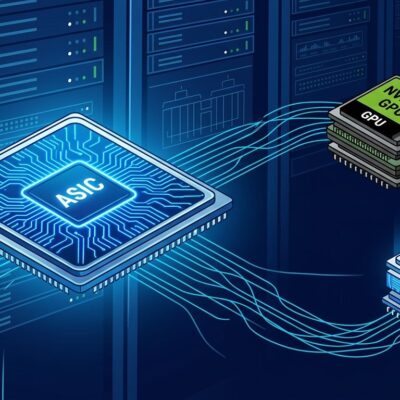
Intel joined Terafab on April 7, 2026, as the primary foundry partner, contributing its 18A process node (2nm-class technology) and manufacturing expertise. Intel’s stock surged 11% following the announcement, contributing to INTC’s 76% gain in 2026 year-to-date. The market reaction signals investor confidence that Intel gains a massive customer—Tesla, SpaceX, and xAI—while Tesla secures capacity without owning the fab’s complexity.
Here’s the contradiction: Tesla claims Terafab is vertically integrated—owning and operating chip design, fabrication, memory, packaging, and testing under one roof. But Intel, a semiconductor giant with decades of fab experience, is doing the actual manufacturing. Industry analysts suggest: “What’s actually happening is Tesla co-anchoring an Intel Foundry expansion and calling it ‘Terafab’ in press releases.”
If Tesla truly had vertically integrated manufacturing capabilities, why need Intel? The most likely explanation: Tesla is designing chips and co-locating at Intel’s facility, not building its own fab from scratch. That’s conventional foundry services with creative branding, not the revolutionary disruption Musk pitched.
Feasibility Reality Check: “No Shortcuts” Says TSMC CEO
TSMC CEO CC Wei responded to Terafab with diplomatic skepticism: “There are no shortcuts”—noting that modern foundries take approximately five years to build and ramp to volume production. Tesla claims prototype fab operational in 2026 and volume production by mid-2027. Industry consensus: This timeline is unrealistic for first-time semiconductor manufacturers attempting cutting-edge 2nm technology.
The 4680 battery cell provides precedent. Tesla promised revolutionary cell manufacturing at scale in 2020. Five years later, Tesla produces roughly 2% of its original volume goal. Critics argue: “The evidence strongly suggests Terafab will follow the same pattern: bold promises, years of delays, and results that fall well short of what was originally claimed.”
TSMC spent decades building fab expertise with thousands of engineers. Intel, with over $100 billion invested and vast experience, struggles to regain manufacturing leadership. Tesla wants to go from zero fab experience to running the world’s largest 2nm facility in 18 months. Physics doesn’t care about bold timelines. Semiconductor manufacturing is the hardest industrial challenge on Earth, requiring extraordinary precision, yield optimization, and talent. Tesla has designed chips successfully (AI4, AI5). Chip design and chip manufacturing are entirely different disciplines.
The $20B Question: Actual Cost Could Hit $50B+
Tesla estimates Terafab at $20-25 billion, but this cost is not yet incorporated into Tesla’s record 2026 capital expenditure plan. Financial analysts are significantly more pessimistic: Morgan Stanley estimates $35-45 billion in additional capex beyond stated equipment costs, while Barclays warns the total could reach “many multiples” above $50 billion. For context, Intel’s Arizona fab costs $32 billion, and its planned Ohio megafab could hit $100 billion.
The market reacted with skepticism. Tesla shares initially dropped 17% post-announcement, hitting $367.96—the lowest level in six months. While the stock later recovered 3.5% as some investors embraced the long-term vision, the volatility signals fundamental uncertainty. The market prioritizes tangible returns over strategic narratives, and Terafab’s payback timeline stretches decades if it works at all.
If Tesla needs $50 billion for Terafab, it likely requires a capital raise—its first since 2020. This impacts Tesla’s ability to fund vehicle production, Optimus robot development, and other priorities. The question isn’t whether chip independence is strategically valuable. The question is whether $20-50 billion allocated to semiconductor manufacturing delivers better returns than investing in Tesla’s core business: making profitable electric vehicles at scale.
What Terafab Actually Produces: 80% for Space, Not Cars
Terafab will manufacture two distinct chip types: AI5 inference processors for Tesla vehicles and Optimus robots (ground-based edge AI), and D3 radiation-hardened processors for SpaceX’s orbital AI satellite constellation. The AI5 chip reached tape-out on April 15, 2026—just two days ago—delivering 2,000-2,500 TOPS performance, 5 times faster than AI4, with a 384-bit memory interface and 768 GB/s to 1.536 TB/s bandwidth.
Here’s the reveal: Musk claims 80% of Terafab’s output will be D3 chips for SpaceX’s planned 1 million satellite constellation, which will function as an orbital data center. Each satellite provides 100 kilowatts of AI compute in space. Only 20% of Terafab’s capacity goes to Tesla vehicles and robots.
The 80/20 split reveals Terafab’s true purpose: powering SpaceX’s orbital AI ambitions, not just supplying Tesla vehicles. That’s fine if orbital data centers prove technically and economically viable. But SpaceX hasn’t demonstrated this works at scale yet. Tesla is committing $20-50 billion to manufacture chips for a market that doesn’t yet exist, while its vehicle business faces slowing sales and intense competition.
Vertical Integration Debate: Apple’s Fabless Success vs Intel’s Struggles
Terafab represents extreme vertical integration: consolidating chip design, lithography, fabrication, memory, packaging, and testing under one roof. This contrasts sharply with industry norms. Apple, the most successful chip designer, uses a fabless model—designing world-class M-series and A-series chips but outsourcing all manufacturing to TSMC. Intel, the vertically integrated incumbent, spent over $100 billion trying to regain manufacturing leadership but lost Apple, AMD, and Nvidia to TSMC’s superior foundry services.
Apple’s approach creates a “virtual IDM” (Integrated Device Manufacturer) without fab ownership. TSMC dedicates hundreds of engineers to Apple, customizing process technology for Apple’s needs. The result: industry-leading silicon with zero fab capex burden. AMD thrives as a fabless company after spinning off GlobalFoundries. The lesson: specialization works. Tesla is betting the opposite—that owning everything delivers advantages worth $20-50 billion in capital costs.
The industry has answered this question: fabless wins for most companies. Vertical integration only makes sense at hyperscale (TSMC, Samsung) or for unique requirements (defense, space). Tesla’s D3 space chips qualify as unique. But AI5 inference chips for vehicles? Apple proves you don’t need to own fabs to make world-class chips. You need to partner with TSMC.
Key Takeaways
- Terafab announced March 21, Intel joined April 7, 2026 – $20-25 billion stated investment for 1 terawatt AI compute annually at 2nm process technology, targeting 100,000 wafer starts per month to match TSMC’s scale.
- Intel partnership raises credibility questions – If Tesla’s fab is truly vertically integrated, why need Intel’s manufacturing expertise? Most likely scenario: Intel does the actual fab work, Tesla gets branding and co-location benefits.
- TSMC CEO warns “no shortcuts” – Modern foundries take 5 years minimum to ramp. Tesla’s 18-month timeline (prototype 2026, volume 2027) is unrealistic. Precedent: 4680 batteries delivered 2% of target after 5 years.
- Actual cost could hit $50 billion+ – Morgan Stanley estimates $35-45B, Barclays warns “many multiples” above $50B. Not yet in Tesla’s capex plan. For comparison, Intel’s Arizona fab costs $32B, Ohio megafab projected $100B.
- 80% output for SpaceX space chips, not Tesla vehicles – D3 radiation-hardened chips for orbital AI satellites consume most capacity. AI5 vehicle chips (5x AI4 performance, 2,000-2,500 TOPS) are only 20% of output, revealing true priority.
- Vertical integration fights industry consensus – Apple’s fabless success and Intel’s vertical struggles suggest specialization wins. Tesla bets $20-50B that extreme integration delivers advantages. High execution risk for unproven strategy.
The semiconductor industry doesn’t run on bold vision and aggressive timelines. It runs on decades of accumulated expertise, billions in sustained R&D, and painful yield optimization. Tesla has designed excellent chips. Manufacturing them at TSMC-level scale is an entirely different challenge—one that Intel, with $100 billion and vast experience, still can’t fully master. Terafab is either visionary disruption or a $20-50 billion distraction. The Intel partnership suggests it’s closer to the latter.