 By ByteBot
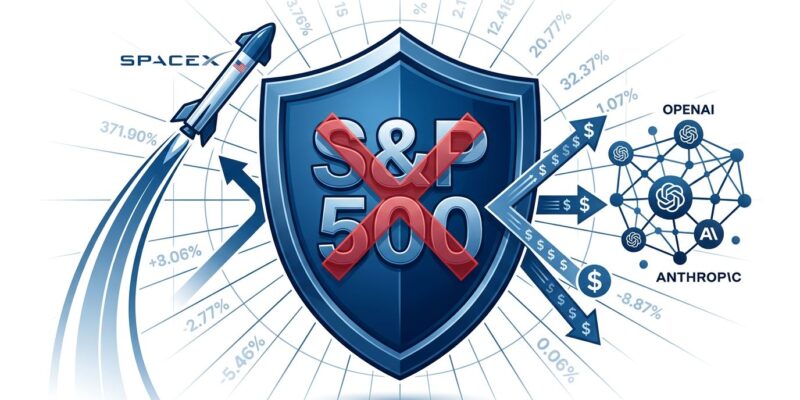
On June 4, 2026, S&P Dow Jones Indices rejected proposed rule changes that would have allowed SpaceX, OpenAI, and Anthropic to skip the line into the S&P 500 after their IPOs. The decision was blunt: “Exceptions to the financial viability, seasoning, and IWF requirements should not be granted solely based on market capitalization.” SpaceX goes public on June 12 — six days after that statement — and now faces a wait of at least a year before $14 billion in passive fund inflows can kick in automatically. For OpenAI and Anthropic, the delay is longer, because they are not yet profitable. For developers who use their APIs daily, the delay has a price.
Why the S&P 500 Said No to AI IPOs
The S&P 500 has three standing requirements for new entrants: a 12-month post-IPO seasoning period, a minimum 10% public float, and demonstrated GAAP profitability in both the most recent quarter and the trailing four quarters. On April 30, S&P opened a consultation on two proposed waivers — shortening the seasoning period to six months, and eliminating the profitability requirement for megacap companies. According to coverage of the S&P committee decision, both waivers were rejected on June 4.
The valuation numbers justify the caution. Morningstar independently valued SpaceX at $780 billion. Its IPO target is $1.75 trillion. That is a $970 billion gap — roughly the GDP of Indonesia — between what independent analysts think the company is worth and what it wants to sell shares for. Protecting the 170 million Americans in S&P 500 passive funds from being automatically invested in that gap is exactly what the profitability requirement exists to do. Nasdaq, MSCI, and FTSE Russell all relaxed their rules. S&P held firm. That distinction matters more than it might appear.
The AI Profitability Math: Harder Than the Revenue Looks
SpaceX posted a $4.94 billion net loss in 2025 on $18.67 billion in revenue — 33% year-over-year growth, but negative at every line below the top. Its IPO plans to offer only about 3% of shares publicly, well below the 10% float requirement. Musk’s company cannot meet S&P 500 entry standards on any of the three criteria simultaneously.
Anthropic is closer. The company expects its first quarterly operating profit in Q2 2026: $559 million on $10.9 billion in revenue. That is a 5% operating margin. However, at a near-$965 billion valuation, a 5% margin produces an implied price-to-earnings ratio approaching 400x — and that assumes the profit is sustained and grows. Even if Anthropic’s October 2026 IPO proceeds and those quarterly profits continue, S&P 500 entry requires four consecutive profitable quarters plus 12 months of trading. The earliest realistic path is late 2028. OpenAI’s timeline is murkier still: $5.7 billion in Q1 2026 revenue, still unprofitable, massive ongoing training costs.
What the S&P 500 Rejection Means for Developers
The connection between an S&P index committee decision and your API bill is not abstract. Bloomberg Intelligence estimated that fast-track S&P 500 entry would have triggered $14 billion in automatic passive fund purchases for SpaceX, $8 billion for OpenAI, and $4.6 billion for Anthropic. That capital — free, no strings attached, no need to demonstrate product-market fit — is now unavailable. The revenue has to come from somewhere else. It is coming from developers.
Anthropic made its first move before the S&P announcement was even cold. Effective June 15, 2026, Anthropic is splitting Claude subscriptions into two separate pools: interactive access and automated or programmatic usage. Automated tool usage — Claude Code, API calls, MCP integrations — is being stripped from base subscriptions and billed via fixed monthly API credits. Meanwhile, OpenAI responded by offering two months of free Codex access to enterprise users migrating from Claude. That is not generosity; that is a land grab.
The stakes are real. Uber’s CTO confirmed to The Information that the company burned through its entire 2026 AI budget in four months after Claude Code adoption jumped from 32% to 84% across 5,000 engineers. Monthly per-engineer API costs ranged from $500 to $2,000. The budget did not expand to match the adoption. Developers absorbed the cost pressure. That dynamic is not going away, and the S&P’s June 4 decision accelerates it.
Related: Enterprise AI Coding Costs: Uber’s $1,500 Cap Explained
S&P Stood Alone — and That Tells You Something
Every other major index provider moved in the opposite direction. Nasdaq approved fast-track admission in March 2026 — 15 trading days for new large listings. MSCI reduced its inclusion buffer to 10 days. FTSE Russell shortened its wait to just five days. The S&P 500 is now the only major benchmark that still requires a year of trading and demonstrated profitability. That is increasingly rare institutional discipline in a market that has been willing to price AI companies at valuations requiring near-perfect execution for the next decade.
S&P’s minor concession was allowing these companies into its broader Total Market Index — a far less influential benchmark that does not command the same $7.5 trillion in passive fund flow. SpaceX will likely qualify for the Nasdaq-100 on its first day of trading. For developers, the Nasdaq-100 trajectory matters less than whether the companies they depend on are building toward sustainable profitability — or burning fast and hoping the market forgives the losses.
Key Takeaways
- S&P Dow Jones rejected fast-track S&P 500 entry for SpaceX, OpenAI, and Anthropic on June 4, delaying $26.6 billion in combined passive fund inflows
- The three requirements that stay: 12-month post-IPO seasoning, 10% minimum public float, and GAAP profitability across four consecutive quarters
- Anthropic’s first operating profit is projected for Q2 2026, but its earliest possible S&P 500 entry is late 2028; OpenAI’s path is unclear
- The delayed passive capital has a direct effect on developer pricing: Anthropic’s June 15 billing restructure and OpenAI’s Codex migration offer are both symptoms of the same financial pressure
- Every other major index relaxed its rules; S&P’s decision is a rare institutional check on AI valuation expectations that matters for anyone who builds on these platforms