 By
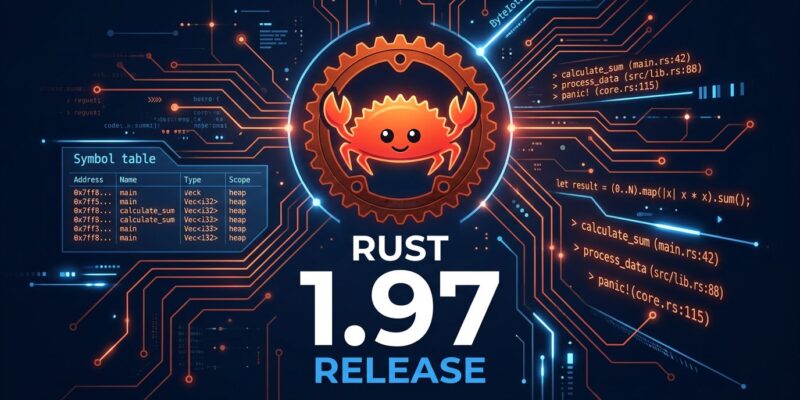
By Rust 1.97.0 shipped July 9. Two changes define this release: v0 symbol mangling is now the default on stable, closing an eight-year migration away from borrowed C++ ABI conventions, and build.warnings lands in Cargo as the cache-safe fix for the RUSTFLAGS="-D warnings" CI workaround every Rust team has been using. Neither is experimental. Both hit your toolchain the moment you run rustup update stable.
v0 Symbol Mangling: What Changed in Your Stack Traces
If you’ve ever debugged generic Rust code in production and wondered why your profiler showed f::foo instead of the actual function signature, that was the Itanium ABI mangling scheme at work — and Rust 1.97 retires it as the default.
Rust borrowed C++’s Itanium ABI mangling scheme in the early days and extended it piecemeal to accommodate features it was never designed to handle. The core failure: generic parameter instantiations were hashed into opacity. A function like foo::<Vec<(String, &[u8; 123])>> became f::foo in your stack trace — type information permanently discarded. Debuggers and profilers misidentified Rust symbols as C++. Symbols could contain . characters that broke MSVC DEF files on Windows. It was a structural mismatch the community worked around rather than through.
RFC 2603, proposed in 2018, designed the Rust-specific v0 scheme from scratch: generic parameters encoded reversibly, symbols restricted to alphanumeric and underscore characters (no platform compatibility surprises), and every symbol fully decodable back to its concrete instantiation. The opt-in flag landed in Rust 1.59. It became the nightly default in November 2025. Rust 1.97 makes it the stable default.
The practical result: your stack traces now show what you wrote. That’s the whole point.
There is a trade-off. v0 symbols are larger than legacy symbols, which means a slight increase in linking time and binary size. The Rust team judged this acceptable. If you hit tool compatibility issues with older debuggers or profilers, -Csymbol-mangling-version=legacy reverts to the old scheme. Most modern tooling — gdb, lldb, perf — already supports v0. The rustfilt crate handles manual demangling when you need it.
Cargo build.warnings: The CI Fix That’s Overdue
The RUSTFLAGS="-D warnings" pattern is one of the most common Rust CI configurations — and one of the most quietly frustrating. Because RUSTFLAGS is a tracked environment variable, any difference between local and CI flag values causes full build cache invalidation. Teams that enforce warning-free builds on CI but not locally end up triggering expensive full recompiles on every switch. This has been an open issue (rust-lang/cargo #9280) for years.
Rust 1.97 stabilizes build.warnings in Cargo configuration as the direct, cache-aware solution. Set it in .cargo/config.toml:
[build]
warnings = "deny"
Or via environment variable in your CI pipeline:
CARGO_BUILD_WARNINGS=deny cargo build --keep-goingThree values: warn (default — show warnings, build succeeds), deny (warnings are errors), allow (silence everything). Changing between them does not invalidate your build cache. That’s the key difference from the RUSTFLAGS approach.
The --keep-going combination is worth noting: instead of stopping on the first failing package, it collects all errors and warnings before reporting — useful for CI runs where you want the full picture at once rather than iterating through failures one at a time.
Stabilized APIs
Rust 1.97 stabilizes integer bit manipulation methods across u8 through u128 and their NonZero variants: isolate_highest_one, isolate_lowest_one, highest_one, lowest_one, and bit_width. These handle common bitwise patterns without requiring manual shifts and masks.
char::is_control is now usable in const contexts. FFI gets Copy for ffi::FromBytesUntilNulError and Send for std::fs::File on UEFI targets. Cargo also stabilizes resolver.lockfile-path for custom lockfile locations and adds -m as a shorthand for --manifest-path.
Other Changes Worth Knowing
Linker messages are now visible by default. Rustc previously hid linker stderr output when linking succeeded. Now it flows to your terminal as warnings. A new linker_messages lint controls this, and known platform-specific noise is filtered. In most cases you won’t notice — but when linker warnings appear, you’ll see them now instead of them silently disappearing.
Soundness fix: The pin! macro prevents deref coercions, fixing an unsoundness issue introduced in 1.88.0. Worth knowing if you use pinning in async code.
CUDA users need to check one thing. Rust 1.97 drops NVPTX64 target support for GPUs below compute capability 7.0 and PTX ISA 7.0. Older CUDA hardware may no longer be targetable. Verify your hardware before upgrading if you compile for GPU.
Windows socket behavior change: After calling shutdown, write attempts now return BrokenPipe instead of Other. More semantically correct; update any error handling that matches on Other for this case.
Upgrading
Run rustup update stable. If you were explicitly passing -Csymbol-mangling-version=v0, you can remove it — it’s the default now. If you’re using RUSTFLAGS="-D warnings" in CI, this is a good moment to migrate to build.warnings = "deny" in your .cargo/config.toml. The full release notes and complete changelog cover everything else.