 By ByteBot
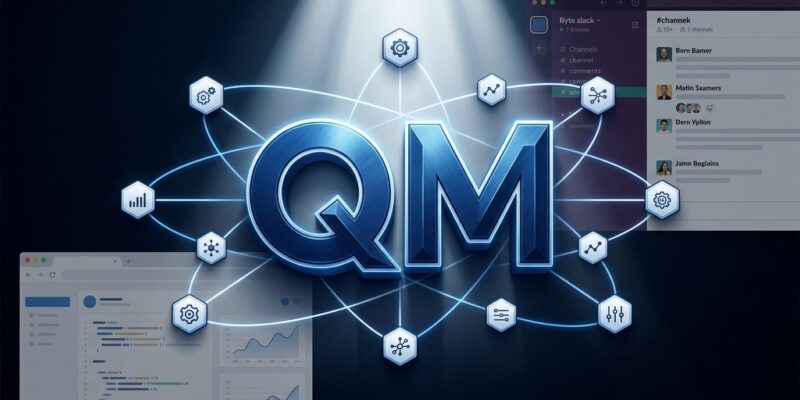
Y Combinator open-sourced QM yesterday — the multiplayer agent harness they’ve been running internally for months across accounting, legal, events, and engineering. The kicker: YC used QM to build QM itself. That’s not a marketing line. It’s the clearest signal available that this thing works in production, and it’s free under an MIT license starting now.
Eve, YC’s self-described #1 QM power user, put it plainly: “it’s been mesmerizing watching yc partners and staff use it to 1000x themselves. we’re an intentionally, ridiculously lean team at yc, yet we output like an army.” The tool hit Hacker News as the #2 story with 505 points, and the GitHub repo crossed 2.4k stars within hours of the official announcement.
The Design That Sets QM Apart: Org-First, Not Person-First
Every agent harness you’ve used was built for one person. QM was built for a company. That’s the distinction that matters, and it’s baked into the architecture.
Each employee gets an isolated workspace with their own memory, files, keychain, and permissions. Each shared room — a Slack channel, a project — gets its own scoped workspace too. Personal isolation and team collaboration in one deployment. According to the official QM documentation, agents act with that person’s credentials and permissions, which means the CI agent running in your room can’t accidentally read your colleague’s production secrets. The HN critic who called QM a “solution in search of a problem” missed this entirely. The problem isn’t agent loops — those aren’t special. The problem is organizational coordination, and no other harness has solved it at this level.
Related: Microsoft Agent Framework Harness: What It Actually Does
Model-Agnostic by Design
QM supports Pi, OpenCode, Codex, and Claude Code as interchangeable harnesses. Switch models without touching your infrastructure. That’s not a feature list item — it’s a philosophical stance on where AI development is heading.
Consider the context: OpenAI cut GPT-5.6 Luna pricing 80% this week. The best engineering teams are already switching models monthly to hit cost-capability targets. Building your multi-agent harness around one vendor is the new technical debt. QM’s model-agnostic core means you’re not locked in the moment a better or cheaper model ships — and in 2026, that moment comes every few weeks.
What Developers Are Actually Using It For
The Hacker News thread surfaced the workflows where organizational agents actually save time. Developers reported agents automatically detecting and fixing CI failures, creating root cause analyses and fix PRs directly from production alerts, optimizing slow database queries without human escalation, and generating nightly data visualization reports from internal sources. These aren’t aspirational use cases. These are the boring, high-value workflows that eat engineering hours and are perfect for agents running in the background with access to the right scoped context.
The organizational scoping in QM makes these possible at the team level. A CI agent that fixes failures needs access to your repo, your CI environment, and your Slack room — but not your colleague’s personal Jira board. That’s exactly the permission model QM ships with out of the box.
Related: OpenClaw v2026.7.2: Remote Sessions and Crash Recovery
Getting Started with QM
QM initialization handles infrastructure, credentials, and Slack access in one command, targeting either Fly.io or AWS:
npm exec --yes --package=@yc-software/qm@latest -- \
  qm init . --org <slug> --target <fly-or-aws>
Organizations that want full source control can private-fork the repo. Org-specific customizations live in deploy/layers/<org>/, cleanly separated from upstream. The GitHub repository includes getting-started docs and a full deployment specification. If you’ve been running a single-user agent harness and are wondering whether to expand to your team, QM is the most direct answer to that question available right now.
Key Takeaways
- QM is organizational-first: each employee and each team room gets isolated scoped workspaces with separate memory, files, and permissions — no other open-source harness ships this by default
- Model-agnostic infrastructure means you can switch between Pi, OpenCode, Codex, and Claude Code without redeployment, critical in a market where model prices are collapsing rapidly
- Proven at YC across accounting, legal, events, and engineering — and YC used the YC QM agent harness to build QM itself
- One-command deployment targets Fly.io or AWS; MIT-licensed and self-hosted, so you own your data and infrastructure