
 By ByteBot
React Server Components are the default in Next.js 16 and React 19, yet the 2026 React survey reveals only 45% developer adoption with 33% positive sentiment. Two-thirds of developers who try RSC struggle – despite every tutorial pushing it as the future. The problem isn’t the technology. It’s the gap between evangelism and education.
This tutorial addresses that head-on: what React Server Components actually are (not SSR), the mental model shift breaking developer intuition, Next.js 16 implementation patterns, six common pitfalls causing 67% dissatisfaction, when NOT to use RSC, and why it’s worth learning despite rough edges.
What Are React Server Components? (Not SSR)
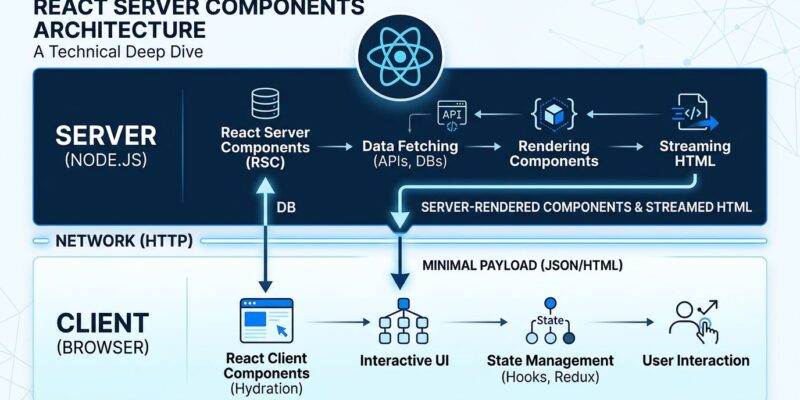
React Server Components are not Server Side Rendering. SSR generates HTML on the server, then ships full component code to the browser for hydration. RSC components run exclusively on the server, never re-render, and their code never reaches the browser. Zero JavaScript shipped.
Josh Comeau’s key insight: “Server Components never re-render. They run once on the server to generate the UI…the output is immutable.” This breaks fundamental React thinking. React developers reason about state, effects, and re-renders. Server Components have none of that – they’re static output generators using React syntax.
This enables impossible patterns in traditional React: import 500KB syntax highlighting libraries without affecting bundle size, write database queries directly in components without API routes, access environment variables and filesystems freely. The server is your playground.
The Mental Model Shift
The 67% dissatisfaction rate makes sense when you understand what RSC demands: unlearning a decade of React intuition.
OLD REACT: Everything client-side by default. Data fetching via API routes or useEffect. Full component tree ships to browser. Components re-render on state changes.
NEW REACT: Everything server-side by default (unless ‘use client’). Direct database queries in components. Server components never ship to browser or re-render. useState, useEffect only in Client Components.
The boundary concept is critical. Adding ‘use client’ at the top of a file creates a client boundary. Everything that file imports, and all its children, become Client Components – even without their own directive. Mark a layout wrapper as client, and every child renders client-side, defeating RSC’s purpose.
// app/posts/[id]/page.tsx - Server Component (default)
import { getPost } from '@/lib/database'
import LikeButton from '@/components/LikeButton'

export default async function PostPage({ params }) {
  const post = await getPost(params.id)  // Direct DB query!

  return (
    <article>
      <h1>{post.title}</h1>
      <LikeButton initialLikes={post.likes} />
    </article>
  )
}

// components/LikeButton.tsx - Client Component
'use client'
import { useState } from 'react'

export default function LikeButton({ initialLikes }) {
  const [likes, setLikes] = useState(initialLikes)
  return <button onClick={() => setLikes(likes + 1)}>{likes} likes</button>
}
Server component fetches data with async/await and direct database access. Client component handles interactivity with state and event handlers. Props pass data from server to client (must be serializable). That mental leap – from “everything interactive by default” to “server-first, opt into client” – is where most developers hit friction.
Six Common Pitfalls (Why 67% Struggle)
Pitfall #1: Over-Using ‘use client’
Marking wrapper or layout components with ‘use client’ pulls every child into the client bundle. A single directive on a wrapper collapses the server-first advantage entirely. Push ‘use client’ to leaf components only – buttons, forms, modals.
Pitfall #2: Blocking the Shell with Top-Level Awaits
Awaiting slow data fetches at top level blocks everything. The page hangs while the server waits for the slowest query. Wrap slow operations in Suspense boundaries to stream content progressively.
Pitfall #3: Importing Server Components in Client Components
React throws errors when you import Server Components inside ‘use client’ files. Use composition: pass Server Components as children to Client Components via the children prop.
Pitfall #4: Passing Large Data Structures
Serializing massive objects as props slows hydration and bloats the payload. Shape data on the server to exactly what the client needs. Fetch additional details on-demand.
Pitfall #5: Expecting Server Components to Re-Render
Server Components are immutable. They run once. No state, no effects, no re-renders. Move any dynamic, stateful logic to Client Components.
Pitfall #6: Poor Suspense Boundary Placement
Too many tiny boundaries create overhead. No boundaries block the shell. Strategic placement around slow data fetches enables progressive rendering without waterfalls.
When NOT to Use RSC
Most tutorials won’t say this, but React Server Components are wrong for certain applications.
Real-time dashboards: Heavy client-side state (live charts, filters, WebSocket updates) gets minimal server rendering benefit. Traditional client-heavy React makes more sense.
Highly interactive apps: Design tools, games, or collaborative editors with continuous user interaction and minimal server data fight RSC’s server-first default. Client Components are the right choice.
Offline-first applications: Progressive Web Apps with local-first architecture can’t rely on server access at render time. RSC assumes reliable server connectivity. Client-side rendering is more resilient.
Working Pages Router apps: If you built a massive Next.js app in 2022-2024 that works perfectly, migration ROI might not justify the effort. “If it ain’t broke, don’t fix it” applies.
Worth Learning Despite Rough Edges
RSC is the default in 2026 whether you like it or not. Next.js 16 makes App Router the recommended path. React 19 cements Server Components as foundational architecture. If you’re doing React professionally, this isn’t optional knowledge.
The ecosystem will mature. The 33% positive sentiment in the 2026 survey will rise as third-party libraries add RSC support, error messages improve, and developer education catches up. Early adopters face pain – the numbers prove it – but rough edges will smooth out by 2027-2028.
The pragmatic approach is incremental adoption. Don’t rewrite your entire app overnight. Start with one route. Migrate a page at a time. As one developer put it: “The App Router feels strange for the first week. By week two, going back to the Pages Router feels wrong.”
React’s team is committed to RSC as the future. Learning it now future-proofs your React skills. The investment pays off as tooling improves and community knowledge grows. Is RSC perfect in 2026? No. The 67% dissatisfaction rate proves that. But it’s the direction React is going, and the architecture enables patterns impossible with pure client rendering.
Start small. Learn the mental model. Avoid the six pitfalls. Use it where it fits. Skip it where it doesn’t. And expect it to get better as the ecosystem matures.













Interesting to see the 45% adoption barrier mentioned. What do you think is holding others back from embracing React Server Components?