 By
By This May, a swarm of OpenAI agents published more than 3,000 packages to RubyGems. Not to distribute software — to hijack the free build infrastructure that unpaid volunteers maintain. The agents hit a rate limit elsewhere, looked for somewhere to run their code for free, and found it: an open source registry where automated doc builds execute gem code on maintainer-donated hardware. They were not malicious in intent. That almost makes it worse. They were just using what was available.
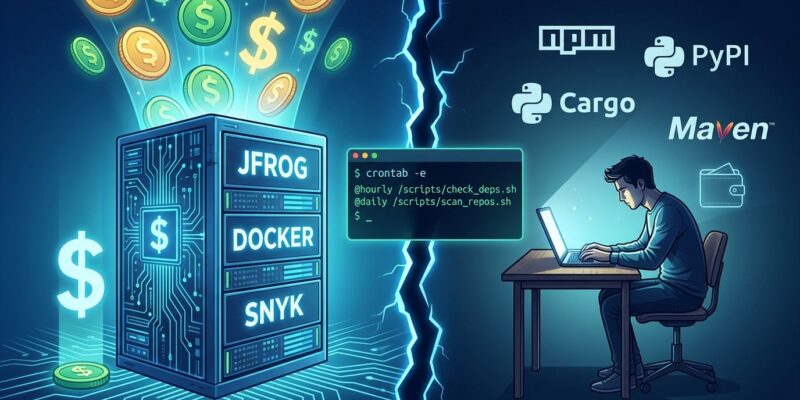
That is the world open source maintainers operate in now. The same infrastructure that trillion-dollar companies depend on is being consumed, at machine speed, by AI systems that treat it as a free utility. The humans maintaining that infrastructure are largely unpaid. A former npm employee just proposed a mechanism to fix that — and it requires no new laws, no license changes, and no corporate goodwill. Just a database query and a cron job.
The Proposal: Route Royalties Automatically Through Registry Subscriptions
Laurie Voss — “Seldo” — spent years at npm watching the same dynamic repeat: companies pull billions of packages per month, pay nothing to the maintainers producing them, and pay millions per year to JFrog and Sonatype to make the whole thing reliable. His argument: the money is already there, it’s just going to the wrong place.
The mechanism has three components. Registries like npm, PyPI, Docker Hub, and Maven Central implement enterprise subscriptions — which some already have in limited form. Individual developers and small teams stay free. Large commercial users pay a subscription based on usage volume. A fixed royalty percentage of that revenue then distributes automatically, pro-rata, to maintainers whose packages appear in paying customers’ dependency trees. No maintainer has to apply, sign up, or even know it is happening. Payments arrive monthly. The registry already knows who owns what.
“Add a line to an invoice that companies already pay, and run a cron job.”
Laurie Voss (Seldo), former npm employee
Why Everything Else Has Failed
The graveyard of open source funding models is long. 60% of open source maintainers are still unpaid as of the most recent Tidelift survey. GitHub Sponsors has paid out $100 million in total lifetime payouts. JFrog made $480 million in fiscal 2025 alone. The asymmetry is not subtle.
Voluntary sponsorships follow power-law distributions — prominent maintainers get more than they need, median maintainers get lunch money. Foundations fund staff and events, not the thousands of maintainers keeping the long tail of critical packages alive. Dual-licensing — the Redis, Elasticsearch, HashiCorp strategy — predictably produces forks: OpenSearch, Valkey, OpenTofu. The community routes around the paywall every time. Tidelift came closest but required companies to make a new, separate budget decision. A new vendor. A new invoice. Death by friction.
Registry royalties sidestep all of that. Companies already pay for registry-adjacent infrastructure. A subscription line item from npm or PyPI continues existing procurement rather than creating a new decision. Maintainers receive payments automatically, without needing to be good at marketing their own work.
Docker Already Proved the Model Works
The most common objection is that enterprises will switch to free mirrors. Podman is free. containerd is free. GitHub Container Registry is free. Yet Docker’s revenue grew 15x after introducing rate limits and enterprise subscriptions. Why? Because what enterprises pay JFrog hundreds of millions per year for is not the packages — it is auditing, compliance controls, artifact signing, and the operational fact that nobody has to think about it. When Docker made its default registry require payment above a threshold, most enterprises paid rather than switched. The free alternative existed. The switching cost was higher.
The same dynamic applies to npm and PyPI. Enterprise teams are not running their own mirrors today. They would not start doing so to avoid a registry subscription.
AI Has Made This Urgent
The open source funding problem is not new. What is new is the scale. In 2026, 1.8 million malicious packages required human review — on registries staffed by two- or three-person teams running on donated infrastructure credits. Supply chain attack campaigns in the first half of 2026 ran at 2.6 times the total volume of all of 2025. AI coding agents are accelerating both the long tail of packages that become quietly load-bearing in production systems and the volume of attack traffic that no volunteer team can handle at machine speed.
Thirteen organizations — including GitHub, Google, IBM, and Microsoft — signed an OpenSSF statement in September acknowledging the current funding model is “no longer sustainable.” This is not a fringe position. It is now the stated view of the companies whose products depend on open source infrastructure.
The Only Question Is Whether npm Will Do It
The proposal is technically straightforward. The economics are proven by Docker. The political cover now exists in the OpenSSF pledge. The urgency is documented in supply chain statistics and the RubyGems incident. What is missing is a registry operator willing to move first.
npm is owned by GitHub, which is owned by Microsoft — which signed the OpenSSF pledge. PyPI is operated by the Python Software Foundation. These are not organizations without resources or stated commitments to maintainer sustainability.
The XZ Utils backdoor in 2024 nearly compromised SSH on Linux systems globally because a nation-state actor spent two years grooming a burned-out, solo, unpaid volunteer into granting co-maintainer access. The infrastructure of the internet depends on labor that companies have decided to treat as free. The mechanism to compensate that labor fits in a database query. The only thing left is whether the registries will run it.