 By
By AI coding agents write code faster than teams can review it. That gap is no longer a soft productivity complaint — LinearB studied 8.1 million pull requests across 4,800 organizations and found that developers using AI merge 98% more PRs but spend 91% longer on code review. The bottleneck didn’t disappear when you installed a coding agent. It relocated downstream, into the merge queue. CodeRabbit just raised $143 million at a $1.5 billion valuation to make that everyone’s problem to solve — and their product to buy.
The Real Numbers Behind the Slowdown
LinearB’s data makes the irony concrete. Developers feel 20% faster. Teams are actually 19% slower. AI-generated PRs wait 4.6 times longer before anyone picks them up for review. Once a reviewer does start, they move through AI code twice as fast — but that “once” is doing a lot of work. The acceptance rate for AI-authored PRs sits at 32.7%. Meanwhile, AI-written code surfaces 1.7 times more issues than human-written code and introduces 15 to 18 percent more security vulnerabilities. Faster code generation moved the bottleneck. It didn’t remove it.
CodeRabbit’s argument is blunt: the review layer hasn’t scaled with agent output. “The backlog is moving from tickets to pull requests,” the company said in its announcement. That is both a diagnosis and a market thesis.
What Agentic Change Management Actually Is
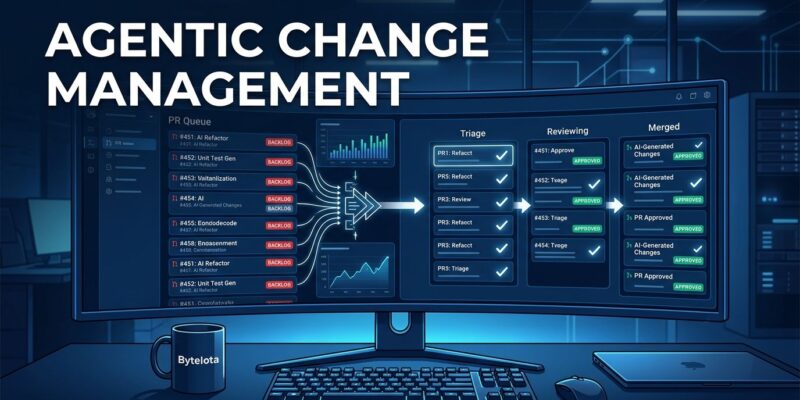
The $143 million funded what CodeRabbit calls Agentic Change Management — a control layer that sits between agent-generated code and production. It ships as three connected capabilities.
Triage scores incoming pull requests before any human touches them. The scoring factors in value, urgency, risk, dependencies, readiness, and reviewer fit. High-risk changes get routed to senior reviewers. Low-risk changes enter automated workflows. Duplicate or half-baked PRs get filtered before they clog the queue. Think of it as the triage nurse for your merge queue — the one that keeps the waiting room from becoming a parking lot.
Change Stack replaces the alphabetical file diff view with something actually readable. It organizes a PR into semantic layers: contracts, domain behavior, integrations, tests, and migrations. Blast-radius analysis shows what else in the codebase a change could break. For agent-generated PRs where you didn’t write the code and aren’t sure what it does, this matters.
Security Agent extends coverage past the merge. It continuously scans production code — not just incoming PRs — for logic flaws and dependency vulnerabilities across files and data flows. When it finds something, it generates a fix and routes it back as a PR. The review workflow becomes the remediation workflow.
The Business Signal
CodeRabbit hit $50 million ARR in July 2026, doubling from $25 million at the end of 2025. Revenue grew five times over the past year. It conducts more than two million code reviews weekly across 17,000 customers including Adyen, BMW, NVIDIA, and JFrog. Atomico and Smash Capital led the Series C, with BMW i Ventures and Datadog also writing checks.
That last detail matters: Datadog investing in a code governance tool is a signal. Infrastructure observability companies understand that “shift left” now means something different when agents generate most of the code being shifted.
Free for Open Source
CodeRabbit has always been free for open-source projects, and the Series C comes with a concrete commitment: $10 million dedicated to keeping full Pro-tier AI review capabilities free for OSS maintainers over the next 12 months. Public repos get the complete feature set — auto-fix suggestions, 40-plus linters, custom review instructions — at no cost. If you maintain an open-source project drowning in AI-generated contributions, this is worth installing today.
For private teams, the free tier has no expiration and requires no credit card. Essentials plans start at $30 per developer per month.
The Bigger Picture
The tools that write code — Cursor, Claude Code, OpenCode, GitHub Copilot — are well-funded and well-covered. CodeRabbit is betting that the governance layer on top of those tools is an equally large, and currently underserved, market. If AI agents are going to be the primary authors of production software, someone needs to manage the pipeline they are filling. The $143 million says CodeRabbit thinks it is them.
That may be right. The harder question is whether teams will pay for governance before the consequences of skipping it hit them. Based on the PR bottleneck data, a lot of teams are already past that point and haven’t noticed yet.