 By ByteBot
DeepSeek dropped V4.1 Flash on September 9 with MIT open weights, a new architecture, and a $0.003 per million cached-input tokens off-peak price. Within twelve days, Anthropic had cut Opus 5.5 pricing by 20%, and OpenAI followed the same afternoon with GPT-6 Sol and Luna at roughly half their previous rates. DeepSeek did not just release a model — it forced every premium lab to justify its pricing.
The Architecture Behind the Cost Reduction
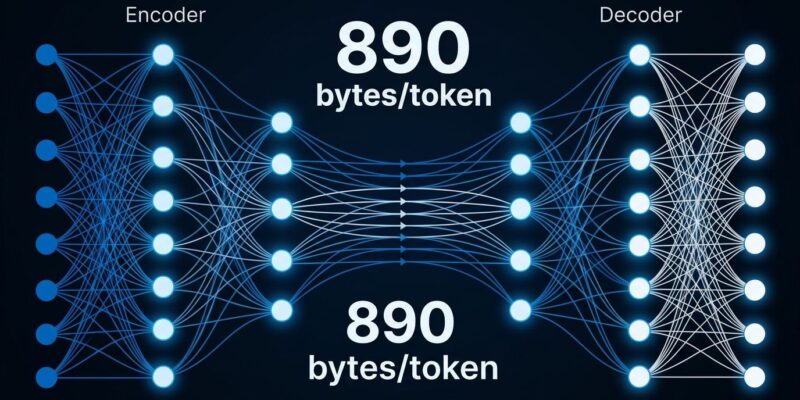
V4.1 Flash ships a genuinely new design called Causal Encoder-Decoder (CED). The 40 transformer layers split in half: the first 20 form a causal encoder that processes input, and the last 20 form a decoder that generates output. The decoder’s global KV cache is projected directly from the encoder’s final hidden states rather than recalculated at every decoder layer. The model activates only 8 billion parameters during prefill and 16 billion during generation — asymmetric by design, because agent workloads read massive prompts and produce comparatively small outputs.
The practical result: a global KV cache footprint of approximately 890 bytes per token, down from 3,514 bytes in V4-Flash. For a one-million-token context, that is roughly 890 MB instead of 3.4 GB. Agent loops that re-read cached context across iterations benefit directly. Compressed Sparse Attention 2 (CSA2), FP4 KV quantization, and 196 billion Engram parameters accessed via sparse hashing rather than dense computation drive the remaining gains. DeepSeek published the full architecture breakdown in their technical paper on arXiv.
Benchmarks: Where It Wins and Where It Does Not
On the DeepSWE v1.1 software-engineering benchmark, V4.1 Flash scores 74.2 — narrowly ahead of Claude Opus 5 at 74.0 and GPT-5.6 Sol at 73.0. Terminal-Bench 2.1 returns 90.6 against Opus 5’s 89.1. HumanEval improved to 79.4 from V4-Flash’s 69.5. Codeforces sits at 3,471.
The counterpoint matters: on Terminal-Bench 4.0, V4.1 Flash scores 31.2 versus Opus 5’s 51.8. ProgramBench shows 20.3 against 37.0. These are open-ended, complex multi-step reasoning benchmarks. V4.1 Flash excels at structured agentic work — code review, CI automation, document analysis pipelines. For reasoning chains with ambiguous goals and many interdependencies, Opus 5.5 remains ahead. The distinction is worth getting right before you swap your production model.
What Running It Actually Costs
Off-peak cached input runs at $0.003 per million tokens. Uncached input is $0.15 per million; output is $0.60 per million. At peak hours those rates double. Compare that to Claude Opus 5.5: $0.20 per million cached reads, $4 input, $20 output. For an agent loop re-reading 500,000 cached tokens per run across 1,000 daily executions, that is roughly $1.50 per day on V4.1 Flash versus $100 per day on Opus 5.5. At that scale the build decision changes.
Open Weights and the Compliance Unlock
The MIT license matters beyond cost. Organizations in regulated industries that cannot route data through DeepSeek’s proprietary API can now deploy V4.1 Flash through EU-sovereign infrastructure. The weights are available on Hugging Face under MIT, and European providers already support compliant hosting. Healthcare, finance, and public-sector teams excluded from the open-weight quality tier now have a viable path that does not require sending data outside their jurisdiction.
Self-Hosting: Viable, but Scope the Hardware First
The minimum VRAM floor is 614 GB (with 1.2x headroom) — in practice an H200 eight-GPU node or GB200 NVL4. The checkpoint is approximately 511 GB on disk. Serving requires vLLM 0.30.0 or later via Docker. For most teams the API is the correct choice. For organizations with compliance requirements or volume high enough to justify the infrastructure, the MIT license makes self-hosting economically viable in a way previous proprietary checkpoints did not. The vLLM serving guide covers GPU-specific configuration, Engram offloading, and speculative decoding setup.
vllm serve deepseek-ai/DeepSeek-V4.1-Flash \
  --language-model-only \
  --tensor-parallel-size 4
DeepSeek V4.1 Flash is not a universal replacement for frontier models. But for well-specified coding agents, document pipelines, and repetitive automation work, it delivers near-frontier performance at a price that makes extended-context and high-volume deployments viable. The open weights are a genuine bonus for teams with compliance constraints. The most honest measure of this model’s impact: its release forced Anthropic and OpenAI to cut their prices the same week.