 By ByteBot
RAGFlow 0.27 landed on August 19 and quietly deprecated two features enterprise teams have been building on: GraphRAG and RAPTOR are no longer available in the UI. In their place: a seven-artifact Knowledge Compilation engine, a refactored Agentic RAG framework with configurable thinking modes, and a parting note — this is the last version before the Python backend gets replaced with Go.
Knowledge Compilation: What Replaced GraphRAG and RAPTOR
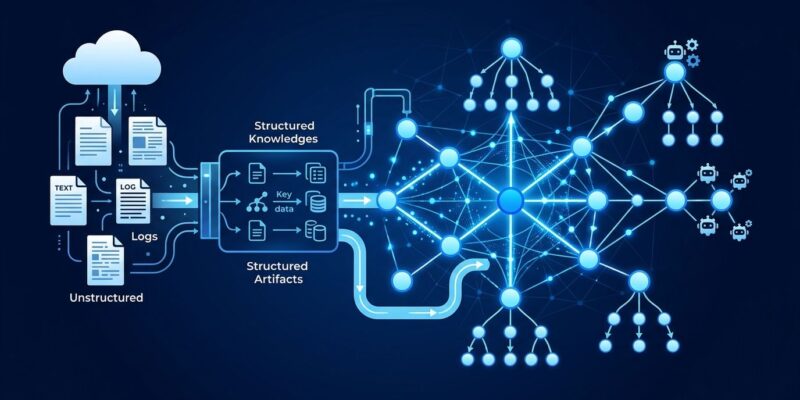
The headline feature is Knowledge Compilation, which converts unstructured documents into structured, reusable knowledge artifacts. Instead of choosing between one graph approach or one summarization strategy, RAGFlow 0.27 gives you seven artifact types:
- Wiki — Organizes a dataset’s fragmented information into interconnected knowledge pages, browsable by subject, entity, and concept, with a graph view for exploring associations.
- Graph — Displays entities and their relationships. Replaces GraphRAG. Best for org structures, product relationships, and personal networks.
- Tree — Arranges knowledge hierarchically based on semantic relationships, preserving document reading order. Replaces RAPTOR. Suited for layered exploration of complex long documents.
- Page Index — A structured, page-by-page index for document navigation.
- Mind Map — Clusters related concepts visually across a document or dataset.
- Timeline — Extracts and orders temporally-structured events from content.
- To Skills — Converts a dataset into agent-consumable Skill files, each with a name, description, hierarchy, and relevant source references.
Graph and Tree are document-level artifacts. Wiki and To Skills operate at the dataset level. All are accessible under Dataset → Artifacts.
What Happened to GraphRAG and RAPTOR
Both are deprecated in 0.27 and removed from the UI. Here’s what matters if you were using either:
Your existing data is safe. Previously generated GraphRAG and RAPTOR content remains searchable. You don’t need to regenerate anything to keep reading from those indexes.
What changed is the write side. The automatic incremental build process — which kept graph and hierarchical indexes updated continuously — is replaced by manual batch building. Batch building carries significantly less construction overhead. If your pipelines depend on incremental updates, you’ll need to switch to scheduling batch runs instead.
The one-to-one migration mapping: GraphRAG → Graph artifact, RAPTOR → Tree artifact. Configuration has moved from dataset toggles to the new Knowledge Compilation template system. The Knowledge Compilation docs walk through the setup.
Agentic RAG: Now with Thinking Modes
The Agentic RAG framework was fully refactored in 0.27 with measurable improvements in reasoning speed and benchmark performance. The practical addition: four configurable thinking modes.
- Low — Fast, minimal reasoning. Good for simple factual lookups.
- Medium — Balanced. The default for most use cases.
- High — Deep multi-step reasoning for analytical or comparative queries.
- Ultra — Maximum depth, compute-intensive. Designed for multi-hop research tasks.
The mode is exposed through the API, so agent frameworks can control it per-interaction rather than globally. That lets you default to Medium for routine queries while routing complex research tasks to Ultra — a practical cost-vs-quality dial that mirrors how OpenAI’s o-series reasoning models approach compute scaling.
The Go Migration Signal
RAGFlow’s team made an explicit statement with 0.27: this is the last major version with Python as the backend. The next version migrates the API server to Go — for better performance, lower memory footprint, and single-binary deployment. That matters operationally; RAGFlow already requires 32GB+ RAM in production, and a leaner runtime will help.
It also signals something broader. RAGFlow is repositioning itself not as a RAG tool but as an intelligent agent data foundation. Knowledge artifacts — particularly Skills — are designed to be consumed directly by agent frameworks. The Go rewrite is a commitment to the performance requirements of agent-scale call frequencies. Agents call retrieval far more often than humans do, and Python wasn’t going to scale.
RAGFlow 0.27 is available now from the GitHub releases page. The full release notes cover the model provider refactoring (GPT-5.4-mini and GPT-5.4-nano added) and the new generic RESTful API connector for enterprise data ingestion.