 By ByteBot
Raja Koduri just raised $35 million — bringing Oxmiq’s total to $60M — to build what he calls the “Arm of this next era.” His company’s product, OxCore, is a licensable GPU architecture built on RISC-V that runs your existing CUDA and PyTorch code without a single change. The Series A closed July 1, led by Samsung Catalyst Fund and Fundomo, with MediaTek among the strategic backers. If Oxmiq can deliver at scale, this is the most credible direct challenge to NVIDIA’s inference moat since AMD tried with ROCm and mostly stalled.
The Part Developers Actually Care About
Switching off NVIDIA has always meant one thing: rewriting everything. That is the actual problem AMD, Intel, and every CUDA alternative have failed to solve. OxPython — Oxmiq’s developer-facing layer — takes a different approach. It intercepts your existing CUDA and PyTorch calls and routes them transparently to OxCore hardware underneath. According to Oxmiq: “To a program, it looks and behaves like the NVIDIA GPU the program expects, while underneath it routes the real work to whatever hardware is actually there.”
No new language to learn. No migration project. No team convincing session. You run the same code and it works. That is the value proposition in full. Whether the performance matches or beats NVIDIA hardware is a separate question — but eliminating the porting barrier is what makes the conversation worth having in the first place.
What OxCore Is Under the Hood
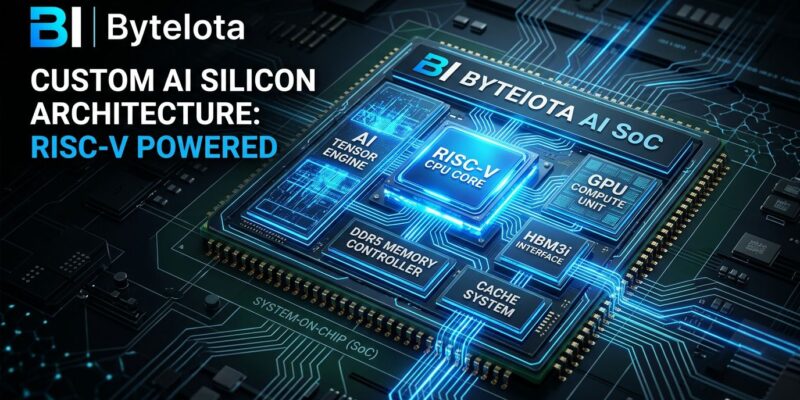
OxCore fuses three compute engines into one licensable IP block: a CUDA-compatible GPU engine, a tensor processing engine for matrix operations, and an orchestration CPU that coordinates workloads. It is built on RISC-V, integrates scalar, vector, and matrix compute in a single unified core, and is designed from the start for near-memory compute — keeping data close to the compute engines rather than shuttling it back and forth across the chip.
The critical word in that description is licensable. Oxmiq is not building a chip to sell you. It is selling the blueprint so that Samsung, MediaTek, neoclouds, and any semiconductor company can build their own chip on top. Tom’s Hardware notes that OxQuilt, their chiplet integration architecture, lets those customers mix logic nodes, memory types, and interconnect standards without being locked to a single supply chain.
OxCore is running on FPGA today. Production silicon has not shipped.
Why the Arm Analogy Holds
Arm did not beat Intel by building a better CPU. It licensed IP that let Qualcomm, Apple, and dozens of others build chips Intel could not compete with on power and cost. Koduri is playing the same game in inference silicon. The difference: Arm had decades to prove the model. Oxmiq needs to validate it in the next two to three years.
The investor list signals intent more than money. Samsung Catalyst Fund and MediaTek do not write Series A checks for startups they do not plan to work with. Both companies have active AI chip programs and supply chain infrastructure. AM Intelligence Labs — a division of Greenko, India’s largest green energy producer — signed as Oxmiq’s first major customer in March 2026 and is planning a 1 GW AI compute hub in Noida by 2027. That deployment, if it ships, would be the first real test of OxCore outside the lab.
The Inference Shift Makes the Timing Right
Inference now accounts for 67% of all AI compute. Custom ASIC shipments from cloud providers are projected to grow 44.6% in 2026, nearly three times the 16.1% growth rate for GPU shipments, according to TrendForce. The hyperscalers — Google TPU, Meta MTIA, Amazon Trainium — have already proven that custom silicon works at scale. The remaining problem is that a full custom chip program costs north of $500 million before you see a single wafer. Oxmiq’s licensing model is exactly the bridge smaller companies need to participate in that shift without betting the company on a single tape-out.
Token costs have dropped 1,000x since 2022. SiliconANGLE’s coverage notes Koduri’s framing — “the cost of converting electrons to tokens has to come down by 50x, which means rebuilding the whole stack” — which is directionally correct even if the timeline is uncertain.
What to Watch
OxCore’s credibility depends on two things: whether Samsung or MediaTek ships chips built on OxCore IP, and whether the AM Intelligence Labs 2027 deployment delivers real inference economics. If both happen, Oxmiq graduates from promising architecture to actual infrastructure. Until then, the CUDA ecosystem — 20-plus years of libraries, tooling, and inertia — remains exactly where it is.
The founding team claims 500 years of collective GPU experience. The architecture is coherent and the business model is proven in adjacent markets. The question is execution, not vision. Jon Peddie Research puts it plainly: Koduri is building the Arm model for AI GPUs. Whether it works is a 2027 question.